
 AU
AU CA
CA NZ
NZ UK
UK US
US IND
IND

 Share
Share
 X (Formerly Twitter)
 Whatsapp
 Facebook
 LinkedIn
 Telegram
 Email This Article
 Copy Link
 Summarize with AI
 Chat GPT
 Perplexity
Highlights
- Strong payroll governance helps employers meet tax, superannuation, and reporting obligations accurately.
- Single Touch Payroll (STP) reporting is central to compliant payroll governance in Australia.
- Regular system reviews and controls reduce the risk of errors and penalties.
- Documented processes and staff training underpin effective payroll governance.
Payroll governance refers to the systems, processes, and controls that help employers meet their legal payroll obligations accurately and on time. In Australia, strong payroll governance is essential to ensuring employers correctly report and pay what they owe for tax, superannuation, fringe benefits, and other payroll-related obligations. It also builds trust with employees and reduces the risk of penalties for non-compliance.
What Is Payroll Governance?
Payroll governance is the framework employers use to manage how payroll is handled within their business. This includes:
- Formal documented policies and procedures for payroll tasks
- Defined roles and responsibilities for staff involved in payroll processing
- Accurate payroll systems and controls that support correct reporting and payment
- Regular reviews and risk checks to prevent errors and detect issues early
- Good record-keeping that shows compliance with legal obligations.
A well-structured governance framework ensures employers understand their obligations and have systems in place to meet them reliably.
Core Employer Obligations Covered by Payroll Governance
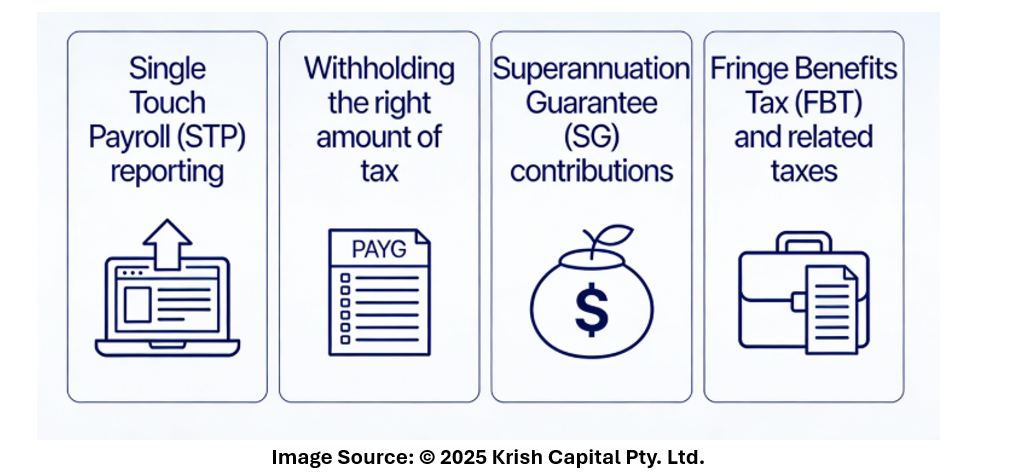
Payroll governance supports employers in meeting key reporting and payment obligations under Australian tax and superannuation law:
- Single Touch Payroll (STP) Reporting
Employers must report employee tax and super information through STP-enabled software each time they pay employees. Timely and accurate STP reporting ensures:
- Electronic activity statements are prefilled correctly
- Employee payroll data is available for other government services
- Employers meet their reporting requirements without duplication.
- Withholding the Right Amount of Tax
Employers must correctly calculate and withhold tax from employee wages and report it via STP and activity statements. Errors can lead to underpayment or penalties.
- Superannuation Guarantee (SG) Contributions
Employers are responsible for calculating and paying super guarantee amounts correctly and on time. Robust governance ensures this statutory obligation is met and reduces the risk of super guarantee charge or penalties.
- Fringe Benefits Tax (FBT) and Other Related Taxes
Reporting and paying FBT where applicable is also part of payroll governance. Systems and checks help ensure liabilities are correctly calculated and reported.
Why Strong Payroll Governance Matters
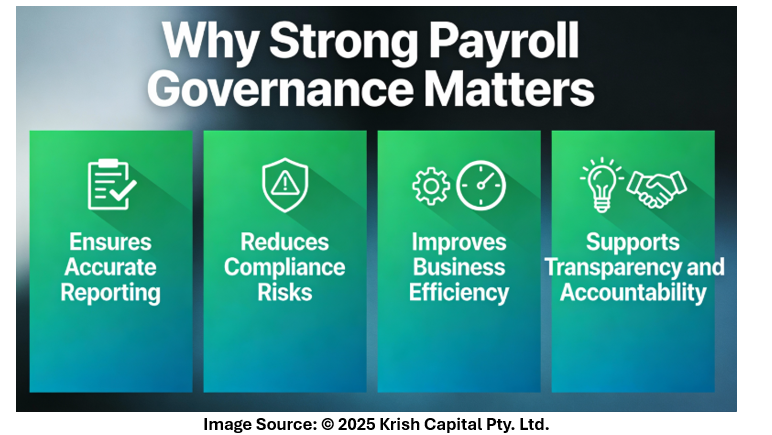
- Ensures Accurate Reporting: Correct payroll reporting through STP and associated systems ensures the ATO and employees receive reliable payroll information.
- Reduces Compliance Risks: Good governance helps employers comply with tax, super and reporting obligations, significantly reducing the risk of interest, penalties or enforcement actions for late or incorrect reporting.
- Improves Business Efficiency: Documented payroll processes and clear roles simplify payroll administration and enable easier training of staff, periodic reviews and scalability as the business grows.
- Supports Transparency and Accountability: Clear governance frameworks help employers and third-party payroll providers understand expectations and responsibilities, reducing mistakes from miscommunication or system setup errors.
Best Practices in Payroll Governance
To strengthen payroll governance and meet obligations, employers should:
- Document payroll policies and procedures tailored to their business structure and size.
- Use STP-enabled software correctly, including mapping pay codes and allowances.
- Review systems and controls regularly to ensure accurate reporting of PAYG withholding, SG, STP and FBT.
- Train payroll and accounting staff so they understand obligations and responsibilities.
Routine reconciliations, audits and updates to procedures help businesses stay compliant and identify issues before they escalate.


 Mar 10, 2026




 Please wait processing your request...