
 AU
AU CA
CA NZ
NZ UK
UK US
US IND
IND

 Share
Share
 X (Formerly Twitter)
 Whatsapp
 Facebook
 LinkedIn
 Telegram
 Email This Article
 Copy Link
 Summarize with AI
 Chat GPT
 Perplexity
Highlights
- Super must be paid for most workers, regardless of how much they earn.
- Employees under 18 qualify only if they work more than 30 hours in a week.
- Contractors may still be eligible for super, even with an ABN.
- Temporary residents and backpackers are generally covered by super rules.
- Sole traders and reservists are among the few clear exemptions.
Paying superannuation is part of everyday payroll for most employers in Australia, but the rules aren’t always as simple as they seem. Whether someone works full-time, picks up the odd shift, helps out in the family business, or even holds an ABN, you may still be required to pay super for them. Getting this right matters because missing payments or applying the wrong rules can lead to penalties.
What Super Is and Why It Exists
Superannuation in Australia, or “super” as it’s commonly called, is a workplace savings system for retirement. A portion of an employee’s earnings is placed into an investment fund that becomes available when they retire. Employers are required to make compulsory contributions to these funds as a percentage of wages.
When Super Becomes Mandatory
If you pay someone to work for you, you’ll usually need to pay super guarantee. How much they earn doesn’t change this. The current super guarantee rate is 12%. For most employees aged 18 and over, you pay super no matter how many hours they work. For workers under 18, super only applies if they work more than 30 hours in a week. Those weekly hours can’t be averaged over a fortnight or month.
When you pay super on time, the contribution is worked out using ordinary time earnings – in other words, what the employee earns for their usual hours of work. If you miss the deadline or pay late, the calculation changes and is based on salary and wages instead.
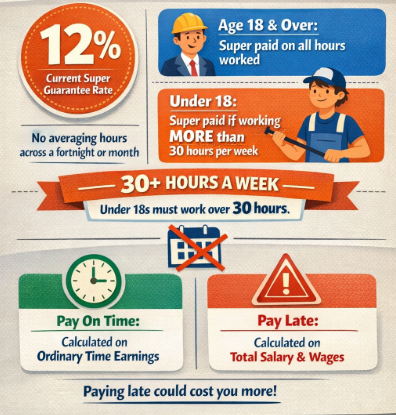
Image source:© 2026 Krish Capital Pty. Ltd.
The $450 Rule That No Longer Applies
In the past, workers earning less than $450 a month didn’t qualify for super. That rule no longer applies. Today, super must be paid regardless of how little someone earns.
Who Is Generally Covered
In most cases, eligibility is broad. It doesn’t matter whether the employee is full-time, part-time, or casual. It also doesn’t matter if they are already receiving a super pension, working under a transition-to-retirement arrangement, are a temporary resident such as a backpacker, are a company director, or even a family member working in your business.
How This Plays Out in Real Life
Samir is a 32-year-old seasonal fruit picker who works short stints each summer. In the past, when his monthly earnings were under $450, he didn’t qualify for super. But in 2025–26, even though he only works limited hours and earns modest pay, his employer must pay super at 12% of his ordinary time earnings.
Special Rules for Workers Under 18
You also need to think carefully about younger workers. Lily is 17 and works two jobs. In one week, she works more than 30 hours at a hardware store, so that employer must pay super for that week. In her café job, she only works a few hours a month, so super doesn’t apply there. The rule is based on what happens in each individual week, not on average hours.
Domestic and Private Workers at Home
If someone works for you in your home – such as a nanny, housekeeper, or carer – and they work more than 30 hours in a week, you must pay super, no matter how much they earn. If they work fewer than 30 hours in a week, you don’t have to. For instance, Noah works 25 hours a week as a housekeeper in a private arrangement, so super doesn’t apply in that case.
If you manage your own NDIS plan and use the funds to hire a carer or domestic worker, super obligations may also apply.
Contractors and ABNs: Still Not Always Exempt
Contractors can be a grey area. Even if someone quotes an ABN, you still need to pay super if they are paid mainly for their labour. How much they earn doesn’t change that requirement.
Workers From Overseas and Australians Working Abroad
Temporary residents, including backpackers and working holiday makers, are generally eligible for super. If you send an Australian employee overseas temporarily, you must continue paying super in Australia and can apply for a certificate of coverage so you don’t have to pay super in the other country as well. Some overseas workers and foreign executives may be exempt in specific situations, and non-resident employees working outside Australia are not covered.
Who Is Not Covered
There are a few clear exclusions. If you’re self-employed as a sole trader or partner, you don’t pay super for yourself. Members of the army, naval, or air force reserves don’t receive super for their reservist work. High-income earners working for multiple employers can opt out of super with a formal exemption certificate, and in those cases, employers don’t have to pay.
The Bottom Line
If you’re paying someone to work for you, it’s safest to assume super applies unless you’re certain an exception exists. The rules around age, hours worked, and the type of work being done make all the difference — and getting those details right keeps you compliant.


 Mar 10, 2026




 Please wait processing your request...