
 AU
AU CA
CA NZ
NZ UK
UK US
US IND
IND

 Share
Share
 X (Formerly Twitter)
 Whatsapp
 Facebook
 LinkedIn
 Telegram
 Email This Article
 Copy Link
 Summarize with AI
 Chat GPT
 Perplexity
Franking credits are one of the most powerful — and often misunderstood — features of the Australian tax system. For investors who hold dividend-paying shares on the Australian Securities Exchange (ASX), franking credits can significantly increase total investment returns.
Australia’s dividend imputation system was designed to eliminate the problem of double taxation on company profits. Under this system, when a company pays corporate tax on its profits, shareholders receive a credit for the tax already paid.
This means:
- Investors may pay less tax on dividend income
- Some investors receive cash refunds from the ATO
- Fully franked dividend stocks can produce higher after-tax returns
For retirees, self-managed super funds (SMSFs), and income investors, franking credits are often a critical component of portfolio strategy.
In fact, many of Australia’s most popular dividend stocks — including major banks and resource companies — distribute billions of dollars in franking credits every year.
This comprehensive guide explains everything investors need to know about franking
credits, including:
- How franking credits work
- How they appear on tax returns
- The 45-day holding rule
- How refunds are paid
- Which investors benefit the most
- Strategies for maximizing franking credit income
Quick Answers: Franking Credits Explained
What are franking credits?
Franking credits are tax credits attached to dividends paid by Australian companies that have already paid corporate tax on their profits.
Why do franking credits exist?
They prevent double taxation, ensuring company profits are not taxed both at the corporate level and again in the hands of shareholders.
Who benefits the most from franking credits?
The biggest beneficiaries typically include:
- retirees
- low-income investors
- self-managed super funds
- dividend income investors
These investors can often receive refunds from the Australian Taxation Office (ATO).
What is the 45-day rule?
To claim franking credits, investors must generally hold shares for at least 45 days
(excluding purchase and sale days) to prove they bear economic risk.
The History of Franking Credits in Australia
The concept of franking credits was introduced in 1987 as part of major tax reforms.
Before that, Australia used a classical taxation system, which created a major problem.
Company profits were taxed twice:
- Once when the company paid corporate tax
- Again when shareholders paid personal income tax on dividends
This double taxation discouraged investment in dividend-paying companies.
To solve this, Australia introduced the dividend imputation system, allowing companies
to pass on tax credits to shareholders.
Key milestones in the evolution of franking credits
- 1987 - Dividend imputation system introduced
- 1997 - Holding period rule introduced
- 2000 - Excess franking credits became refundable
- 2019 - Proposed removal of refunds debated in federal
- election
The 2000 reform was particularly significant because it allowed cash refunds for excess franking credits. This dramatically increased the attractiveness of fully franked dividends for retirees and super funds.
How Franking Credits Work: Step-by-Step Explanation
To understand franking credits, investors must follow the profit journey from company earnings to shareholder income.
- Step 1: Company earns profit
An Australian company generates profit from operations.
Example: Company profit: $100
- Step 2: Company pays corporate tax
The corporate tax rate for most large Australian companies is 30%.
Corporate tax paid: $100 × 30% = $30 tax
After tax profit: $100 − $30 = $70
- Step 3: Company pays dividends
The company distributes the remaining profit as dividends.
Cash dividend paid: $70
- Step 4: Franking credit attached
Because the company already paid $30 in tax, shareholders receive a franking credit for
that amount.
Dividend statement: Cash dividend: $70, Franking credit: $30 Total taxable income: $100
How Franking Credits Appear in Tax Returns
When investors lodge their tax returns, they must declare:
- the cash dividend received
- the franking credit attached
This is known as grossing up the dividend.
Example calculation
- Dividend received: $70
- Franking credit: $30
- Total taxable income: $100
Scenario 1: Investor tax rate 30%, Tax owed: $100 × 30% = $30, Franking credit offset: $30, Final tax payable: $0
Scenario 2: Investor tax rate 45%, Tax owed: $100 × 45% = $45, Franking credit offset: $30, Final tax payable: $15
Scenario 3: Investor tax rate 0%, Tax owed: $0, Franking credit: $30, Refund from ATO: $30
Why Franking Credits Are Extremely Valuable
Franking credits can dramatically increase effective dividend yield.
For example: A stock with a 5% fully franked dividend yield can produce an effective grossed-up yield of about 7.14%.
Grossed-up yield formula
Grossed up dividend yield = Dividend yield ÷ (1 − corporate tax rate)
Example: 5% ÷ 0.70 = 7.14% gross yield
This is why many Australian investors prefer fully franked dividend stocks.
Fully Franked vs Partially Franked Dividends
Not all dividends come with full franking credits.
Companies may issue:
- fully franked dividends
- partially franked dividends
- unfranked dividends
Fully franked dividend
Company paid full corporate tax.
Example: Dividend = $70, Franking credit = $30, Partially franked dividend
Company paid only partial tax.
Example: Dividend = $70, Franking credit = $15, Unfranked dividend
Company paid no Australian corporate tax.
Common examples:
- foreign income
- trust distributions
- REIT dividends
Companies That Commonly Pay Fully Franked Dividends
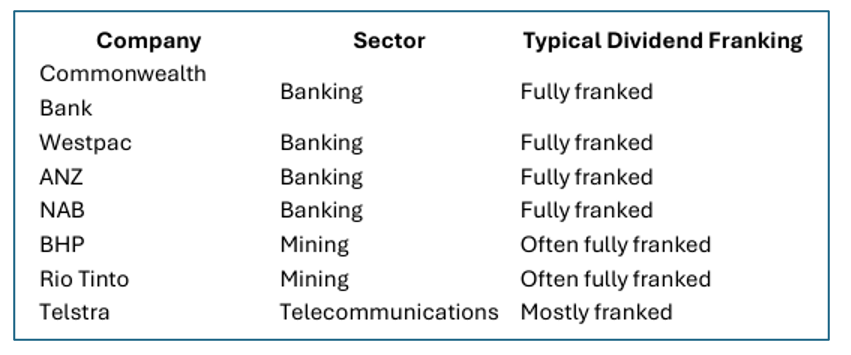
Some of the most famous fully franked dividend payers in Australia include:
These companies generate significant profits in Australia and therefore accumulate large franking credit balances.
The 45-Day Rule: Eligibility Requirement for Franking Credits
One of the most important conditions for claiming franking credits is the holding period rule. This rule prevents investors from buying shares just before the dividend and selling immediately after.
To claim franking credits:
- Shares must be held at risk for at least 45 days
Exclusions:
- Purchase day not counted
- Sale day not counted
The $5,000 Franking Credit Exemption
Small investors may qualify for an exemption. If total franking credits claimed are below $5,000, the holding rule may not apply. This simplifies tax compliance for retail investors.
Franking Credit Refunds Explained
One of the most unique features of Australia's tax system is the ability to receive cash refunds for excess franking credits. This occurs when the franking credit exceeds the investor’s tax liability.
Who receives refunds?
Common recipients include:
- retirees
- pensioners
- SMSFs in pension phase
- low-income earners
Why Retirees Love Franking Credits
Franking credits are extremely popular among retirees because they provide tax-efficient income.
A retiree holding high-dividend stocks may receive:
- cash dividends
- tax credit refunds
This can significantly boost retirement income.
Strategic Investing with Franking Credits
Many investors build portfolios specifically designed to maximize franking credits.
Common strategies include:
- investing in bank stocks
- holding dividend ETFs
- owning mature blue-chip companies
- focusing on high dividend yield sectors
High Franking Credit Sectors in Australia
Some sectors consistently produce strong franking credit flows.
- Banking sector
- Mining sector
- Telecommunications
Franking Credits vs International Dividends
One limitation of franking credits is that they apply only to Australian company tax. Foreign companies do not provide franking credits. This makes domestic dividend stocks particularly attractive for Australian income investors.
Risks of Chasing Franking Credits
Although franking credits are valuable, investors should avoid focusing solely on them.
Potential risks include:
- dividend cuts
- falling share prices
- sector concentration
- tax rule changes
- A balanced investment strategy is essential.
Key Takeaways
- Franking credits prevent double taxation of company profits
- Investors receive tax offsets attached to dividends
- Some investors receive cash refunds from the ATO
- Shares must generally be held at least 45 days
- Fully franked dividends increase effective investment yield
Franking credits remain one of the most powerful features of the Australian investment system.


 Mar 10, 2026




 Please wait processing your request...