
 AU
AU CA
CA NZ
NZ UK
UK US
US IND
IND

 Share
Share
 X (Formerly Twitter)
 Whatsapp
 Facebook
 LinkedIn
 Telegram
 Email This Article
 Copy Link
 Summarize with AI
 Chat GPT
 Perplexity
Highlights
- The Reserve Bank of Australia conducts monetary policy to influence interest rates, economic activity, employment and inflation across the economy.
- The cash rate target is the primary tool used to guide interest rates and financial conditions in Australia.
- Additional measures such as forward guidance, term funding and bond purchases have been used during specific economic conditions.
Monetary policy in Australia involves influencing interest rates to affect aggregate demand, employment and inflation in the economy. It is one of the main economic policies used to stabilise business cycles. The Reserve Bank of Australia is responsible for conducting monetary policy and sets a target for the nation’s official interest rate, known as the cash rate target. This cash rate target is the conventional tool of monetary policy in Australia.
Monetary policy has also included additional tools at different times. These have included forward guidance, the provision of term funding to the banking system, a yield target and quantity targets for the purchase of government bonds. Through these measures, monetary policy can influence interest rates across the economy, including lending and deposit rates faced by households and businesses. Changes in these interest rates affect economic activity, employment and inflation.
Objectives of Monetary Policy
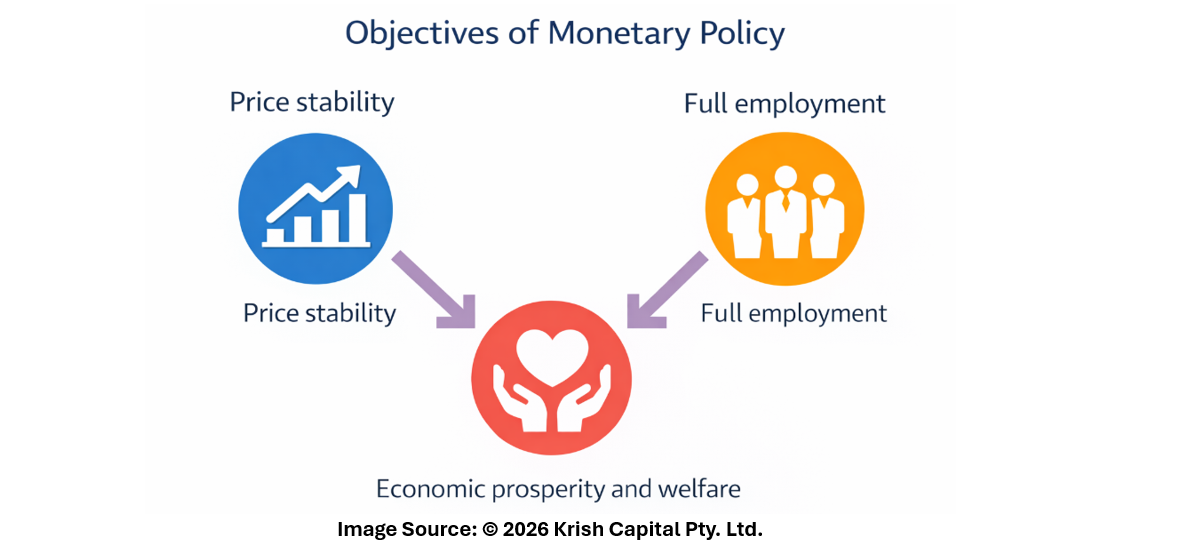
The overarching objective of monetary policy in Australia is to promote the economic prosperity and welfare of the Australian people, both now and into the future. The Reserve Bank makes decisions about monetary policy in order to contribute to price stability and the maintenance of full employment in the economy.
These objectives are set out in the Reserve Bank Act 1959. They are also reflected in the Statement on the Conduct of Monetary Policy, which outlines the framework through which the Reserve Bank and the Australian Government define the approach to monetary policy.
Price Stability
Price stability refers to maintaining low and stable inflation. Inflation represents an increase in the general level of prices of goods and services purchased by households. Maintaining low and stable inflation helps preserve the purchasing power of money over time. This objective supports stability in the economy and assists in maintaining confidence in the value of money.
Full Employment
Full employment refers to an economic environment where there are enough jobs available for people who are willing and able to work. Even when the economy is considered to be at full employment, some level of unemployment may remain due to individuals moving between jobs or because of differences between the skills available in the workforce and those required by employers.
Australia’s Inflation Target
Since the early 1990s, the Reserve Bank has used an inflation targeting framework to guide its monetary policy decisions. Australia operates a flexible inflation target that aims to keep consumer price inflation between 2 and 3 per cent over time.
Under this framework, the Monetary Policy Board sets policy so that inflation is expected to return to the midpoint of the target range. The flexible nature of the target allows the Board to consider economic conditions when making decisions. At the same time, the inflation target provides a clear benchmark for evaluating the performance of monetary policy.
Transmission of Monetary Policy
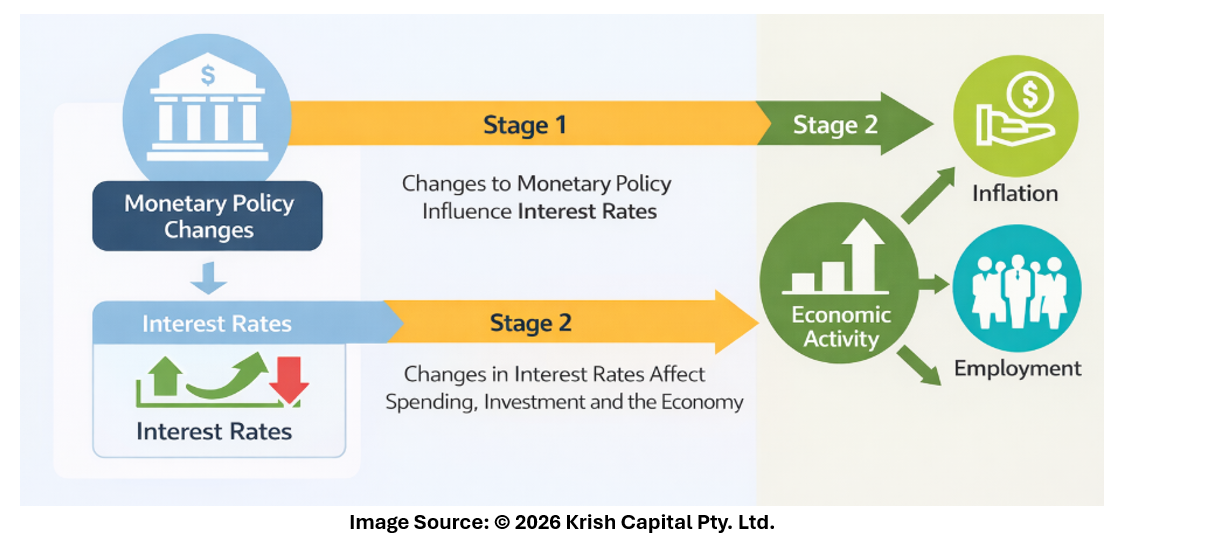
The transmission of monetary policy refers to the process through which changes in policy settings affect economic activity and inflation. This process is complex and the timing and scale of its effects may vary.
In general terms, the transmission process occurs in two stages. First, changes in monetary policy influence interest rates across the economy. Second, these changes in interest rates affect spending, investment and economic activity. As economic activity changes, employment levels and inflation may also be affected.
Implementing Monetary Policy
The Reserve Bank implements monetary policy using a range of tools. The primary instrument is the cash rate target. At times, other measures have also been used, including forward guidance, government bond purchases and the provision of low-cost long-term funding to financial institutions.
The Cash Market
The cash rate target relates to the cash market, where banks lend and borrow funds from each other overnight. The interest rate on these loans is called the cash rate. By setting a target for this rate, the Reserve Bank influences other interest rates in the economy.
Exchange Settlement Balances
The quantity traded in the cash market is known as Exchange Settlement (ES) balances. These balances are held by banks in deposit accounts at the Reserve Bank and are used to settle transactions between financial institutions. ES balances are considered equivalent to cash because they represent funds held at the central bank.
Demand and Supply of ES Balances
Banks use ES balances to make payments to each other and to manage their liquidity. Demand for these balances may change depending on financial market conditions or payment requirements.
The Reserve Bank manages the supply of ES balances to ensure that the cash rate remains close to its target. Prior to the COVID-19 recession, this was mainly achieved through open market operations, often using repurchase agreements. In these transactions, the Reserve Bank temporarily exchanges ES balances for financial securities such as government bonds, allowing it to influence the amount of liquidity available in the banking system.
Interest Rate Corridor
The Reserve Bank also operates a policy interest rate corridor that helps maintain the cash rate near the target. The central bank pays interest on ES balances at a rate slightly below the cash rate target. At the same time, it is willing to lend ES balances to banks at a rate above the target.
These two rates create lower and upper bounds for short-term interest rates in the cash market. Banks therefore have an incentive to lend and borrow funds within this range, which helps guide the cash rate toward the target level.
Additional Monetary Policy Tools
In response to the COVID-19 recession, the Reserve Bank used additional monetary policy measures. These included the Term Funding Facility and a government bond purchase program. These measures increased the supply of ES balances in the banking system.
As a result of this increase in liquidity, the cash rate has at times traded closer to the lower bound of the interest rate corridor rather than exactly at the cash rate target. These tools were introduced to support financial conditions and assist the functioning of the monetary policy framework during that period.
FAQs
- What is the main tool used for monetary policy in Australia?
The primary tool used by the Reserve Bank of Australia is the cash rate target, which influences interest rates across the economy. - What are the main objectives of monetary policy in Australia?
The main objectives are to maintain price stability and support full employment while promoting the economic prosperity and welfare of Australians. - How does the cash rate affect the economy?
Changes in the cash rate influence borrowing and deposit interest rates, which affect spending, investment, economic activity, employment and inflation.


 Mar 09, 2026




 Please wait processing your request...