
 AU
AU CA
CA NZ
NZ UK
UK US
US IND
IND

 Share
Share
 X (Formerly Twitter)
 Whatsapp
 Facebook
 LinkedIn
 Telegram
 Email This Article
 Copy Link
 Summarize with AI
 Chat GPT
 Perplexity
Highlights
• Australian residents must declare global income, including overseas earnings and assets.
• Tax may apply in both Australia and the foreign country of income source.
• Certain overseas employment types may qualify for tax exemption.
• Foreign taxes paid may be offset through the Australian tax system.
• Accurate record-keeping and currency conversion are essential for compliance.
Australian residents are required to declare all income earned both locally and internationally. The Australian Taxation Office (ATO) refers to this as worldwide income. This includes income from work, business, investments, and capital gains on overseas assets. Reporting global income ensures fairness in the tax system and prevents double taxation where possible. The rules apply whether the income comes from direct employment, digital platforms, or foreign investment sources.
Employment and Business Income Abroad
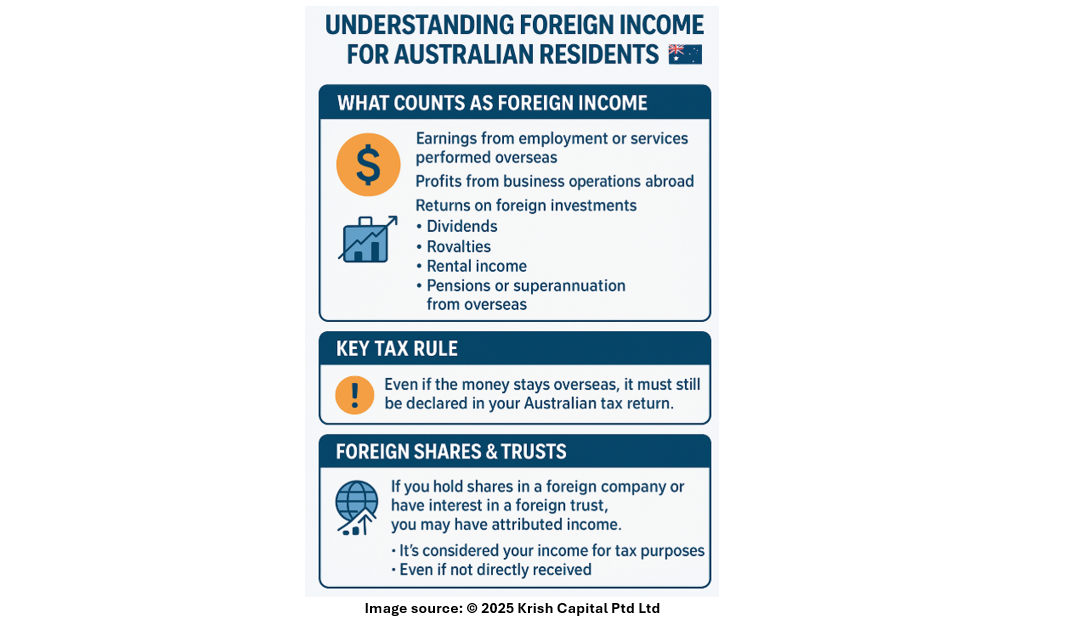
If you work overseas or provide services to a foreign organisation, the income must be reported as if earned in Australia. This includes salaries, consultancy payments, and business profits. Payments received from foreign-hosted platforms—such as freelance or influencer activities—also fall under this rule. The same applies to directors’ fees or contract work performed for overseas entities.
Investment Income and Capital Gains
Income from overseas assets and investments must be included in your Australian tax return. This covers interest, dividends, royalties, and rental income from properties abroad. Pension payments and superannuation income from foreign funds are also part of assessable income.
If you sell an overseas asset, you may incur Australian capital gains tax (CGT). Keeping detailed records of purchase dates, asset values, and sale amounts is crucial. When you become or cease to be an Australian resident, the law treats your foreign assets as acquired or disposed of at that time, requiring accurate valuation.
Taxation and Double Tax Agreements
Australian residents generally pay tax on foreign income in Australia. However, depending on your residency status or visa type, the treatment may differ.

Countries that have tax treaties with Australia allow residents to apply for reduced or exempt withholding tax by submitting a certificate of residency and a tax relief form to the foreign authority.
Australian Government employees delivering Official Development Assistance (ODA) projects are now required to pay tax on that income, except members of disciplined forces who remain eligible for exemption.
Claiming Tax Paid Overseas
If tax was already paid overseas, Australians may claim a foreign income tax offset to prevent double taxation. You must show proof that tax was paid and that the foreign country had taxing rights over the income.
The offset amount may differ from the foreign tax paid. For claims above AUD 1,000, residents must calculate a foreign income tax offset limit to determine the allowable amount.
When Foreign Income May Be Exempt
Some international employment income is exempt from Australian tax under specific conditions.
- Foreign service may be exempt under section 23AG if you are engaged overseas for a qualifying period.
- Approved overseas projects may qualify for exemption under section 23AF.
- Work with certain international organisations can also be tax-free.
- Members of the Australian Defence Force (ADF) performing overseas duties may be eligible for special treatment.
- Income from Australia–United States joint space and defence projects may qualify for specific exemptions under bilateral agreements.
Currency Conversion and Record Keeping
All foreign income must be converted into Australian dollars before inclusion in your tax return. The ATO provides official exchange rates to be used for conversion. Income received across different dates must be converted using the rate applicable at each payment date.
If income relates to multiple financial years, it must be apportioned accordingly. Keeping thorough records of income, foreign taxes paid, and conversion rates helps ensure compliance and supports any future audits.
Audit and Verification
The ATO conducts audits and data-matching checks with overseas tax authorities to verify foreign income declarations. Inaccurate or incomplete reporting may result in penalties or reassessment. Transparent reporting and accurate documentation are key to fulfilling your global tax obligations as an Australian resident.
Australian residents must report all worldwide income, including salaries, investments, and capital gains from foreign assets. While tax offsets and exemptions can prevent double taxation, maintaining accurate records and following ATO rules are crucial for compliance.


 Mar 10, 2026




 Please wait processing your request...