
 AU
AU CA
CA NZ
NZ UK
UK US
US IND
IND

 Share
Share
 X (Formerly Twitter)
 Whatsapp
 Facebook
 LinkedIn
 Telegram
 Email This Article
 Copy Link
 Summarize with AI
 Chat GPT
 Perplexity
_10_03_2025_09_00_06_602306.png)
Image source: © 2025 Krish Capital Pty.Ltd
Highlights
- Tax deferral in Australia allows taxpayers to postpone income recognition or tax payments under specific rules.
- Common deferral areas include lodgment extensions, payment deferrals, employee share schemes, and trust distributions.
- Deferred amounts are not forgiven but taxed later, often at sale, vesting, or repayment events.
- Strict eligibility criteria, ATO oversight, and compliance requirements limit misuse of tax deferral provisions.
Tax deferral refers to postponing the recognition or payment of a tax liability from the present period to a later period. Commonly seen in trust distributions and investment structures, this strategy can reduce immediate tax liabilities and optimise financial planning. In Australia, deferral can arise in several contexts:
- Deferred distributions in trusts or property investments: some components of trust distributions are designated “tax-deferred,” meaning they are not taxed immediately, but reduce cost base and are taxed later, e.g., on sale of units.
- Employee Share Schemes (ESS): where a discount on shares or rights is eligible for a deferral, the taxing point is postponed until a later event.
- Lodgment/payment deferrals: taxpayers (or their agents) may obtain extra time to lodge returns or to pay liabilities under certain circumstances.
- Deferral of student loan (HELP) repayments or ATO levies: under hardship or special circumstances.
Each of these has its own rules, conditions, and legal backing.
Key Types of Tax Deferral in Australia
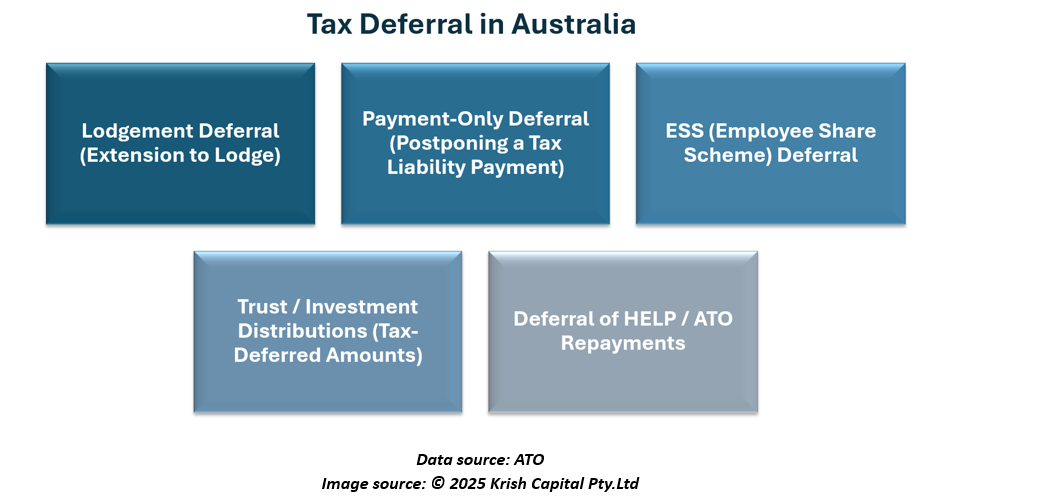
- Lodgement Deferral (Extension to Lodge)
Tax agents (or taxpayers) can request a lodgement deferral, meaning extra time to lodge a document (e.g., tax return, fringe benefits tax return, activity statement) without triggering a “failure to lodge on time” (FTL) penalty.
- Payment-Only Deferral (Postponing a Tax Liability Payment)
Where a liability (e.g., income tax, fringe benefits tax, or amounts arising from lodged activity statements) is due, a taxpayer (via agent) may request a payment-only deferral.
- ESS (Employee Share Scheme) Deferral
Under ESS rules in the tax law, an employee may obtain a deferral of the taxing point when receiving shares, rights, or options from their employer.
- Trust / Investment Distributions (Tax-Deferred Amounts)
Some managed investment trusts or property trusts may pay distributions that include a tax-deferred component — typically arising from non-cash deductions (e.g., depreciation, capital works allowances).
The tax-deferred portion is not assessed in the year of distribution; instead, it reduces the cost base of the investment unit. When the investor later sells or redeems their units, that reduced cost base may result in a higher capital gain. This effectively postpones (defers) tax until the capital gains event.
- Deferral of HELP / ATO Repayments
If a taxpayer has a compulsory student loan repayment (e.g., HELP) or overseas levy, they may apply to defer or amend such repayments under circumstances of serious hardship or special reasons. The ATO may pause or reduce the required repayment. Applicants must provide detailed income/expense statements and evidence (e.g., medical, disaster, unemployment).
Rules, Risks & Considerations
- Strict criteria: Deferral is not automatic; taxpayers must satisfy conditions (exceptional circumstances, qualifying scheme rules, etc.).
- Interest / penalties: Deferral may not fully shield a taxpayer from interest charges or penalties, depending on the arrangement and ATO discretion.
- Deferral is temporary: Deferred tax is not forgiven; it’s postponed to later periods when full payment or assessment occurs.
- Record keeping & compliance: Accurate documentation of circumstances, timing, and compliance is critical.
- Anti-avoidance rules: The general anti-avoidance provisions may apply if the deferral is part of a scheme whose dominant purpose is tax avoidance.
For Australians, tax deferral offers useful flexibility, whether through lodgement or payment extensions, ESS discount deferrals, or deferred trust distributions. But it is bounded by law, ATO policy, and strict eligibility conditions. Taxpayers and agents must carefully assess whether they qualify, maintain appropriate documentation, and be prepared for the eventual taxing point.


 Mar 10, 2026




 Please wait processing your request...