
 AU
AU CA
CA NZ
NZ UK
UK US
US IND
IND

 Share
Share
 X (Formerly Twitter)
 Whatsapp
 Facebook
 LinkedIn
 Telegram
 Email This Article
 Copy Link
 Summarize with AI
 Chat GPT
 Perplexity
Highlights
- You can claim deductions for expenses directly related to earning your income when you paid for them yourself.
- Work-related deductions include car/travel, equipment, clothing, self-education and home-office expenses.
- Written evidence is required for most claims, especially when deductions exceed A$300.
- Deductions also apply to eligible gifts, donations and tax-management expenses.
Individuals can claim deductions for a range of expenses incurred while earning their income, provided the costs meet certain conditions. To qualify, the expense must be paid by you, not reimbursed, and must directly relate to your work or income-producing activities. You must also retain evidence showing the nature and amount of the expense.
According to the ATO, common types of deductible expenses include:
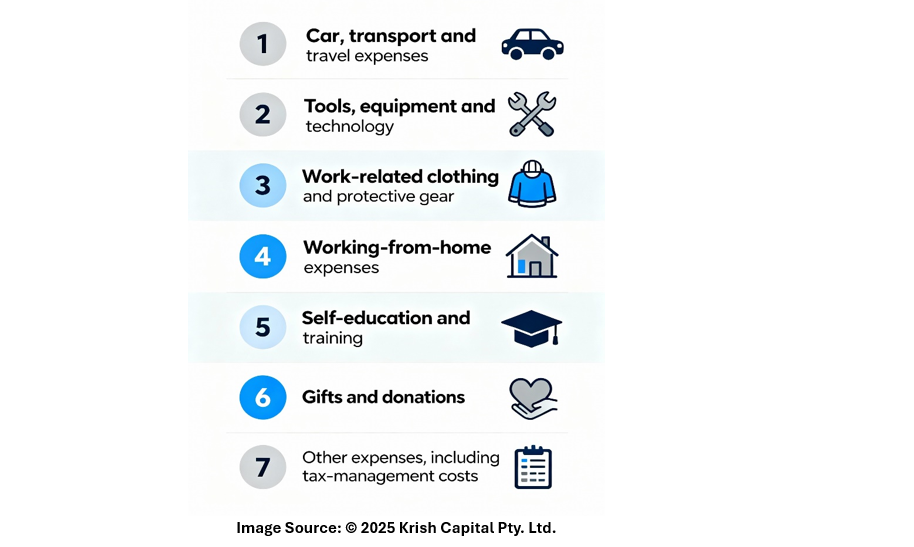
- Car, transport and travel expenses: Costs associated with using your vehicle or travelling for work, such as trips between multiple work locations. Travel from home to a usual workplace is not deductible.
- Tools, equipment and technology: Items essential for your role — such as laptops, mobile phones, software, tools, and professional materials — may be claimed, including repair or depreciation costs.
- Work-related clothing and protective gear: Occupation-specific uniforms, protective clothing and safety equipment required for the job are deductible. Everyday clothing is not.
- Working-from-home expenses: Running costs such as electricity, internet, phone usage, office supplies or decline in value of office equipment may be claimable, depending on work-related use.
- Self-education and training: If training or courses improve the skills needed for your current employment or help maintain your professional knowledge, related expenses may be deductible.
- Gifts and donations: Donations made to eligible organisations registered to receive tax-deductible gifts can be claimed.
- Other expenses, including tax-management costs: Fees for tax advice, preparing or lodging your return, and certain other work-related costs may also be deductible.
Rules and record-keeping: How to calculate what you can claim
Claiming deductions requires meeting specific conditions. You must have incurred the expense during the financial year and must not have been reimbursed. The deduction must relate directly to earning your income. If the expense has both private and work-related use — for example, a mobile phone or internet service — only the work-related portion is deductible, and you must reasonably calculate the percentage.
Keeping good records is essential. Most claims require written evidence, such as receipts, invoices, or usage records. If your total deductions exceed A$300, written documentation becomes compulsory. For assets or equipment costing more than a certain threshold, you may need to claim the decline in value over time rather than the full purchase price in the same year.
Mixed-use expenses require accurate apportionment. For example, if you use a laptop 60% for work and 40% for personal use, only the work-related component can be claimed. Maintaining logs, diaries or usage records helps support these calculations.
To work out what you can claim, list all your eligible expenses for the year, ensure each meets the necessary criteria, and confirm you have appropriate evidence. This process helps you determine the correct deduction amount when lodging your tax return.
Why deductions matter and how to apply them correctly
Claiming allowable deductions reduces your taxable income, potentially lowering the tax you are required to pay. Understanding the rules ensures that you neither over-claim nor overlook legitimate deductions.
Accurate record-keeping throughout the year is the most effective way to manage your deductions. Retain receipts, invoices, and any calculations for apportioning work-related usage. Only include expenses you are genuinely entitled to claim and ensure assets used for both private and work-related purposes are fairly apportioned.
Applying deductions correctly helps you meet your obligations while ensuring you receive the appropriate tax benefit. By following the guidelines and maintaining clear documentation, taxpayers can confidently claim the deductions they are eligible for when submitting their tax return.


 Mar 10, 2026




 Please wait processing your request...