
 AU
AU CA
CA NZ
NZ UK
UK US
US IND
IND

 Share
Share
 X (Formerly Twitter)
 Whatsapp
 Facebook
 LinkedIn
 Telegram
 Email This Article
 Copy Link
 Summarize with AI
 Chat GPT
 Perplexity
Highlights
- Capital Gains Tax may not apply if your home meets full exemption criteria.
- The six-year rule can help protect your main residence even after moving out.
- A 50% CGT discount rewards property owners who hold for over 12 months.
- Different CGT rules apply to foreign residents and expats selling property.
- Eligible ownership and improvement costs can increase your property’s cost base.
- Strong record-keeping and smart timing can reduce your overall CGT liability.
Selling a property in Australia isn’t just about finding the right buyer and closing the deal; it also comes with tax implications that can significantly affect your financial outcome. One of the most important considerations is the Capital Gains Tax (CGT), which applies when you sell or dispose of certain assets, including real estate. Whether you’re a homeowner or a property investor, knowing how CGT works — and when it doesn’t apply — can help you make smarter financial decisions and avoid unexpected surprises.
What Triggers Capital Gains Tax on Your Property Sale?
A Capital Gains Tax (CGT) event occurs when you sell, transfer, or give away a property that is subject to CGT. The Australian Taxation Office (ATO) treats this as a “disposal” of the asset.
The capital gain is the difference between the sale price and the property’s cost base, which includes the purchase price, stamp duty, and similar costs.
If the result is a gain, it is added to your taxable income. If it’s a capital loss, you can use it to offset future capital gains.
However, not every sale automatically triggers CGT — it depends on how the property was used and how long you owned it.
Home Exemption Basics
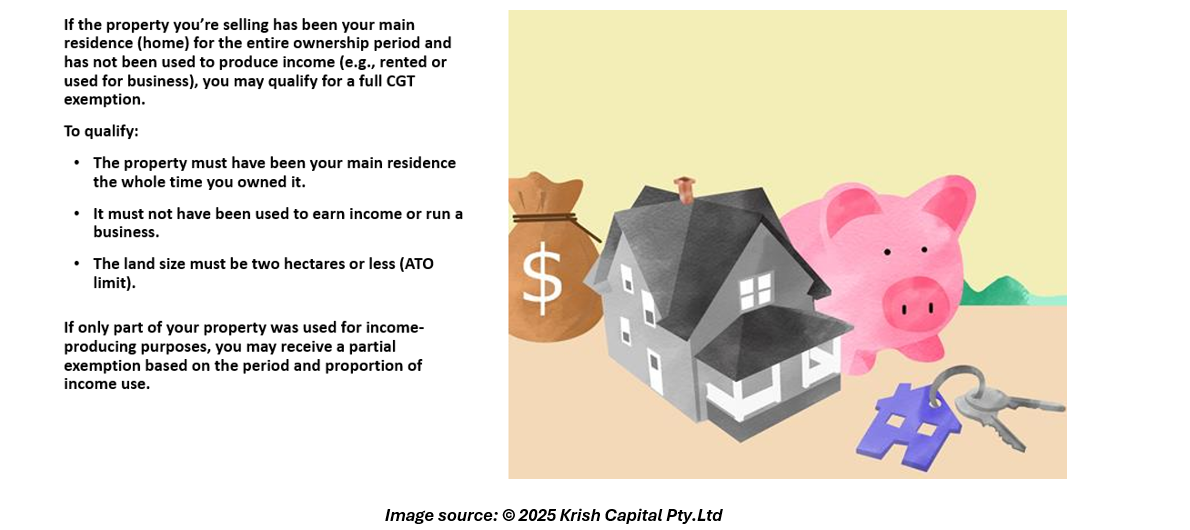
The Six-Year Absence Rule
If you move out of your home and rent it out, the six-year rule lets you continue to treat it as your main residence for up to six years, even while it’s rented — provided you don’t nominate another property as your main home.
If you move back into the property, the six-year period resets, allowing another potential exemption period in the future.
If the property is vacant (not rented) while you’re away, you can treat it as your main residence indefinitely, if you don’t claim another property as your main home during that period.
This rule offers flexibility for homeowners who temporarily relocate for work or investment purposes.
Selling an Investment Property?
For investment properties, CGT generally applies when sold. These properties are held to generate income through rent or capital growth.
Several factors affect the CGT payable, including:
- Length of ownership
- Tax residency status
- Eligibility for CGT discounts
Investors can reduce taxable gains by adding eligible ownership and improvement costs (such as renovations, stamp duty, or agent fees) to the cost base. However, costs already claimed as tax deductions — like depreciation — cannot be added again.
The 50% CGT Discount
If you’ve owned a property for more than 12 months and are an Australian resident for tax purposes, you may be eligible for the 50% CGT discount.
For example, if your gain is AUD 100,000, only AUD 50,000 would be added to your taxable income.
This discount can significantly lower your CGT liability, making the timing of a property sale a crucial part of effective tax planning.
Overseas Owners and CGT
If you’re a foreign tax resident, or you became one before selling your Australian property, different rules apply.
Since 1 July 2020, foreign residents are no longer eligible for the main residence exemption, except in limited “life event” cases such as terminal illness or death of a spouse or child.
Foreign sellers are also subject to capital gains withholding tax at settlement, and the 50% discount may not apply unless part of the ownership period was while you were an Australian resident.
Crunching the Numbers
To estimate your CGT, work out the cost base, which includes:
- Purchase price
- Stamp duty, legal, and conveyancing fees
- Improvement or renovation costs
- Selling costs (agent commissions, advertising, marketing)
Then, subtract the cost base from your sale price to determine your capital gain.
For instance, if your property sells for AUD 800,000 and the cost base is AUD 600,000, your capital gain is AUD 200,000.
If you qualify for the 50% discount, only AUD 100,000 would be added to your taxable income.
Smart Moves to Save Tax
You can manage your CGT liability legally by:
- Holding the property for at least 12 months to access the discount.
- Using the six-year rule if renting out your former home.
- Maximising your cost base by including all eligible improvements and acquisition costs.
- Timing your sale in a lower-income year to reduce your effective tax rate.
These strategies rely on accurate record-keeping and timing, so professional advice is valuable in complex situations.
Organise Your Paper Trail
The ATO requires that you keep detailed records to support your CGT calculation and exemption claims. These should include:
- Purchase and sale contracts
- Receipts for legal, renovation, and improvement costs
- Rental and occupancy records
- Dates of moving in and out
Records must generally be kept for at least five years after you lodge your tax return for the year in which the property was sold.
Good documentation helps verify exemptions, discounts, and compliance with ATO rules.
Plan Ahead, Save More
Understanding how Capital Gains Tax (CGT) applies to property sales helps homeowners and investors plan ahead with confidence.
It’s not just “sell and pay tax” — how the property was used, your residency status, and ownership period all matter.
With careful planning, smart timing, and thorough record-keeping, you can reduce your CGT liability and improve your after-tax return on property sales in Australia.


 Mar 10, 2026




 Please wait processing your request...