
 CA
 NZ
 UK
 US
 IND

 AU

 Share
 X (Formerly Twitter)
 Whatsapp
 Facebook
 LinkedIn
 Telegram
 Email This Article
 Copy Link
 Summarize with AI
 Chat GPT
 Perplexity

Key Highlights
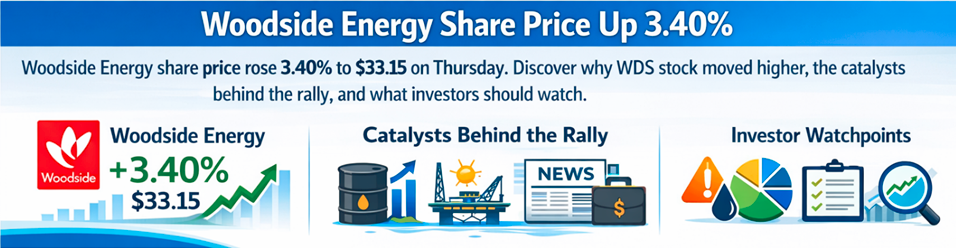
- Woodside Energy shares trading at $33.15, up 3.40% on the day.
- The rally was driven by ASX energy sector strength, firm crude oil and LNG prices, and continued investor confidence in Woodside’s project pipeline.
- Recent operational milestones, including the Beaumont New Ammonia facility handover in the United States, support the company’s growth narrative.
- Woodside’s scale and earnings mix make it the most liquid ASX 200 energy exposure and a key benchmark for the sector.
- Key risks include commodity price volatility, large-project execution, and energy transition concerns.
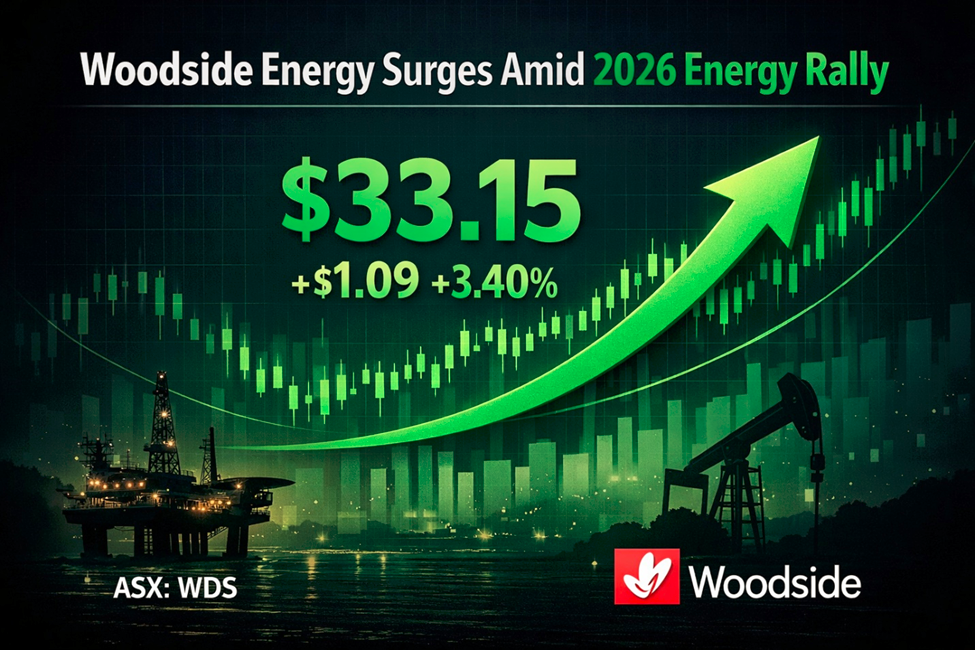
The Woodside Energy share price (ASX:WDS) is trading higher in Thursday’s session with a gain of $1.09, trading at $33.15. That’s a daily move of +3.40% and extends a strong run for Australia’s largest listed oil and gas producer. Woodside has been one of the clear beneficiaries of the 2026 energy sector rally, and today’s advance continues a pattern of outperformance relative to the broader S&P/ASX 200.
With institutional investors rotating into energy on firm crude oil prices, LNG pricing strength, and disciplined capital management, the Woodside Energy share price has become a bellwether for investor confidence in the Australian resources sector. Below, we look at the reasons behind the move, the operational and strategic context, and what shareholder should watch next.
Company overview: Who is Woodside Energy?
Woodside Energy Group Limited is Australia’s largest independent oil and gas company, with a global portfolio that spans Australia, the Americas, and Africa. Headquartered in Perth, Woodside has been a mainstay of the Australian energy sector for decades and was transformed by the 2022 merger with BHP Petroleum, which significantly expanded its production base, reserves, and geographic reach.
Woodside’s portfolio is anchored by major LNG projects in Western Australia, including the North West Shelf and Pluto facilities, alongside key oil projects in the Gulf of Mexico, Senegal, and other growth regions. The company also holds interests in the Scarborough and Trion developments, which are among the most significant new energy projects under construction in the world.
Beyond conventional oil and gas, Woodside has been investing in new energy projects, including the Beaumont New Ammonia facility in southeast Texas, hydrogen, carbon capture, and related lower-carbon initiatives. These new energy plays are still relatively small in earnings terms but are strategically important for Woodside’s long-term positioning.
For investors, Woodside offers scale, liquidity, diversified global production, and a track record of capital returns. It is the single largest energy exposure in many Australian equity portfolios and is often used as a proxy for both the ASX 200 energy sector and for global LNG markets.
Why Woodside Energy shares went up today
Several factors combined to push the Woodside Energy share price higher.
1. ASX 200 energy sector rally
Energy shares have been the best performing sector on the ASX over recent weeks. Firm crude prices, improving product spreads, and renewed institutional interest in cash-generating resources companies have all supported the sector. As the largest ASX-listed energy name, Woodside is a natural beneficiary and is often the first name to rally when sector sentiment turns.
2. Firm oil and LNG prices
Both Brent crude and benchmark Asian LNG prices have been supportive of Woodside’s earnings profile. With long-term LNG contracts indexed to oil prices and a meaningful portion of production sold on spot terms, Woodside benefits from firm prices across the board. Today’s rally reflects market confidence that those prices can be sustained.
3. Operational milestones at Beaumont
Woodside recently announced that it has assumed operational control of the Beaumont New Ammonia facility in southeast Texas. This is a meaningful step in Woodside’s new energy strategy and signals that the company is executing on its diversification plans. While the direct earnings impact is modest today, the strategic significance is meaningful for long-term valuation.
4. Capital discipline narrative
Woodside has been public about its commitment to capital discipline, returning surplus cash to shareholders, and prioritising projects with robust returns. That narrative continues to resonate with institutional investors and supports ongoing buying interest.
5. Sentiment around the growth project pipeline
Projects like Scarborough, Trion, and the Sangomar ramp-up are critical to the medium-term growth outlook for Woodside. As each of these projects progresses, the market reprices the company’s reserve base and free cash flow trajectory. Positive expectations around these developments are baked into today’s move.
6. Short-covering and technical buying
Woodside’s share price has been grinding higher for several weeks and today’s move extends that trend. When a large-cap breaks out of a recent range, it often triggers short covering and technical buying from systematic funds, amplifying the move.
News, announcements, and market catalysts to watch
No fresh price-sensitive ASX announcement was made by Woodside during the session. Still, several recent disclosures and ongoing narratives are shaping the Woodside Energy share price.
Beaumont New Ammonia
Woodside’s operational control of the Beaumont facility represents a concrete step in its new energy strategy. Investors will watch for updates on commissioning, production ramp-up, and offtake arrangements as the facility moves toward full operations.
Sustainability Briefing 2026
Woodside recently held its 2026 Sustainability Briefing, at which Acting Chief Executive Officer Liz Westcott outlined the central role of sustainability in the company’s strategy. The briefing reinforced Woodside’s view that lower-carbon products and operational emissions reductions can coexist with traditional oil and gas growth.
Scarborough and Trion progress
Scarborough is one of the most significant LNG projects under construction globally, and Trion is a major deepwater oil development in Mexico. Updates on cost, schedule, and first production for these projects have a direct impact on valuation.
Capital management
Woodside has historically returned surplus capital to shareholders via fully franked dividends and, at times, share buybacks. Any update on dividend policy or capital returns tends to move the share price.
LNG offtake contracts
Woodside continues to sign long-term LNG offtake agreements with customers in Asia and Europe. Each new contract adds visibility to future revenue and supports the valuation of its project pipeline.
Sector and macro factors affecting the move
Looking at Woodside in isolation misses the broader context. Today’s rally reflects sector-wide dynamics as much as company-specific factors.
Brent crude prices
Brent crude has been firm on supply discipline, steady global demand, and geopolitical premiums. Because a significant portion of Woodside’s contract LNG is oil-linked, Brent is a key variable for the company’s earnings.
Asian LNG spot prices
Spot LNG prices in Asia have been supportive, particularly during seasonal demand spikes. While Woodside is not purely a spot seller, its flexibility to direct cargoes to higher-priced markets boosts earnings when spot prices are strong.
Supply discipline
Major oil producers have continued to exercise discipline around production, which has supported prices. That discipline reduces the risk of an oversupply shock that would weigh on Woodside’s earnings.
Investor rotation
Global and local investors have been rotating into energy on valuation grounds, citing attractive free cash flow yields and robust balance sheets. Woodside is a key beneficiary of this rotation given its scale and liquidity.
Australian dollar and interest rates
A softer Australian dollar boosts AUD-denominated earnings from Woodside’s US dollar revenue streams. Lower domestic interest rates also make high-yielding dividend stocks more attractive relative to cash.
Global energy politics
Geopolitical events continue to shape oil and gas markets. Any disruption to global supply quickly translates into higher prices and, by extension, higher Woodside earnings estimates.
What investors are watching next
Investors in the Woodside Energy share price have a busy calendar of catalysts ahead.
Investors will be watching next for quarterly production and sales updates, progress on Scarborough and Trion, commissioning of Beaumont New Ammonia, any capital management announcements, and the direction of Brent crude and Asian LNG prices.
Production updates
Woodside’s quarterly production report is one of the most important data points for the stock. It includes volumes, realised prices, operating costs, and project progress updates. Strong production reports have historically been a positive catalyst.
Scarborough and Pluto Train 2
Scarborough is under construction and is expected to materially lift Woodside’s production capacity once it comes online. Investors will look for updates on cost, schedule, and any commissioning activities.
Trion development
Trion, the deepwater oil development in Mexico in partnership with Pemex, is another key growth project. Its progress will be closely watched for early production signals.
New energy progress
Beaumont New Ammonia, hydrogen studies, and carbon capture projects are relatively small today but will be important over time. Updates on these projects signal Woodside’s commitment to its lower-carbon strategy.
Broker price targets
Following today’s rally, broker analysts are likely to revise models and update price targets. An upward drift in consensus targets would support continued outperformance.
Dividend trajectory and franking credits
Woodside’s dividend trajectory is a major focus for Australian retail and SMSF investors who value franking credits. The company has maintained a policy of paying out a high proportion of underlying earnings, which has delivered a meaningful fully franked yield when commodity prices are supportive. Investors should watch for management commentary on the target payout ratio, balance sheet metrics, and any trade-off between growth investment and shareholder returns. When Woodside’s capital returns are strong, the stock tends to trade at a premium to pure-play producer peers without such a dividend culture.
Long-term LNG demand outlook
The long-term outlook for LNG demand is one of the most important structural variables for Woodside. Emerging Asian economies continue to invest in gas-fired power generation as a cleaner alternative to coal, while Europe remains focused on diversifying away from certain pipeline gas sources. Demand for LNG in transport, industrial use, and chemical feedstock applications also continues to evolve. For investors, the central question is not whether LNG will have a role in the future energy mix, but how large that role will be and how durable the pricing premium can remain. Woodside’s scale positions it as one of the winners in any scenario where LNG remains a core part of the global energy system.
Risks to the current momentum
The Woodside Energy share price has been riding a wave of positive sentiment, but several risks could challenge that momentum.
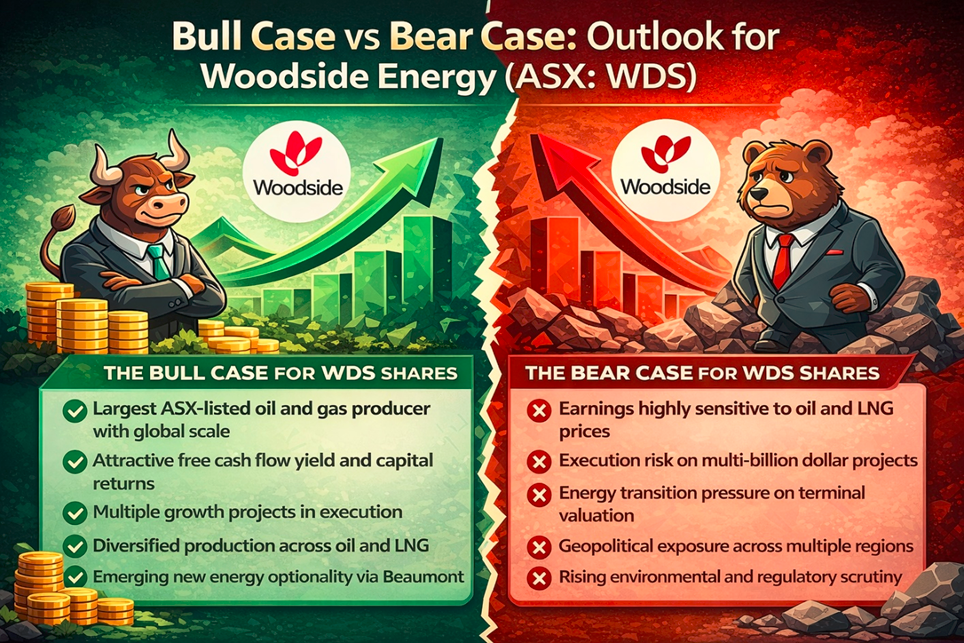
Commodity price volatility is the most immediate. Any sustained decline in Brent crude or Asian LNG prices would reduce earnings and weigh on the stock. Global oversupply, demand shocks, or changes in OPEC policy could all trigger such moves.
Large-project execution risk is significant. Scarborough, Trion, and Beaumont are multi-billion dollar projects with complex engineering, procurement, and commissioning challenges. Cost overruns or delays would affect valuation.
Energy transition concerns represent a longer-term risk. While oil and gas remain core to global energy needs for years to come, regulatory and investor pressure around emissions continues to grow. Woodside’s response to these pressures will be closely watched.
Geopolitical risk cuts both ways. Disruption can boost prices, but it can also threaten specific assets or supply chains in the regions where Woodside operates.
Currency risk is also relevant. Although AUD weakness supports earnings in local currency terms, volatility can create short-term noise in reported results.
Regulatory and climate policy risks
Australia’s climate policy continues to evolve, and regulatory settings around methane emissions, carbon pricing, and approvals for new gas projects can have a meaningful impact on Woodside’s domestic operations. Investors should pay attention to policy signals from the federal government and state regulators, particularly in Western Australia where much of Woodside’s existing production base is located. Changes in approval processes or operating conditions could affect the pace and cost of project delivery.
Conclusion: What today’s Woodside rally means
Today’s 3.40% gain in the Woodside Energy share price is a clear sign that investors continue to view WDS as a core holding for ASX energy exposure. The rally is driven by sector strength, firm commodity prices, and ongoing confidence in Woodside’s growth project pipeline, rather than by any single announcement.
For long-term investors, Woodside remains a quality energy stock with scale, discipline, and a credible growth story. The challenge for holders is to look through short-term volatility and focus on the underlying cash flow trajectory and capital return framework.
At $33.15, the Woodside Energy share price trades near its recent highs but remains supported by robust earnings and a strong project pipeline. Whether the stock can continue to push higher depends largely on commodity price trends and execution at Scarborough, Trion, and Beaumont.


 Nov 12, 2026





 Please wait processing your request...