
 CA
 NZ
 UK
 US
 IND

 AU

 Share
 X (Formerly Twitter)
 Whatsapp
 Facebook
 LinkedIn
 Telegram
 Email This Article
 Copy Link
 Summarize with AI
 Chat GPT
 Perplexity

Key Highlights
- Technology Leads the Market: Information Technology (XIJ) gained 1.52%, recording the strongest performance among the 12 supplied sector indices.
- Utilities and Resources Advance: Utilities (XUJ) rose 1.30%, while Resources (XJR) gained 0.80%, reflecting stronger buying interest across defensive and mining-related exposures.
- Materials and Energy Strengthen: Materials (XMJ) advanced 0.77%, supported by renewed interest in lithium and critical minerals, while Energy (XEJ) increased 0.72%.
- Cyclical Sectors Record Moderate Gains: Consumer Discretionary (XDJ) rose 0.53%, while Industrials (XNJ) and Property (XPJ) also finished higher.
- Financials Underperform: Financials (XFJ) declined 0.35%, becoming the only sector to finish in negative territory amid weakness in major banks and concerns surrounding household lending conditions.
Australian equities recorded broadly positive sector performance on Wednesday, 11 November 2026, with 11 of the 12 supplied sector indices finishing higher. Information Technology (XIJ) led the market with a 1.52% advance, followed by Utilities (XUJ), which gained 1.30%. Resources (XJR) and Materials (XMJ) also recorded positive performances, supported by renewed buying interest in Mining and critical minerals companies. Energy (XEJ) advanced 0.72%, while Consumer Discretionary (XDJ) increased 0.53%. In contrast, Financials (XFJ) was the only declining sector, falling 0.35% as investors responded to banking results and weakening household lending indicators.
Daily ASX Sector Performance Summary
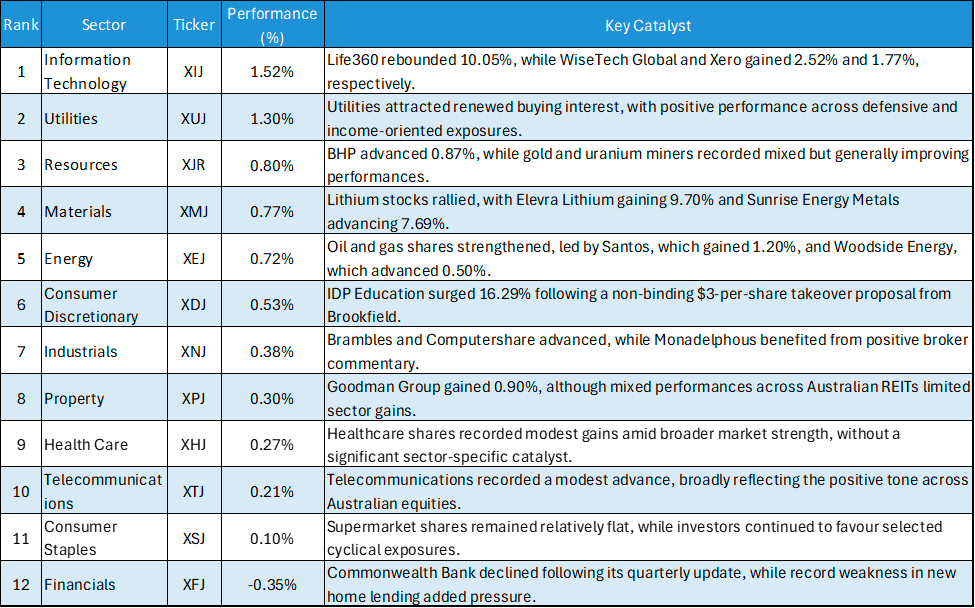
Technology and Utilities Lead a Broad-Based Market Advance
Information Technology (XIJ) was the strongest-performing sector, gaining 1.52% as investors returned to selected growth-oriented companies. Life360 was a major contributor, rebounding 10.05% to $20.81 following substantial weakness in the previous session. The recovery reflected renewed bargain-hunting interest after the company’s recent share price decline. WiseTech Global also advanced 2.52%, while Xero increased 1.77% and TechnologyOne gained 0.64%. The strength across these companies indicated improving investor appetite for technology exposures despite Volatility in international Equity markets.
Utilities (XUJ) advanced 1.30%, becoming the second-strongest sector. The positive performance reflected renewed Demand across defensive and income-oriented investments. Utilities can attract investor interest when Market Participants seek relatively stable Earnings and predictable cash flows amid changing interest-rate expectations. The sector’s advance also contrasted with the weakness in Financials, suggesting that buying interest was not concentrated exclusively in cyclical growth companies.
Resources and Materials Extend Mining Sector Gains
Resources (XJR) increased 0.80%, supported by renewed buying interest across selected mining companies. BHP Group advanced 0.87%, while gold producers recorded mixed performances. Genesis Minerals and Evolution Mining both gained 1.30%, although Newmont declined 2.50%. Uranium stocks also recovered from earlier weakness, with Paladin Energy advancing 0.20%. The improvement suggested that investors remained interested in commodity-related exposures despite continued differences in performance across individual mining subsectors.
Materials (XMJ) gained 0.77%, supported by a particularly strong recovery among lithium and critical minerals companies. Elevra Lithium surged 9.70%, while Sunrise Energy Metals advanced 7.69%. Pilbara Minerals also gained 6.53%, reflecting renewed buying interest in lithium producers following recent weakness. Core Lithium increased 8.00%, further reinforcing the positive performance across battery-materials exposures. The strength in these companies suggested that investors were becoming more constructive towards selected critical minerals opportunities.
Energy (XEJ) advanced 0.72%, supported by positive performances among major oil and gas producers. Santos gained 1.20%, while Woodside Energy increased 0.50%. The improvement across energy shares indicated that investors continued to favour selected Commodity producers despite uncertainty surrounding international energy prices.
Consumer, Industrial and Property Sectors Record Moderate Gains
Consumer Discretionary (XDJ) rose 0.53%, supported by significant corporate developments among selected companies. IDP Education was a standout performer, surging 16.29% following a non-binding Takeover proposal from Brookfield at $3.00 per share. The announcement attracted substantial buying interest and highlighted the influence of company-specific corporate developments on sector performance. However, Adairs declined 2.00% after indicating a more challenging consumer environment, suggesting that household spending pressures continued to affect selected discretionary businesses.
Industrials (XNJ) gained 0.38%, reflecting generally positive performances across several established companies. Brambles advanced 0.60%, while Computershare increased 0.70%. REA Group also gained 0.60%, supported by improving investor sentiment. Monadelphous recorded a notable advance following positive broker commentary, adding to the broader strength across industrial exposures. Nevertheless, the relatively modest sector gain indicated that buying interest remained selective.
Property (XPJ) increased 0.30%, although performance across individual real estate Investment trusts remained mixed. Goodman Group advanced 0.90%, while Scentre Group declined 0.90%. The divergence suggested that investors continued to differentiate between property companies according to their individual growth prospects, asset portfolios and financing conditions. Despite the positive sector performance, uncertainty surrounding interest rates and borrowing costs remained relevant considerations for Australian property trusts.
Healthcare, Telecommunications and Defensive Sectors Lag
Health Care (XHJ) gained 0.27%, recording a modest advance amid the broader improvement in market sentiment. The relatively subdued performance suggested that investors continued to favour technology and commodity-related exposures over healthcare companies. Without a significant sector-specific corporate catalyst, the sector’s performance remained relatively restrained.
Telecommunications (XTJ) advanced 0.21%, indicating limited buying interest compared with the stronger performances across technology and utilities. The modest gain reflected relatively subdued participation from communications-related companies, although the sector maintained positive territory.
Consumer Staples (XSJ) increased just 0.10%, making it the second-weakest performing sector. Supermarket shares remained relatively flat, while retail performances were mixed. Wesfarmers advanced 0.80%, providing some support to the broader consumer-related sector. Nevertheless, the limited advance suggested that investors continued to favour selected growth and cyclical opportunities over more defensive consumer businesses.
Financials (XFJ) was the only sector to finish lower, declining 0.35%. Commonwealth Bank fell 1.21% following its quarterly update, while National Australia Bank declined 1.51%. Although ANZ and Westpac recorded gains, weakness among selected major banking stocks weighed on overall sector performance. The banking sector also faced concerns surrounding household financial conditions, following Australian Bureau of Statistics data showing that the value of new home loans declined 15.5% in the September quarter, representing the largest quarterly fall since the series began in 2002. Commonwealth Bank also reported an increase in Mortgage arrears exceeding 90 days, highlighting potential pressure on household Credit quality. Meanwhile, GQG Partners plunged 19.59% following its latest funds under management update, adding to the weakness across selected financial companies.
Bottom Line
Information Technology (XIJ) led sector performance on 11 November 2026, gaining 1.52%, followed by Utilities (XUJ), which advanced 1.30%. Resources and Materials also recorded positive performances, supported by renewed buying interest in mining, lithium and critical minerals companies. Energy increased 0.72%, while Consumer Discretionary and Industrials recorded smaller gains. Property, Health Care, Telecommunications and Consumer Staples also finished higher, although their advances remained relatively modest. Financials was the only declining sector, falling 0.35%, as weakness in major banks and concerns surrounding household lending conditions weighed on investor sentiment. Overall, the session reflected broad-based market participation, with investors favouring technology, utilities and selected commodity-related exposures while remaining cautious towards banking stocks.


 Nov 12, 2026





 Please wait processing your request...