
 CA
 NZ
 UK
 US
 IND

 AU

 Share
 X (Formerly Twitter)
 Whatsapp
 Facebook
 LinkedIn
 Telegram
 Email This Article
 Copy Link
 Summarize with AI
 Chat GPT
 Perplexity

Key Highlights
- Industrials Lead the Market: Industrials (ASX) gained 2.31%, recording the strongest performance among the 12 supplied sector indices.
- Property and Materials Advance: Property (ASX) rose 2.23%, while Materials (ASX) gained 1.48%, reflecting strong buying interest across cyclical and asset-related shares.
- Resources and Financials Strengthen: Resources (ASX) advanced 1.33%, while Financials (ASX) increased 1.12%, indicating broader participation in the market recovery.
- Technology and Consumer Sectors Gain: Discretionary (ASX) rose 0.56%, while Energy, Information Technology and Health Care also finished higher.
- Telecommunications and Utilities Lag: Telecommunications (ASX) gained just 0.12%, while Utilities (ASX) declined 0.38%, making it the weakest sector in the session.
Australian equities recorded broadly positive sector performance on Tuesday, 10 November 2026, with all but one of the 12 supplied sector indices finishing higher. Industrials (ASX) led the market with a 2.31% advance, narrowly ahead of Property (ASX), which gained 2.23%. Materials (ASX) followed with a 1.48% increase, while Resources (ASX) and Financials (ASX) also recorded gains exceeding 1%. The strength across cyclical, property and financial exposures indicated improving market participation. In contrast, Telecommunications (ASX) recorded the smallest gain at 0.12%, while Utilities (ASX) was the only sector to finish lower, declining 0.38%.
Daily ASX Sector Performance Summary
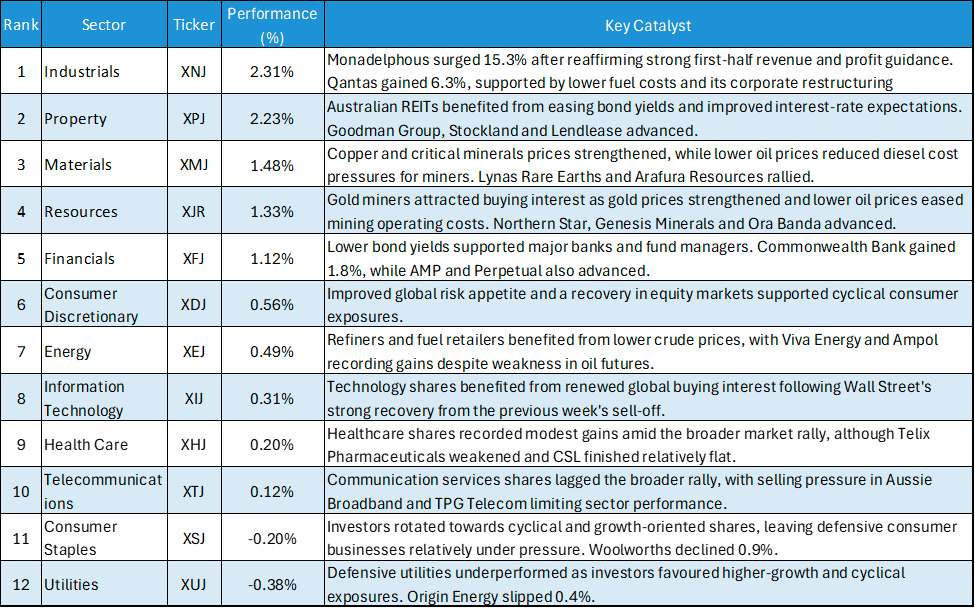
Industrials and Property Lead a Broad-Based Market Recovery
Industrials (ASX) was the strongest-performing sector, gaining 2.31% as investors returned to cyclical shares following the previous week's market weakness. Monadelphous Group was a major contributor, surging 15.3% after indicating first-half Revenue of approximately $1.7 billion and net profit after tax of between $80 million and $85 million. Qantas Airways also advanced 6.3% following its announcement of significant changes to its corporate structure, affecting approximately 850 positions. Lower oil prices provided additional support to the airline sector by reducing expectations for fuel-related operating expenses. Other industrial companies, including Reece, Transurban and Brambles, also recorded gains, indicating that buying interest extended beyond the largest contributors.
Property (ASX) advanced 2.23%, becoming the second-strongest sector. Australian Real Estate Investment Trusts (A-REITs) benefited from declining bond yields and improving expectations surrounding Inflation and monetary policy. Lower borrowing costs can support property companies through reduced financing expenses, while improving the relative attractiveness of rental income compared with fixed-income investments. Goodman Group gained 3.4%, while Stockland advanced 2.5% and Lendlease increased 2.9%. Charter Hall also recorded a positive session. The strength across property trusts suggested renewed investor interest in interest-rate-sensitive Assets following recent weakness.
Materials, Resources and Financials Extend Market Gains
Materials (ASX) gained 1.48%, supported by improving conditions across several Commodity markets. Copper prices strengthened following an overnight advance, while nickel and other base metals attracted renewed buying interest. Lower oil prices also provided some relief for Mining companies facing elevated diesel and transportation expenses. Nickel Industries and Sims were among the stronger performers, while BHP Group advanced 1.1%. Rare earths companies also recorded notable gains, with Arafura Resources rising 6.7% and Lynas Rare Earths increasing 4.2%. The recovery reflected improving sentiment towards critical minerals and selected mining companies.
Resources (ASX) increased 1.33%, supported by renewed Demand for gold-related investments. Gold prices strengthened, while lower energy costs provided an additional positive Factor for mining operations. Northern Star Resources, Genesis Minerals and Ora Banda Mining recorded gains, reflecting continued interest in precious metals producers. Uranium companies also maintained positive momentum, with Paladin Energy and Deep Yellow advancing as investors returned to growth-oriented energy exposures. Nevertheless, commodity price Volatility remains an important consideration for the sustainability of the recovery.
Financials (ASX) advanced 1.12%, benefiting from easing bond yields and improving market sentiment. Commonwealth Bank gained 1.8%, while Amp and Perpetual recorded further advances. The improvement across financial shares suggested that investors were becoming more comfortable with the interest-rate outlook. However, the sector remains sensitive to lending conditions, funding costs and potential changes in household Credit quality.
Consumer, Technology and Defensive Sectors Record Smaller Gains
Consumer Discretionary (ASX) rose 0.56%, reflecting improved investor confidence following the recovery in global Equity markets. The broader improvement in risk appetite supported cyclical businesses, although performance remained selective across individual companies. Energy (ASX) gained 0.49% despite a significant decline in Crude Oil prices. Brent Crude futures fell following comments from US President Donald Trump that further attacks on Iran were considered highly unlikely. Refiners and fuel retailers benefited from lower input costs, with Viva Energy and Ampol recording notable advances. However, weakness in crude prices continued to create uncertainty for Upstream oil and gas producers.
Information Technology (ASX) increased 0.31%, supported by improved international technology sentiment following Wall Street's recovery. The sector's relatively modest advance indicated that investors remained selective despite renewed interest in growth-oriented shares. Health Care (ASX) gained 0.20%, while Telecommunications (ASX) advanced just 0.12%. Healthcare performance was relatively subdued, with Telix Pharmaceuticals declining and CSL finishing almost unchanged. Telecommunications shares also faced selling pressure, particularly across selected broadband and communications companies.
Consumer Staples (ASX) declined 0.20%, while Utilities (ASX) recorded the largest sector loss, falling 0.38%. Woolworths Group weakened amid limited buying interest in defensive consumer businesses. Origin Energy also finished lower, contributing to weakness across utilities. The underperformance of these defensive sectors reflected investors' preference for cyclical and growth-oriented exposures during the broader market recovery.
Bottom Line
Industrials (ASX) led sector performance on 10 November 2026, gaining 2.31%, followed closely by Property (ASX), which advanced 2.23%. Materials and Resources also recorded positive performances, supported by improving commodity sentiment and lower mining operating costs. Financials increased 1.12%, while most remaining sectors registered smaller gains. Consumer Staples and Utilities were the only declining sectors, falling 0.20% and 0.38%, respectively. Overall, the session reflected a broad-based recovery, with investors favouring industrial, property, mining and financial exposures over defensive businesses.


 Nov 12, 2026





 Please wait processing your request...