
 CA
 NZ
 UK
 US
 IND

 AU

 Share
 X (Formerly Twitter)
 Whatsapp
 Facebook
 LinkedIn
 Telegram
 Email This Article
 Copy Link
 Summarize with AI
 Chat GPT
 Perplexity

Key Highlights
- Technology Leads Momentum Positioning: Information Technology (XIJ) maintains the strongest position in the Improving quadrant, with its latest endpoint extending towards the upper-right region and indicating exceptionally positive momentum.
- Three Sectors Retain Leading Positions: Information Technology (XIJ), Property (XPJ) and Industrials (XNJ) occupy the Leading quadrant, although Property displays signs of moderating momentum.
- Materials and Resources Maintain Improving Positions: Materials (XMJ) and Resources (XJR) remain in the Improving quadrant, demonstrating positive momentum and continued upward directional movement.
- Four Sectors Remain in Weakening: Telecommunications (XTJ), Financials (XFJ), Health Care (XHJ) and Utilities (XUJ) occupy the lower-right quadrant, reflecting negative momentum despite positive relative strength.
- Energy and Consumer Staples Continue to Lag: Energy (XEJ), Consumer Staples (XSJ) and Consumer Discretionary (XDJ) remain in the Lagging quadrant, indicating persistent negative momentum.
The latest chart therefore shows a distribution of three sectors in Leading, four in Weakening, two in Improving and three in Lagging. However, the directional movement of the plotted trails provides an important distinction within the current configuration. Information Technology maintains a particularly strong momentum position, while Materials and Resources continue to demonstrate positive directional momentum. In contrast, Property retains its Leading classification but displays signs of momentum deterioration. Meanwhile, several sectors remain positioned below the horizontal reference line, highlighting continued weakness in their momentum profiles. The plotted trails illustrate the evolution of sector positioning over the six-period look-back, with the latest endpoint determining the current quadrant classification.
ASX Sector Momentum Quadrants
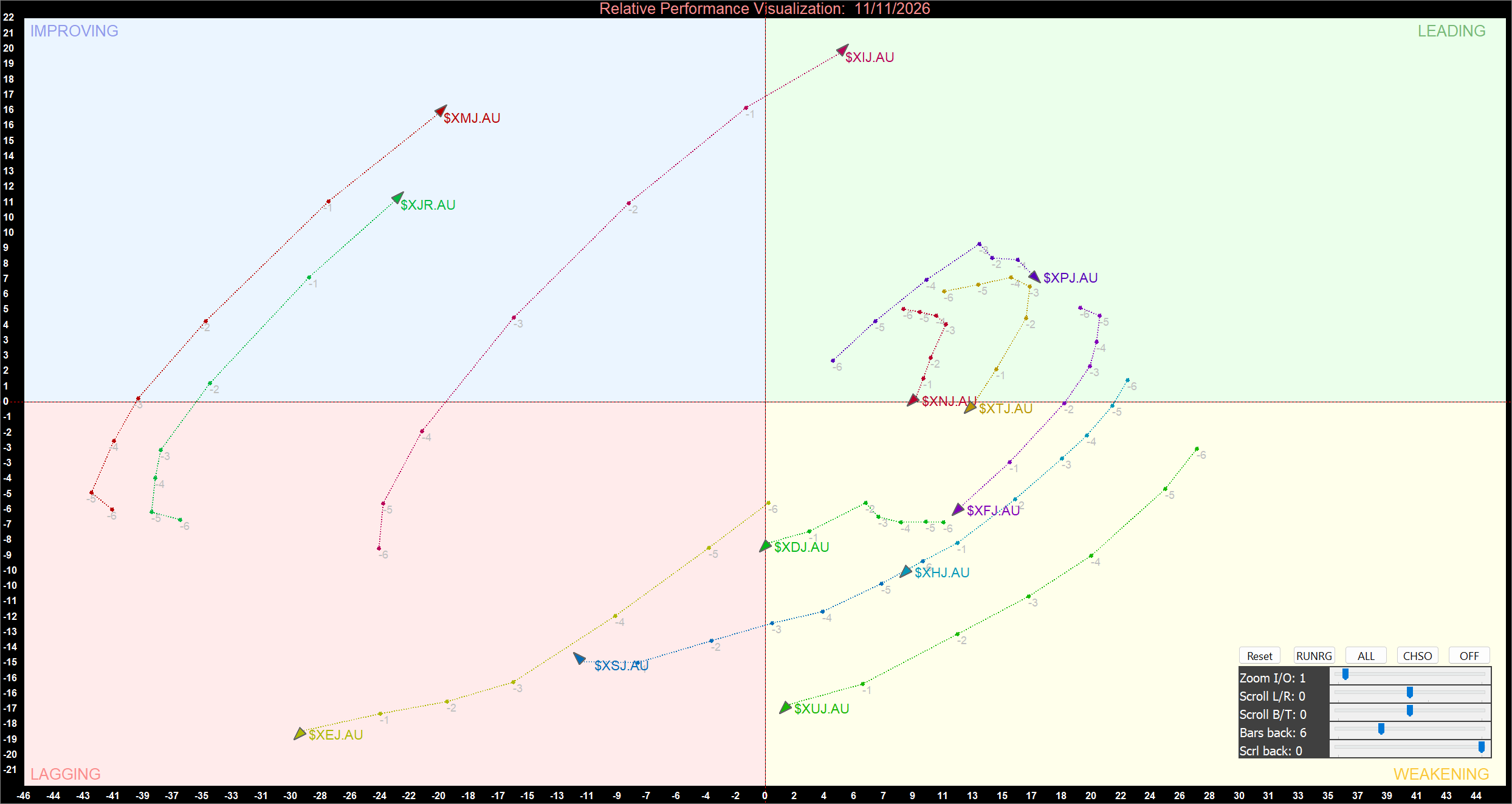
ASX Sector Relative Momentum Chart (at the closing price of 11/11/2026). Powered by AmiBroker.
Information Technology Leads as Property and Industrials Retain Leading Positions
Three of the twelve sector indices remain positioned in the Leading quadrant. Information Technology (XIJ), Property (XPJ) and Industrials (XNJ) all have their latest endpoints above the horizontal axis and to the right of the vertical axis. This configuration indicates positive relative strength and positive momentum against the benchmark. However, their latest directional trajectories reveal different momentum characteristics, with Information Technology demonstrating substantially stronger momentum than the other two sectors.
Information Technology is the strongest-positioned sector across the entire chart, with its latest endpoint located near the upper-right boundary of the Improving and Leading regions. Its sharply upward trajectory over the six-period look-back indicates a significant acceleration in momentum. The sector has moved considerably higher from its previous positions, suggesting that positive momentum continues to strengthen. Property also remains firmly within the Leading quadrant, although its latest trail displays a downward directional movement. This suggests that momentum has moderated despite maintaining positive relative strength. Industrials occupies a comparatively lower position, close to the horizontal reference line, indicating relatively subdued positive momentum.
The distinction between quadrant positioning and directional movement remains important. Property and Industrials have not yet crossed below the horizontal axis and therefore retain their Leading classifications. However, a sustained decline in momentum could eventually move them into Weakening if their relative strength remains positive. Continued upward movement would be required to reinforce their momentum positions.
Four Sectors Remain in Weakening
Telecommunications (XTJ), Financials (XFJ), Health Care (XHJ) and Utilities (XUJ) occupy the Weakening quadrant. Their latest endpoints remain to the right of the vertical axis but below the horizontal axis, indicating positive relative strength alongside negative momentum. These sectors therefore retain a relative-strength advantage against the benchmark, but their momentum readings remain below the zero line.
The four sectors display different degrees of momentum weakness. Utilities is positioned considerably further below the horizontal axis, indicating a particularly weak momentum reading. Health Care also remains deeply within negative territory, while Financials occupies a comparatively higher position, suggesting less pronounced momentum weakness. Telecommunications is positioned close to the horizontal reference line, making its classification more sensitive to relatively small changes in momentum.
A sustained move above the horizontal axis, while remaining to the right of the vertical axis, would return any of these sectors to Leading. Conversely, a move to the left of the vertical axis while momentum remained negative would signal a rotation into Lagging. The next RRG readings will be important in determining whether momentum deterioration stabilises or develops into more pronounced weakness.
Materials and Resources Maintain Improving Positions
Materials (XMJ) and Resources (XJR) remain positioned in the Improving quadrant. Their latest endpoints are above the horizontal axis but remain to the left of the vertical axis, indicating positive momentum despite negative relative strength. This configuration suggests that their momentum has improved relative to the benchmark, although neither has yet established positive relative strength or entered Leading.
Materials is positioned considerably higher within the Improving quadrant, indicating a comparatively stronger momentum reading. Its latest trajectory shows a substantial upward movement over the six-period look-back, reflecting a pronounced recovery from previously weaker momentum conditions. Resources also maintains a positive momentum position, with its latest endpoint located above the horizontal axis. Its upward trajectory indicates continued improvement, although its momentum position remains below that of Materials.
The plotted trails illustrate the recovery in momentum across these sectors from previously weaker positions. A move to the right of the vertical axis while remaining above the horizontal axis would confirm a transition into Leading. Continued upward and rightward movement would provide stronger confirmation that improving momentum is translating into positive relative strength. However, a renewed decline below the horizontal axis would return either sector to Lagging.
Energy, Consumer Staples and Consumer Discretionary Remain in Lagging
Energy (XEJ), Consumer Staples (XSJ) and Consumer Discretionary (XDJ) continue to occupy the Lagging quadrant. Their latest endpoints remain to the left of the vertical axis and below the horizontal axis, indicating negative relative strength and negative momentum. Their positions confirm that they remain among the weaker groups in the current relative rotation configuration.
Energy is positioned substantially further left and lower than Consumer Staples, reflecting a more pronounced negative momentum and relative-strength configuration. Consumer Staples also remains deeply within negative territory, although its endpoint is closer to the central reference area. Consumer Discretionary is positioned close to the vertical boundary but remains below the horizontal axis, indicating that its momentum has yet to recover into positive territory.
A sustained move above the horizontal axis would provide the first indication of improving momentum and shift any of these sectors into Improving. A subsequent move to the right of the vertical axis would be required to establish positive relative strength and enter Leading. Until such movements occur, their current positioning suggests that momentum conditions remain unfavourable.
Bottom Line
The ASX sector momentum chart for 11 November 2026 shows three sectors in Leading: Information Technology, Property and Industrials. Information Technology maintains the strongest momentum position, while Property displays signs of moderation and Industrials remains close to the horizontal boundary. Telecommunications, Financials, Health Care and Utilities remain in Weakening, reflecting negative momentum despite positive relative strength. Materials and Resources occupy Improving, with both sectors demonstrating positive directional momentum. Energy, Consumer Staples and Consumer Discretionary continue to lag. Overall, the configuration highlights a significant momentum advantage for Information Technology, while Materials and Resources demonstrate improving conditions. Subsequent RRG readings will be important in determining whether these improving sectors can enter Leading and whether the existing Leadership group can sustain its positive momentum.


 Nov 12, 2026





 Please wait processing your request...