
 CA
 NZ
 UK
 US
 IND

 AU

 Share
 X (Formerly Twitter)
 Whatsapp
 Facebook
 LinkedIn
 Telegram
 Email This Article
 Copy Link
 Summarize with AI
 Chat GPT
 Perplexity

Key takeaways
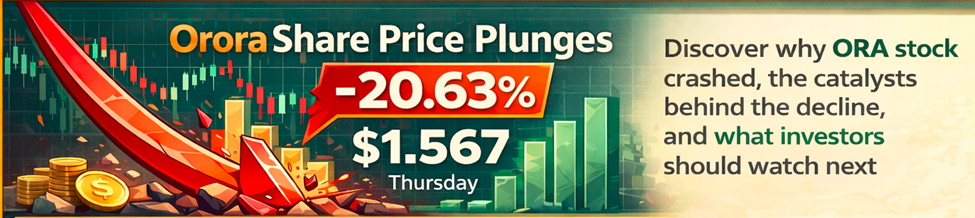
- Orora shares trading at $1.567, down 20.63% on the day.
- The scale of the move is consistent with a market-moving negative catalyst such as an earnings downgrade, guidance revision, or adverse news around the Saverglass acquisition.
- Saverglass, the French luxury glass bottle business acquired by Orora, has been a key source of investor frustration and is likely a central driver of today’s move.
- Packaging demand and premium spirits and wine volumes remain under pressure across several key markets.
- Key risks include further impairment charges, balance sheet stress, and continued underperformance in the Saverglass division.
The Orora share price (ASX:ORA) suffered a brutal session on Thursday, dropping $0.40, trading at $1.567, a daily decline of -20.63%. That makes Orora the single worst performer on the S&P/ASX 200 today and one of the worst single-day declines the packaging group has seen in years. For shareholder who have already watched the stock lag the broader market over the past 12 months, today’s move is likely to bring fresh frustration and difficult questions for the board.
In this article, we break down the likely catalysts behind the Orora share price collapse, what the company does, how the packaging and glass segments are performing, and the key risks and opportunities investors should watch next.
Company overview: Who is Orora?

Orora Limited is an Australian packaging company that designs, manufactures, and supplies a range of packaging products and services across Australia, New Zealand, North America, Europe, and international markets. The company’s core businesses include aluminium beverage cans, glass wine and spirits bottles, and a range of packaging solutions for beverages, food, and industrial customers.
Historically, Orora was a spin-off from Amcor and was well known for its Australasian beverage can and glass operations. In 2023, the company completed a transformative acquisition of Saverglass, a French producer of premium and luxury glass bottles primarily serving the spirits, cognac, and high-end wine markets. The deal was aimed at expanding Orora’s exposure to premium categories with higher growth and stronger margins than its legacy Australian and New Zealand operations.
Unfortunately, the timing of the Saverglass acquisition proved challenging. Global demand for premium spirits and luxury wine softened shortly after the deal closed, and Orora found itself absorbing a business whose end-market conditions had deteriorated rapidly. The company has since restructured, closed furnace capacity, and worked through inventory, but the financial performance of Saverglass has been a consistent source of negative surprise for shareholders.
For investors, Orora’s story is now about stabilising Saverglass, defending its legacy packaging earnings, and rebuilding market confidence after a string of disappointing results.
Why Orora shares went down today
Given the magnitude of today’s move, the decline in the Orora share price is almost certainly the result of a material catalyst. Here are the most likely drivers, with the caveat that some of these should be considered market speculation until fully confirmed by company disclosures.
1. Likely earnings guidance revision or trading update
A 20.63% single-day decline is consistent with an earnings downgrade or profit warning. Retailers and packaging companies often issue trading updates ahead of formal results when performance has materially changed. Market speculation would suggest that Orora may have revised earnings expectations lower, or that the company’s recent commentary has unsettled analysts and investors. Until an official disclosure is reviewed, the specific trigger should be labelled a likely driver rather than a confirmed event.
2. Continued weakness at Saverglass
Saverglass has been a central concern for investors since the deal closed. The luxury spirits and cognac markets have softened dramatically, particularly in China and parts of Europe, and that has weighed on glass bottle demand. If today’s move is tied to Saverglass underperformance, it would reinforce the market’s long-running concerns about the acquisition.
3. Impairment risk speculation
Whenever a major acquisition underperforms, investors start to discount the possibility of future goodwill impairments. Even the perception that an impairment may be coming can trigger selling, particularly among institutional holders who are sensitive to reported headline earnings.
4. Analyst downgrades and target price cuts
Sharp moves in a stock often trigger a cascade of broker downgrades and price target reductions. That in turn forces rules-based funds and passive rebalancing trades to sell, amplifying the initial decline. This dynamic is particularly relevant for mid-cap stocks like Orora.
5. Loss of confidence in management narrative
For the Orora share price to fall 15% in a single session, the broader investor narrative needs to break. When that happens, it is usually because the market feels that management’s most recent reassurance has been overtaken by events. Shareholders may now be demanding more concrete evidence that Saverglass can be stabilised.
News, announcements, and market catalysts to watch
The exact catalyst behind today’s move should be verified against Orora’s ASX announcements. If you are an investor, check the ASX company announcements platform for any trading update, profit warning, or market disclosure released around the time of the sell-off. In the absence of a confirmed announcement, several contextual themes remain relevant.
Saverglass trading conditions
Investors will be watching for any update on Saverglass volumes, utilisation rates, and price realisation. The business serves a luxury end-market that has been under pressure, and any commentary on when demand may stabilise is critical.
Australian and New Zealand beverage cans
Orora’s legacy beverage can business in Australia and New Zealand has historically been a reliable earnings contributor. Any signs of volume or margin pressure in this segment would compound the concerns around Saverglass.
North American beverage cans
Orora also has operations in North America through its OPS beverage can business. Volumes in this market can swing with customer contract terms and broader consumer beverage trends.
Balance sheet and debt
Orora took on debt to fund the Saverglass acquisition. Investors should monitor leverage ratios, covenant headroom, and any commentary on capital management. If earnings continue to underperform, debt metrics become a larger concern.
Capital management and dividends
If earnings are pressured, the sustainability of the Orora dividend may come under review. Investors sensitive to income should watch for any commentary on dividend policy.
Sector and macro factors affecting the move
The Orora share price move is not purely a company-specific story. Broader sector and macro factors also play a role.
Packaging industry demand
Demand for packaging is closely tied to consumer spending, beverage volumes, and food consumption. In weaker consumer environments, packaging volumes can soften, particularly for discretionary premium categories.
Luxury spirits and wine market
The global luxury spirits and wine market, a key end-customer for Saverglass, has been going through a cyclical downturn. Cognac producers have cut shipments to China, and premium wine consumption has softened in Europe and North America. This macro backdrop is central to Saverglass’s performance.
Energy and input costs
Glass manufacturing is energy intensive. Volatility in natural gas and electricity prices can materially affect production costs, particularly in Europe where Saverglass operates. Higher input costs during a period of weak demand compound earnings pressure.
Currency translation
Orora’s revenue is spread across multiple geographies and currencies. Movements in the euro, US dollar, and Australian dollar can affect reported earnings in AUD terms.
Interest rates and credit markets
Higher interest expenses squeeze free cash flow for leveraged companies. Even as the RBA has eased rates, European and US rates remain a factor in Orora’s cost of debt.
Investor appetite for leveraged turnarounds
When market sentiment shifts away from leveraged turnaround stories, stocks like Orora can sell off heavily even without fresh news. Today’s move is consistent with that kind of sentiment shift.
What investors are watching next
Following today’s sharp decline, investors are watching for several important updates.
Investors will be watching next for Orora’s next trading update or profit guidance, any commentary on Saverglass performance and potential impairment, updates on debt levels and covenant headroom, board and management responses to shareholder concerns, and broker price target revisions following today’s move.
Management response
A 20% single-day decline usually triggers a communications response from the company. Investors should watch for an investor briefing, CEO statement, or follow-up market disclosure that provides clarity on what has changed.
Analyst notes
Broker research following a sharp decline is often the most informative view on the stock. Analysts with direct access to management will interpret the trading environment and provide revised earnings estimates. These notes should be reviewed carefully.
Debt and balance sheet
If the share price decline is linked to earnings concerns, the next logical question is whether Orora’s balance sheet can absorb further pressure. Investors should review net debt, leverage ratios, and covenant terms.
Saverglass strategy
Shareholders will be looking for evidence that management has a credible path to stabilising Saverglass. This may include cost-cutting programs, portfolio reviews, partial divestitures, or restructuring announcements.
Shareholder activism potential
When a stock declines as sharply as Orora has today, it often attracts the attention of activist investors or private equity funds looking for undervalued assets. Activist campaigns can accelerate strategic changes, force board refreshment, or push for a sale of underperforming assets. While no such activity is confirmed, the possibility is part of why a stock can see a floor emerge after a major decline. Investors should monitor substantial shareholder notices for any changes that indicate new holders are accumulating positions.
Comparison with peers
Orora’s closest peer is Amcor, its former parent company, which remains one of the largest global packaging players. Other ASX-listed and global packaging peers include Pact Group and a range of international glass and metal packaging companies. Comparing Orora’s valuation and earnings trajectory with these peers helps investors understand the extent to which today’s decline reflects company-specific issues versus broader sector headwinds. The conclusion is often mixed, with some sector headwinds but also clear company-specific challenges that peers are not facing to the same extent.
Credit rating and funding
Orora’s credit rating is monitored by agencies that assess the company’s ability to service its debt. A deterioration in earnings could trigger a rating review, which would increase borrowing costs and make refinancing more difficult. Investors should watch for any commentary from rating agencies following today’s move, as rating changes often lag share price declines but still matter for the long-term cost of capital.
Risks to the current momentum
Today’s decline has been sharp, but several risks could extend the downside for Orora shareholders.
First, further profit warnings remain possible. If trading conditions continue to deteriorate, Orora may need to revise guidance again.
Second, impairment charges could still be announced. Large goodwill write-downs are a non-cash hit but affect reported earnings and can prompt additional selling from investors focused on headline metrics.
Third, balance sheet pressure could emerge if leverage ratios climb toward covenant thresholds. Any capital raising would further dilute existing shareholders.
Fourth, continued volatility in luxury end-markets could weigh on Saverglass for longer than expected. The cognac and premium wine markets have historically taken years to recover from downturns.
Fifth, management changes are sometimes the consequence of sustained underperformance, and any leadership transition can add further uncertainty to the stock.
Additional macro risks
Beyond company-specific concerns, Orora faces exposure to several macro risks that could amplify its challenges. A slowdown in global consumer spending would further weigh on premium beverage volumes. A recession in Europe would hit Saverglass’s core markets particularly hard. Higher natural gas prices, whether driven by geopolitics or supply disruptions, would increase glass manufacturing costs. Any of these could extend the period of difficulty before the business can return to growth.
Conclusion: What today’s Orora sell-off means
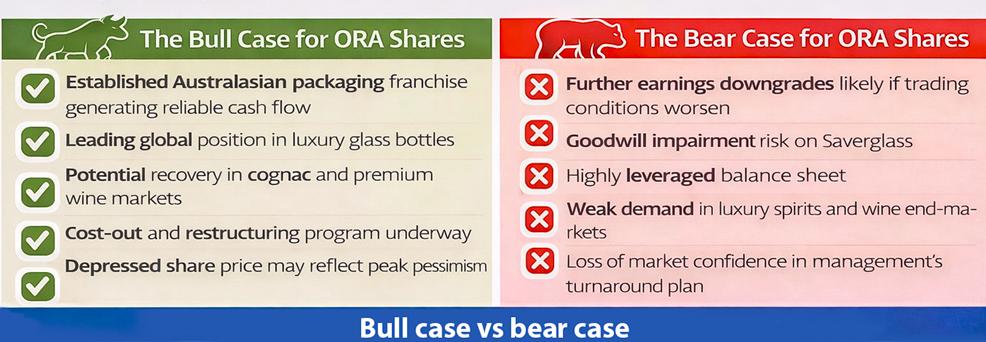
Today’s 20.63% decline in the Orora share price is a painful reminder of the risks involved in large, cross-border M&A. The Saverglass acquisition was intended to transform Orora into a higher-growth premium packaging business, but it has instead become a source of ongoing earnings disappointment.
For investors, the key question now is whether Orora can stabilise Saverglass and demonstrate a credible path back to earnings growth. Until there is clear evidence of that stabilisation, the stock is likely to trade defensively and remain vulnerable to further negative surprises.
At $1.567, the Orora share price reflects significant pessimism about the future. Contrarian investors may see value at these levels, but buying before the earnings trajectory stabilises is a high-risk bet. Conservative investors may prefer to wait for confirmation that the worst is behind the business before committing capital.


 Nov 12, 2026





 Please wait processing your request...