
 CA
 NZ
 UK
 US
 IND

 AU

 Share
 X (Formerly Twitter)
 Whatsapp
 Facebook
 LinkedIn
 Telegram
 Email This Article
 Copy Link
 Summarize with AI
 Chat GPT
 Perplexity

Date: Friday, 13 November 2026
Key Highlights
- Utilities Lead Sector Performance: Utilities (XUJ) advanced 1.28%, recording the strongest performance among the 12 supplied ASX sector indices.
- Telecommunications and Consumer Discretionary Edge Higher: Telecommunications (XTJ) gained 0.19%, while Consumer Discretionary (XDJ) increased 0.02%, indicating relatively subdued buying interest.
- Most Sectors Finish Lower: Nine of the 12 sector indices declined, highlighting widespread weakness across the Australian sharemarket.
- Financials, Healthcare and Energy Underperform: Financials (XFJ) declined 0.44%, Health Care (XHJ) fell 0.45%, while Energy (XEJ) lost 0.51%.
- Technology and Property Record Significant Losses: Information Technology (XIJ) declined 0.78%, while Property (XPJ) dropped 1.27%.
- Resources and Materials Remain Weakest: Resources (XJR) fell 1.45%, while Materials (XMJ) declined 1.61%, recording the two weakest performances.
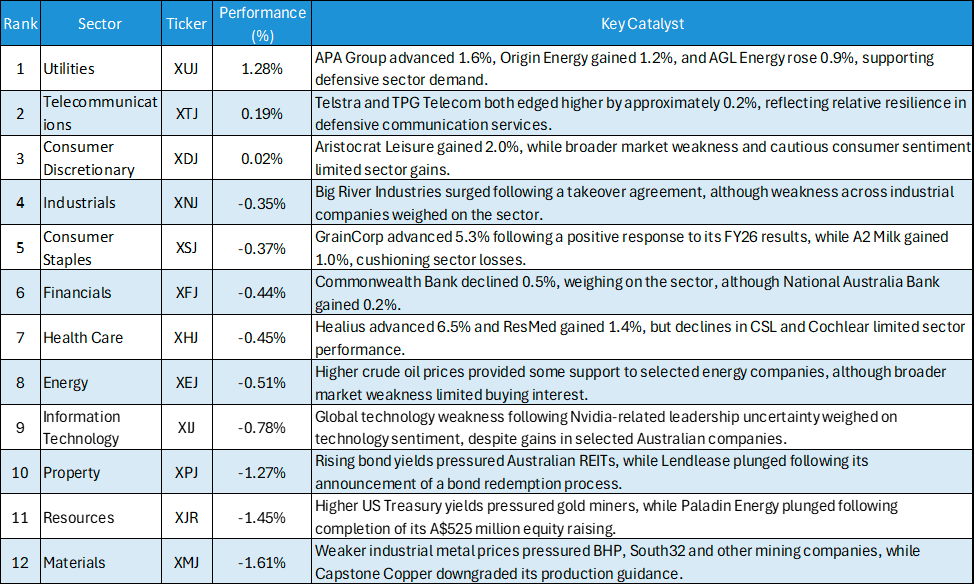
Australian equities recorded predominantly negative sector performance on Friday, 13 November 2026, with only three of the 12 supplied sector indices finishing higher. Utilities (XUJ) led the market with a 1.28% advance, while Telecommunications (XTJ) and Consumer Discretionary (XDJ) recorded marginal gains. However, selling pressure was evident across most other sectors, particularly Materials, Resources and Property. Information Technology also experienced notable weakness, reflecting a challenging trading environment for growth-oriented companies. The overall performance highlighted a defensive rotation towards Utilities, contrasting with continued weakness across commodity-related and interest-rate-sensitive sectors.
Daily ASX Sector Performance Summary
Utilities Lead as Defensive Sectors Outperform
Utilities (XUJ) was the strongest-performing sector, advancing 1.28% as investors favoured defensive exposures amid heightened global uncertainty. APA Group was a notable contributor, gaining 1.6%, while Origin Energy advanced 1.2%. AGL Energy also increased 0.9%. These gains reflected renewed interest in companies with relatively defensive Earnings characteristics, particularly as higher Global Bond yields and weaker Commodity prices created uncertainty across Equity markets.
Telecommunications (XTJ) advanced 0.19%, recording the second-best performance. Telstra and TPG Telecom both gained approximately 0.2%, demonstrating relative resilience despite the broader market downturn. The sector's defensive characteristics helped maintain modest buying interest, although the gains remained limited.
Consumer Discretionary (XDJ) edged higher by 0.02%, making it the third-best-performing sector. Aristocrat Leisure advanced 2.0%, providing some support to the index. However, the marginal sector gain suggested that investors remained cautious towards economically sensitive companies amid concerns about borrowing costs and consumer spending.
Consumer Staples (XSJ) declined 0.37%, outperforming the broader market despite finishing lower. GrainCorp was a notable contributor, surging 5.3% following a positive response to its FY26 financial results. The A2 Milk Company also advanced 1.0%. Nevertheless, weakness across other consumer-related companies prevented the sector from recording a positive performance.
Financials, Healthcare and Energy Record Moderate Losses
Financials (XFJ) declined 0.44%, reflecting weakness among major Australian banking stocks. Commonwealth Bank of Australia fell 0.5%, weighing on the sector due to its substantial index weighting. However, National Australia Bank advanced 0.2%, while ANZ finished broadly unchanged. The sector recovered some of its intraday losses towards the closing session, although overall investor sentiment remained cautious.
Health Care (XHJ) decreased 0.45%, despite positive performances from selected healthcare companies. Healius advanced 6.5%, while ResMed gained 1.4%. However, CSL declined 0.8% and Cochlear fell 1.1%, offsetting the gains from other healthcare companies. The weakness reflected some profit-taking following strong performances in selected healthcare stocks during previous sessions.
Energy (XEJ) lost 0.51%, despite relatively supportive developments in international oil markets. Crude Oil prices rebounded following geopolitical tensions involving Iran and disruptions affecting energy infrastructure and shipping routes. Nevertheless, the broader risk-off environment limited buying interest across the sector.
Industrials (XNJ) declined 0.35%, reflecting relatively subdued investor sentiment. Big River Industries was a notable exception, surging after announcing an agreement to be acquired by CTL Australia for A$1.62 per share in cash. However, weakness across other industrial companies prevented the positive corporate development from translating into broader sector gains.
Technology, Property and Mining-Related Sectors Face Selling Pressure
Information Technology (XIJ) declined 0.78%, reflecting continued uncertainty surrounding international technology markets. Global sentiment deteriorated following reports concerning Nvidia chief executive Jensen Huang, while rising US Treasury yields further pressured growth-oriented investments. Although selected Australian technology companies demonstrated resilience, broader market weakness contributed to the sector's negative performance.
Property (XPJ) fell 1.27%, becoming the second-weakest sector. Australian real estate Investment trusts remained particularly sensitive to rising bond yields, which reduced the relative attractiveness of their income distributions. Lendlease was a significant underperformer, plunging 8.4% after announcing the commencement of a process to redeem approximately A$1.22 billion of outstanding bonds. Goodman Group also declined 2.0%, while GPT Group fell 2.3%.
Resources (XJR) declined 1.45%, reflecting substantial weakness across gold, uranium and other mining-related companies. Higher US Treasury yields increased the Opportunity cost of holding non-income-producing precious metals, contributing to selling pressure across gold producers. Paladin Energy was particularly weak, plunging 17.6% following completion of its A$525 million equity raising. Genesis Minerals and Evolution Mining also recorded notable declines.
Materials (XMJ) was the weakest-performing sector, falling 1.61%. Weakness in industrial metals, particularly aluminium, tin, zinc and copper, pressured major mining companies. BHP Group declined 1.3%, while South32 fell 2.0%. Capstone Copper also experienced significant selling pressure after lowering the bottom end of its 2026 copper production guidance, citing maintenance delays and industrial action in Chile. These developments reinforced investor caution towards commodity-related exposures.
Bottom Line
Utilities (XUJ) led ASX sector performance on 13 November 2026, advancing 1.28%, followed by Telecommunications (XTJ) and Consumer Discretionary (XDJ), which recorded marginal gains. However, nine of the 12 supplied sector indices finished lower, highlighting widespread selling pressure across the Australian sharemarket. Financials, Healthcare and Energy recorded moderate declines, while Information Technology and Property experienced more substantial weakness. Resources and Materials were the weakest-performing sectors, falling 1.45% and 1.61%, respectively, amid higher bond yields, weaker industrial metal prices and continued selling across mining stocks. Overall, the session reflected a clear preference for defensive investments, with Utilities and Telecommunications outperforming while investors reduced exposure to commodity-related, property and growth-oriented companies.


 Nov 16, 2026





 Please wait processing your request...