
 CA
 NZ
 UK
 US
 IND

 AU

 Share
 X (Formerly Twitter)
 Whatsapp
 Facebook
 LinkedIn
 Telegram
 Email This Article
 Copy Link
 Summarize with AI
 Chat GPT
 Perplexity

Key Highlights
- Utilities Lead the Market: Utilities (XUJ) advanced 1.52%, recording the only positive performance among the 12 supplied sector indices.
- Technology and Consumer Staples Show Relative Resilience: Information Technology (XIJ) declined 0.31%, while Consumer Staples (XSJ) fell 0.59%.
- Broad-Based Selling Pressure: Eleven of the 12 sector indices finished lower, reflecting a defensive rotation and reduced appetite for risk-sensitive assets.
- Financials and Cyclical Sectors Weaken: Financials (XFJ) declined 1.34%, while Consumer Discretionary (XDJ) and Energy (XEJ) fell 1.78% and 1.86%, respectively.
- Mining-Related Sectors Underperform: Resources (XJR) dropped 3.59%, while Materials (XMJ) fell 3.86%, recording the two weakest performances.
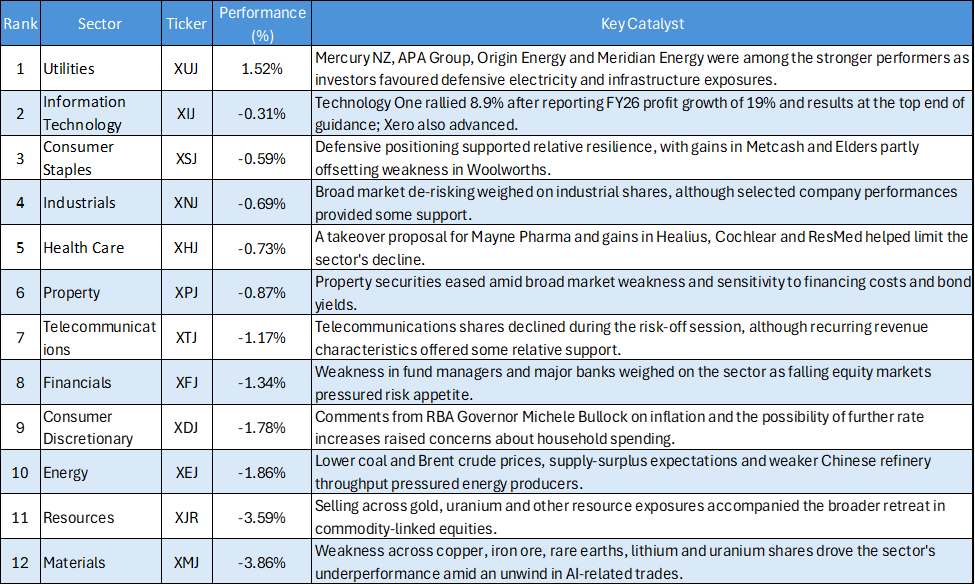
Australian equities recorded predominantly negative sector performance on Tuesday, 17 November 2026, with 11 of the 12 supplied sector indices finishing lower. Utilities (XUJ) was the only sector to advance, gaining 1.52%, while Information Technology (XIJ) and Consumer Staples (XSJ) recorded comparatively modest declines of 0.31% and 0.59%, respectively. Selling pressure was more pronounced across cyclical and commodity-related sectors, particularly Materials and Resources, which recorded the weakest performances. The divergence highlighted a defensive rotation towards utilities and away from risk-sensitive market segments.
Daily ASX Sector Performance Summary
Utilities Lead as Investors Favour Defensive Exposures
Utilities (XUJ) was the strongest-performing sector, advancing 1.52% and standing apart from the broader market decline. Buying interest in electricity generators and infrastructure businesses reflected Demand for relatively predictable Earnings and recurring cash flows. Mercury NZ, APA Group, Origin Energy and Meridian Energy were among the stronger performers. The sector's defensive characteristics can become more attractive when investors reduce exposure to cyclical businesses, although utilities remain sensitive to financing costs, interest rates and changes in energy-market conditions.
Information Technology (XIJ) recorded the second-best performance, declining only 0.31%. Technology One was a notable contributor, rallying after reporting FY26 profit growth of 19% and delivering results at the top end of guidance. Xero also advanced, helping offset weakness elsewhere in the sector. Consumer Staples (XSJ) fell 0.59%, with gains in Metcash and Elders partly offsetting a decline in Woolworths. The relatively modest losses across technology and consumer staples indicated that investors continued to favour selected companies with established earnings or defensive Business characteristics.
Healthcare, Property and Industrials Record Moderate Declines
Health Care (XHJ) declined 0.73%, with a Takeover proposal for Mayne Pharma providing a company-specific catalyst. Gains in Healius, Cochlear and ResMed also helped moderate the sector's decline. Property (XPJ) fell 0.87%, reflecting the broad reduction in risk appetite. Real estate securities remain sensitive to bond yields, funding costs and expectations for economic growth, which can influence valuations and distribution expectations. Industrials (XNJ) decreased 0.69%, as weakness across the wider market outweighed selective company-level support. Telecommunications (XTJ) declined 1.17%, with its Recurring Revenue profile offering some relative resilience but not insulating the sector from the broader sell-off.
Financials, Consumer Discretionary and Energy Face Selling Pressure
Financials (XFJ) decreased 1.34%, as weakness across asset managers and major banks weighed on the sector. Fund managers can be particularly sensitive to falling Equity markets because their fee income is often linked to funds under management. Consumer Discretionary (XDJ) fell 1.78%, with concerns about household budgets and the outlook for interest rates weighing on investor sentiment. Comments from Reserve Bank Governor Michele Bullock reinforced the central bank's focus on controlling Inflation and the possibility that Monetary Policy may need to remain restrictive. Energy (XEJ) declined 1.86%, reflecting softer coal and Crude Oil prices, expectations of a global oil Supply surplus and weaker Chinese refinery throughput. These factors reduced buying interest across oil, gas and coal exposures.
Resources and Materials Record the Sharpest Declines
Resources (XJR) declined 3.59%, while Materials (XMJ) was the weakest-performing sector, falling 3.86%. The losses reflected widespread selling across commodity-related shares as investors reduced exposure to cyclical Assets and reassessed the outlook for industrial materials. Iron ore and copper prices weakened, while rare earths, lithium and uranium companies also faced selling pressure. Major diversified miners, including BHP and Rio Tinto, declined, while other Mining companies experienced heavier losses.
The retreat in technology and AI-related investments also affected sentiment towards companies associated with the infrastructure supply chain, including selected copper and materials producers. This reinforced the pressure on the resources and materials sectors, where valuations can be sensitive to expectations for global industrial activity and Commodity demand. The sharp declines highlighted how quickly sentiment can change across mining-related equities when investors reassess growth expectations, commodity prices and portfolio risk.
Bottom Line
Utilities (XUJ) led ASX sector performance on 17 November 2026, advancing 1.52% as investors favoured defensive electricity and infrastructure exposures during a broadly weaker session. Information Technology and Consumer Staples recorded the mildest declines, while Healthcare, Property and Industrials experienced moderate losses. Financials, Consumer Discretionary and Energy faced more substantial selling pressure. Resources and Materials were the weakest sectors, declining 3.59% and 3.86%, respectively, amid weakness across iron ore, copper, rare earths, lithium and uranium shares. Overall, the session reflected a defensive rotation away from cyclical and commodity-related investments.


 Nov 18, 2026





 Please wait processing your request...