
 CA
 NZ
 UK
 US
 IND

 AU

 Share
 X (Formerly Twitter)
 Whatsapp
 Facebook
 LinkedIn
 Telegram
 Email This Article
 Copy Link
 Summarize with AI
 Chat GPT
 Perplexity

Key Highlights
- Information Technology Leads Sector Performance: Information Technology (XIJ) advanced 1.07%, recording the strongest performance among the 12 supplied ASX sector indices.
- Property and Consumer Staples Record Strong Gains: Property (XPJ) gained 0.85%, while Consumer Staples (XSJ) increased 0.69%, indicating improved buying interest across selected sectors.
- Most Sectors Finish Higher: Nine of the 12 sector indices advanced, highlighting a predominantly positive Trading session across the Australian sharemarket.
- Telecommunications and Industrials Advance: Telecommunications (XTJ) gained 0.50%, while Industrials (XNJ) rose 0.30%.
- Financials and Healthcare Record Marginal Changes: Financials (XFJ) increased 0.04%, while Health Care (XHJ) declined 0.09%.
- Resources and Materials Remain Weakest: Resources (XJR) fell 2.02%, while Materials (XMJ) declined 2.17%, recording the two weakest performances.
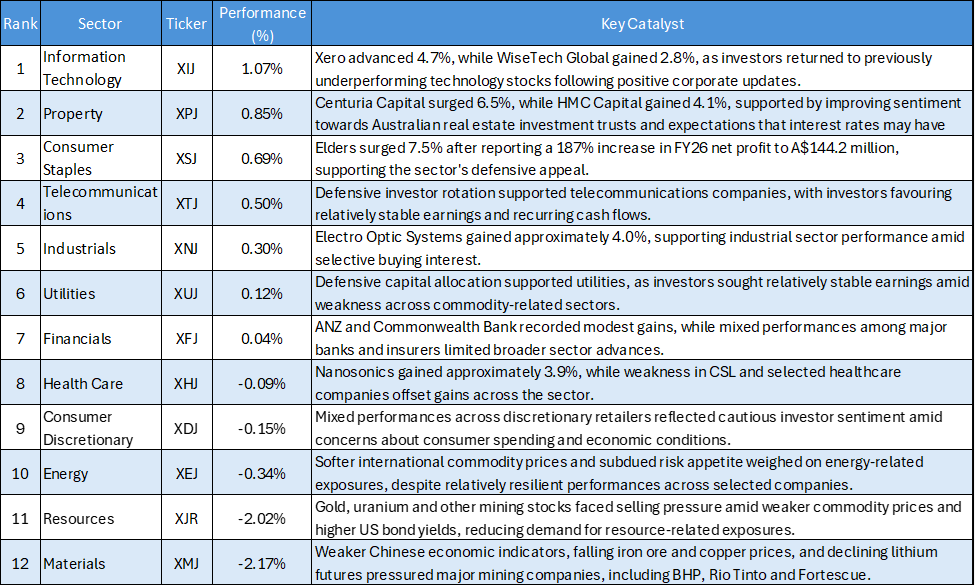
Australian equities recorded predominantly positive sector performance on Monday, 16 November 2026, with nine of the 12 supplied sector indices finishing higher. Information Technology (XIJ) led the market with a 1.07% advance, followed by Property (XPJ) and Consumer Staples (XSJ), which gained 0.85% and 0.69%, respectively. Telecommunications and Industrials also recorded positive performances, suggesting improving investor interest across several market segments. However, substantial selling pressure persisted across commodity-related sectors, particularly Materials and Resources. The divergence between technology and property gains and continued weakness in mining-related exposures highlighted an uneven recovery across the Australian sharemarket.
Daily ASX Sector Performance Summary
Information Technology and Property Lead Sector Gains
Information Technology (XIJ) was the strongest-performing sector, advancing 1.07% as investors returned to selected Australian technology companies following recent weakness in international technology markets. Xero was a notable contributor, gaining 4.7%, while WiseTech Global advanced 2.8%. Both companies had previously underperformed amid concerns about artificial intelligence disrupting subscription-based software Business models. However, improving investor interest in previously beaten-down technology stocks supported the sector's recovery. Xero also benefited from a positive response to its recent trading update, helping restore confidence among investors.
Property (XPJ) increased 0.85%, recording the second-best performance among the 12 supplied sector indices. Centuria Capital Group surged 6.5%, while HMC Capital advanced 4.1%. Vicinity Centres also gained 2.9%, with GPT Group and Stockland recording additional gains. Improving sentiment towards Australian Real Estate Investment Trusts contributed to the positive performance. Investors increasingly appeared to anticipate that domestic interest rates may have peaked, potentially improving financing conditions and supporting property valuations. Nevertheless, the sector remains sensitive to changes in bond yields and future Monetary Policy developments.
Consumer Staples (XSJ) advanced 0.69%, supported by strong corporate Earnings from selected companies. Elders was a significant contributor, surging 7.5% after reporting a 187% increase in full-year net profit to A$144.2 million. Revenue also increased 31% to approximately A$4 billion, reflecting contributions from its Delta Ag acquisition. The company's positive financial results reinforced investor confidence and supported the sector's performance. The defensive characteristics of consumer staples also attracted capital as investors reduced exposure to commodity-related investments.
Telecommunications (XTJ) gained 0.50%, reflecting continued interest in defensive companies with relatively predictable earnings and recurring cash flows. Industrials (XNJ) advanced 0.30%, supported by selective buying interest. Electro Optic Systems was a notable contributor, gaining approximately 4.0%. Utilities (XUJ) increased 0.12%, while Financials (XFJ) edged higher by 0.04%. Modest gains among ANZ and Commonwealth Bank supported financial sector performance, although mixed performances across major banking stocks limited the overall advance.
Healthcare, Consumer and Energy Sectors Record Marginal Declines
Health Care (XHJ) declined 0.09%, recording a relatively modest loss despite mixed performances among major healthcare companies. Nanosonics advanced approximately 3.9%, providing some support to the sector. However, weakness in CSL and selected healthcare stocks offset these gains. The relatively small decline suggested that selling pressure remained limited compared with the substantial weakness experienced across mining-related sectors.
Consumer Discretionary (XDJ) decreased 0.15%, reflecting subdued investor interest in economically sensitive companies. Mixed performances across discretionary retailers highlighted continued uncertainty surrounding household spending and the broader economic outlook. Energy (XEJ) fell 0.34%, as softer Commodity prices and cautious market sentiment limited buying interest. Despite the relatively modest decline, energy-related investments remained exposed to fluctuations in international commodity markets.
Resources and Materials Face Substantial Selling Pressure
Resources (XJR) declined 2.02%, becoming the second-weakest-performing sector. Selling pressure extended across gold, uranium and other mining-related companies as weaker commodity prices and higher US bond yields discouraged investment in resource stocks. Gold prices remained under pressure as rising bond yields increased the Opportunity cost of holding non-interest-bearing precious metals. Uranium and other Mining companies also experienced weakness, reflecting broader concerns about commodity Demand and investor appetite for cyclical exposures.
Materials (XMJ) was the weakest-performing sector, falling 2.17%. The decline reflected disappointing economic indicators from China, Australia's largest trading partner, which reinforced concerns about future demand for industrial commodities. China's October economic data revealed that fixed asset investment contracted 8.1% year-on-year, while industrial production increased by 4.8%, below market expectations of 5.3%. Retail sales also grew by just 0.4%, compared with forecasts of 0.8%, highlighting persistent weakness in domestic economic activity.
Commodity prices subsequently faced additional pressure. Iron ore futures declined 1.9% to approximately US$88.75 per tonne, amid concerns about rising Chinese stockpiles and weaker steel demand. BHP Group fell 2.8%, Rio Tinto declined 2.2%, while Fortescue lost 2.9%. Copper-related companies also experienced substantial selling pressure, with Capstone Copper falling 4.8% and Sandfire Resources declining 3.4%. Meanwhile, lithium producers weakened as Chinese lithium carbonate futures dropped 3.2%. These developments reinforced investor caution towards Australian mining companies and contributed to the substantial underperformance of the Materials sector.
Bottom Line
Information Technology (XIJ) led ASX sector performance on 16 November 2026, advancing 1.07%, followed by Property (XPJ) and Consumer Staples (XSJ), which gained 0.85% and 0.69%, respectively. Nine of the 12 supplied sector indices finished higher, indicating improving investor interest across several market segments. Telecommunications and Industrials also recorded positive performances, while Financials and Healthcare remained relatively stable. However, Resources and Materials experienced substantial declines, falling 2.02% and 2.17%, respectively, amid weaker Chinese economic indicators, declining commodity prices and continued selling pressure across mining stocks. Overall, the session reflected a selective rotation towards technology, property and defensive investments, contrasting with persistent weakness across commodity-related sectors.


 Nov 18, 2026





 Please wait processing your request...