
 CA
 NZ
 UK
 US
 IND

 AU

 Share
 X (Formerly Twitter)
 Whatsapp
 Facebook
 LinkedIn
 Telegram
 Email This Article
 Copy Link
 Summarize with AI
 Chat GPT
 Perplexity

Key Highlights
- Materials (XMJ) led the supplied sector ranking, advancing 3.71%, as investors returned to Mining and metals shares following a recovery in Commodity prices.
- Resources (XJR) gained 3.68%, while Energy (XEJ) rose 2.67%, highlighting broad strength across commodity-linked sectors.
- Information Technology (XIJ) advanced 0.49%, followed by Industrials (XNJ) at 0.27% and Financials (XFJ) at 0.05%, while gains outside resources were comparatively modest.
- Six of the 12 supplied sector indices advanced, while six declined. Consumer Staples (XSJ) was the weakest performer, falling 1.36%, followed by Consumer Discretionary (XDJ), down 0.71%.
- The session reflected a rotation towards cyclical and commodity-sensitive exposures, supported by a stronger offshore lead and renewed buying in metals and energy shares.
Australian equities rebounded on Thursday, 26 November 2026, as investors returned to mining and energy shares after a volatile period for commodity markets. Materials (XMJ) and Resources (XJR) recorded the strongest advances, while Energy (XEJ) also outperformed. The recovery followed improved sentiment across global markets and a rebound in several commodity prices, encouraging bargain-hunting in companies exposed to metals, minerals and energy. The move also suggested a shift away from the defensive positioning that had characterised the previous session. However, the gains were not universal, with consumer-facing and selected defensive sectors remaining under pressure.
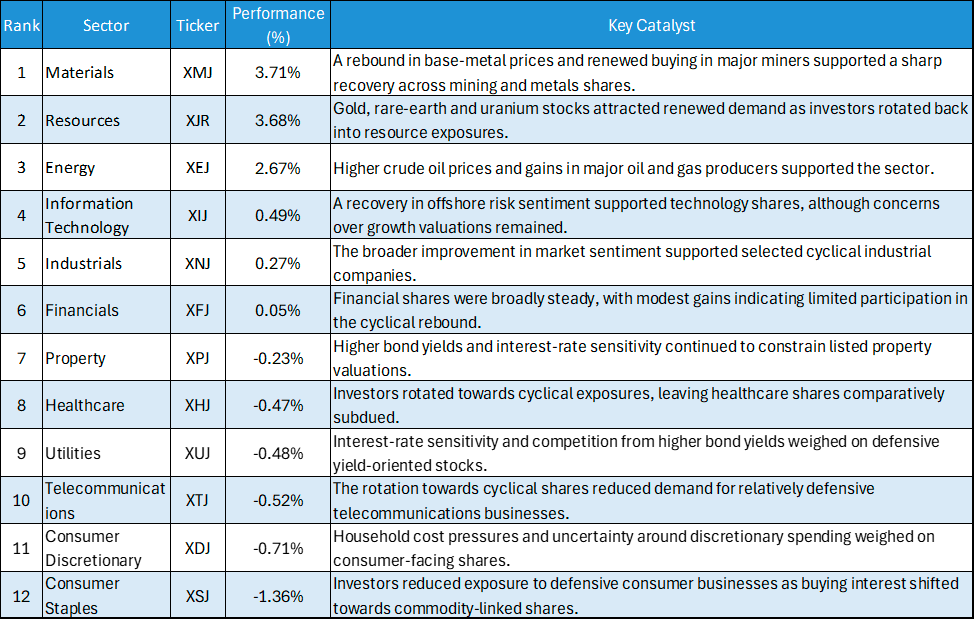
Daily ASX Sector Performance Summary
Materials and Resources Lead the Market
Materials (XMJ) was the strongest-performing sector, advancing 3.71%, closely followed by Resources (XJR), which gained 3.68%. The rebound reflected renewed Demand for mining and metals exposures after the previous session's weakness. Market reports highlighted a recovery in copper during Asian trading, with copper futures rebounding after a sharp decline, while iron ore futures also moved higher. Major diversified miners, including BHP, Rio Tinto and Fortescue, recorded solid gains, helping lift the broader materials complex. Copper-focused producers and rare-earth companies also attracted buying interest, suggesting that the recovery extended beyond the largest index constituents. Gold and uranium shares contributed to the strength across the wider resources group, as investors sought exposure to precious metals and critical minerals. Despite the strong daily performance, the rally should be assessed against recent Volatility in commodity markets. Lithium prices remained weak even as several lithium-related shares recovered, highlighting the influence of positioning and broader sector sentiment. The sustainability of the advance will depend on whether improvements in underlying commodity prices are maintained and whether demand expectations, particularly from China, continue to stabilise.
Energy Shares Extend the Recovery
Energy (XEJ) advanced 2.67%, making it the third-best performer. The sector benefited from stronger Crude Oil prices and renewed buying in major producers. Woodside Energy, Santos and other oil and gas companies were among the shares supported by the firmer energy market. Reports of further tanker-related tensions in the Middle East contributed to an increase in oil prices, reinforcing the sector's positive performance. Nevertheless, energy shares remain sensitive to geopolitical developments, global demand expectations and changes in Supply conditions. Any Reversal in crude prices could quickly affect investor appetite for the sector.
Technology and Other Cyclical Sectors Record Modest Gains
Information Technology (XIJ) rose 0.49%, while Industrials (XNJ) gained 0.27% and Financials (XFJ) edged higher by 0.05%. Technology shares recovered modestly as global market sentiment improved, although the sector's gain was considerably smaller than those recorded by Materials and Resources. Investors continued to assess elevated valuations and the outlook for artificial-intelligence-related investment, leaving technology performance vulnerable to changes in global risk appetite. Industrials benefited from the broader improvement in cyclical sentiment, while Financials remained largely unchanged, indicating that the session's advance was concentrated in commodity-linked businesses rather than a broad-based rally across all economically sensitive sectors.
Defensive and Consumer Sectors Underperform
Property (XPJ) declined 0.23%, Healthcare (XHJ) fell 0.47%, and Utilities (XUJ) slipped 0.48%. Telecommunications (XTJ) also weakened by 0.52%, suggesting that investors reduced exposure to defensive and yield-oriented businesses as resources and energy shares attracted capital. Higher bond yields can place pressure on property, utilities and other income-sensitive sectors by increasing financing costs and making competing fixed-income investments more attractive. Consumer Discretionary (XDJ) fell 0.71%, while Consumer Staples (XSJ) recorded the largest decline, down 1.36%. The weakness indicated that consumer-facing shares did not participate in the market's commodity-led recovery. Ongoing pressure on household budgets and uncertainty surrounding discretionary demand may continue to influence retail and consumer services businesses. The divergence between strong resource-sector gains and weakness in consumer shares highlights the selective nature of the session's market rotation.
Bottom Line
Materials (XMJ) and Resources (XJR) led the ASX sector ranking on 26 November 2026, gaining 3.71% and 3.68%, respectively, while Energy (XEJ) advanced 2.67%. Information Technology, Industrials and Financials recorded smaller gains, whereas six sectors finished lower. Consumer Staples was the weakest performer, followed by Consumer Discretionary and Telecommunications. Overall, the session reflected a clear rotation towards commodity-sensitive shares, supported by firmer metals and energy prices and improved global risk sentiment. Investors should monitor the sustainability of the commodity rebound, movements in bond yields, geopolitical developments and demand conditions in major export markets to determine whether the recovery can broaden beyond mining and energy stocks.


 Nov 27, 2026





 Please wait processing your request...