
 CA
 NZ
 UK
 US
 IND

 AU

 Share
 X (Formerly Twitter)
 Whatsapp
 Facebook
 LinkedIn
 Telegram
 Email This Article
 Copy Link
 Summarize with AI
 Chat GPT
 Perplexity

Key Highlights
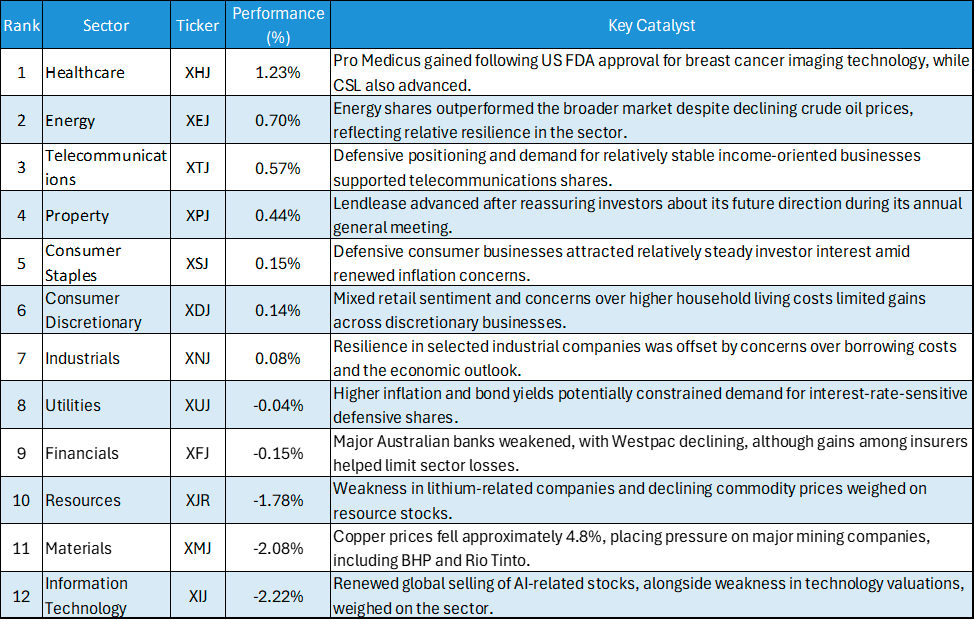
- Healthcare (XHJ) led the supplied sector ranking, advancing 1.23%, as investors favoured defensive businesses amid renewed concerns over Australian inflation.
- Energy (XEJ) gained 0.70%, followed by Telecommunications (XTJ), which advanced 0.57%, indicating continued Demand for selected defensive and income-oriented shares.
- Property (XPJ) and Consumer Staples (XSJ) recorded gains of 0.44% and 0.15%, respectively, while Consumer Discretionary (XDJ) edged higher by 0.14%.
- Resources (XJR) declined 1.78%, while Materials (XMJ) and Information Technology (XIJ) fell 2.08% and 2.22%, respectively, reflecting weakness across commodity-related and growth-oriented stocks.
- The sector performance highlighted a defensive rotation, with seven of the 12 supplied sectors advancing and technology and mining-related shares experiencing the greatest selling pressure.
Australian sector performance was mixed on Wednesday, 25 November 2026, as investors reassessed the economic outlook following an unexpected acceleration in inflation. Healthcare (XHJ) was the strongest performer, followed by Energy (XEJ) and Telecommunications (XTJ). However, Information Technology (XIJ), Materials (XMJ) and Resources (XJR) experienced substantial declines. Market reports highlighted that Australian Inflation had increased to 4.9%, exceeding expectations and renewing concerns about the Reserve Bank of Australia's interest-rate outlook. Meanwhile, renewed selling in global technology stocks and weakness in lithium-related shares contributed to pressure across growth-oriented and resource-related sectors.
Daily ASX Sector Performance Summary
Healthcare and Defensive Sectors Lead the Market
Healthcare (XHJ) was the strongest-performing sector, advancing 1.23% on 25 November 2026. The sector benefited from company-specific developments and renewed investor interest in defensive businesses amid heightened economic uncertainty. Pro Medicus gained 3.6% following US FDA approval for its breast cancer imaging technology, while heavyweight CSL advanced 1.8%. These gains helped healthcare outperform the broader market, demonstrating the importance of company-specific catalysts during periods of market volatility. Nevertheless, continued performance will depend on Earnings growth, regulatory developments and demand for healthcare services.
Energy (XEJ) gained 0.70%, making it the second-best performer. Its relative strength was notable because international Crude Oil prices moved lower during the session, with Brent Crude declining approximately 1.4%. Telecommunications (XTJ) also advanced 0.57%, reflecting comparatively resilient demand for defensive and income-oriented investments. However, these gains should be considered against the broader market environment, where rising inflation and elevated bond yields could influence valuations across defensive sectors.
Property and Consumer Shares Record Modest Gains
Property (XPJ) advanced 0.44%, supported by strength in selected listed property companies. Lendlease was among the market's strongest individual performers, rising approximately 4.7% after investors received reassurance about the company's future direction during its annual general meeting. However, the sector's relatively modest advance suggests that investors remained cautious about property valuations, financing expenses and the implications of higher interest rates.
Consumer Staples (XSJ) gained 0.15%, while Consumer Discretionary (XDJ) edged higher by 0.14%. The relatively small gains indicated that consumer-related shares struggled to attract substantial buying interest. Australia's latest inflation figures showed headline inflation reaching 4.9%, while non-discretionary prices increased 6.1% annually compared with 3.2% for discretionary items. These developments highlighted continued pressure on household budgets, potentially limiting discretionary spending and creating challenges for retailers. Industrials (XNJ) also recorded a marginal increase of 0.08%, indicating that cyclical businesses experienced relatively subdued trading activity.
Financials and Mining Shares Face Renewed Selling Pressure
Utilities (XUJ) slipped 0.04%, while Financials (XFJ) declined 0.15%. The financial sector experienced pressure from weakness among major Australian banks, although gains across selected insurance companies helped limit the overall decline. Westpac fell 0.8%, while Commonwealth Bank managed to advance 0.3%. The unexpected inflation increase also raised concerns about the Reserve Bank of Australia's future Monetary Policy decisions, potentially influencing lending conditions, funding expenses and investor expectations for financial institutions.
Resources (XJR) declined 1.78%, while Materials (XMJ) fell 2.08%, highlighting substantial weakness across commodity-related companies. The Materials sector was particularly affected by a sharp decline in copper prices, which dropped approximately 4.8% overnight. Major miners BHP and Rio Tinto both recorded losses of around 2%, while copper producer Capstone experienced a considerably larger decline. Meanwhile, lithium-related shares faced additional pressure following weakness in Chinese lithium carbonate futures. Develop Global announced that it was halting work on a lithium mine, contributing to a broader sell-off across the lithium industry. The weakness suggests that investors remained cautious about Commodity demand, particularly from China, while further price declines could continue weighing on mining valuations.
Technology Shares Record the Largest Decline
Information Technology (XIJ) was the weakest-performing sector, declining 2.22%. The deterioration reflected renewed selling pressure across global technology shares, particularly companies associated with artificial intelligence. Wall Street's technology rally lost momentum as investors reassessed valuations and the sustainability of AI-related investment. Anthropic also attracted market attention after its shares fell below their listing price, adding to concerns surrounding the broader technology Investment theme.
The weakness in international technology stocks contributed to negative sentiment towards Australian technology companies, with investors becoming more cautious about growth-oriented businesses. The sector's underperformance also highlighted its sensitivity to changes in interest-rate expectations, particularly when higher inflation increases uncertainty surrounding future borrowing costs. Continued pressure on technology valuations could therefore remain a significant risk to the sector's near-term performance.
Bottom Line
Healthcare (XHJ) led the ASX sector ranking on 25 November 2026, advancing 1.23%, followed by Energy (XEJ) and Telecommunications (XTJ), which gained 0.70% and 0.57%, respectively. Property (XPJ), Consumer Staples (XSJ) and Consumer Discretionary (XDJ) also recorded modest gains, while Utilities (XUJ) and Financials (XFJ) experienced relatively limited declines. Resources (XJR), Materials (XMJ) and Information Technology (XIJ) were the weakest performers, reflecting pressure from falling commodity prices, lithium-related weakness and renewed selling in global technology stocks. Overall, the session highlighted a defensive rotation within the Australian sharemarket, as investors favoured healthcare and selected defensive businesses while reducing exposure to technology and mining-related companies. Investors should monitor upcoming inflation developments, RBA policy expectations, international commodity prices and global technology sentiment to assess whether the divergence between defensive and growth-oriented sectors will persist.


 Nov 26, 2026





 Please wait processing your request...