
 CA
 NZ
 UK
 US
 IND

 AU

 Share
 X (Formerly Twitter)
 Whatsapp
 Facebook
 LinkedIn
 Telegram
 Email This Article
 Copy Link
 Summarize with AI
 Chat GPT
 Perplexity

Key Highlights
- Information Technology (XIJ) led the supplied sector ranking, advancing 2.97%, as a strong rebound in US technology stocks revived investor interest in growth-oriented companies.
- Consumer Discretionary (XDJ) gained 2.42%, supported by renewed buying in retail and consumer-related shares.
- Healthcare (XHJ) and Property (XPJ) advanced 2.39% and 2.36%, respectively, reflecting broad participation in the market recovery.
- Industrials (XNJ) and Financials (XFJ) also recorded gains exceeding 1.80%, indicating improved investor appetite across cyclical and economically sensitive sectors.
- Energy (XEJ) was the only sector to finish lower, declining 0.18%, while the broader market benefited from an improved global risk appetite following Wall Street's technology-led rebound.
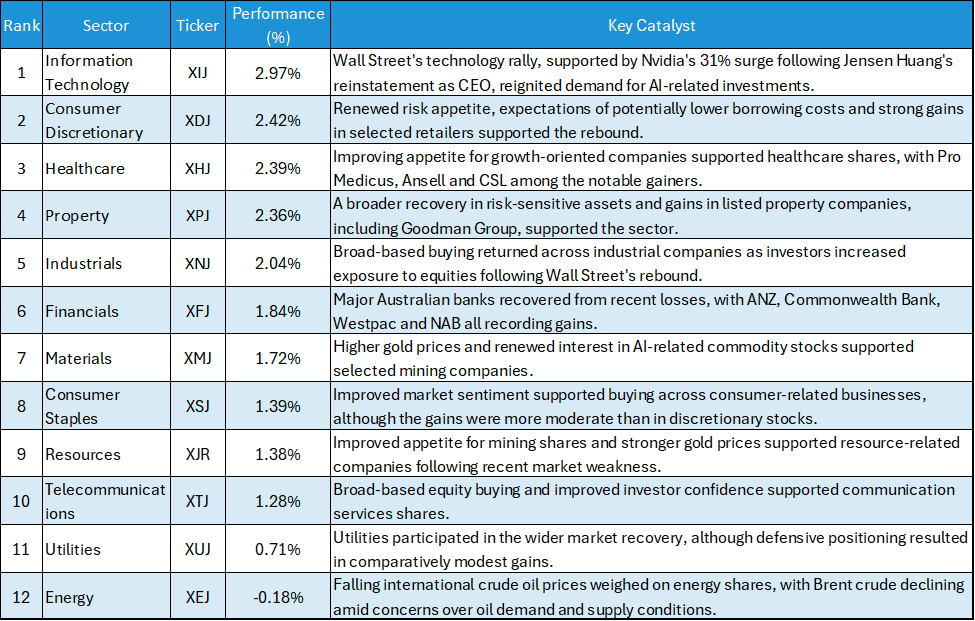
Australian sector performance was broadly positive on Tuesday, 24 November 2026, with 11 of the 12 supplied sector categories recording gains. Information Technology (XIJ) was the strongest performer, rising 2.97%, followed by Consumer Discretionary (XDJ), which advanced 2.42%. Healthcare (XHJ) and Property (XPJ) also delivered solid gains, while Industrials (XNJ) and Financials (XFJ) benefited from improving market sentiment. Market reports attributed the recovery to Wall Street's powerful technology rebound, which renewed Demand for artificial-intelligence-related investments and encouraged investors to return to risk-sensitive assets. Energy (XEJ), however, remained marginally weaker, highlighting that the recovery was not entirely uniform.
Daily ASX Sector Performance Summary
Technology and Growth Stocks Lead the Market Rebound
Information Technology (XIJ) was the strongest-performing sector, advancing 2.97% on 24 November 2026. The recovery was closely associated with Wall Street's powerful technology rally, which reignited investor interest in artificial intelligence and growth-oriented companies. Nvidia's substantial overnight advance following Jensen Huang's reinstatement as chief executive provided an important catalyst for the renewed enthusiasm surrounding the AI Investment theme. Australian technology stocks benefited from the improved sentiment, with WiseTech Global, Appen and Codan among the companies recording notable gains. The sector's Leadership suggests that investors were becoming more comfortable increasing exposure to higher-growth businesses after recent market volatility. However, the sustainability of the recovery will depend on continued Earnings growth, technology investment and evidence that AI-related valuations remain supported by underlying fundamentals.
Consumer Discretionary (XDJ) advanced 2.42%, recovering from its previous weakness. Selected retailers and consumer-related businesses attracted renewed buying interest as investors reassessed the domestic economic outlook and potential implications for interest rates. Lovisa Holdings, Kogan.com and Temple & Webster recorded particularly strong gains. The improvement also reflected a broader recovery in investor confidence following the previous session's selling pressure. Nevertheless, the sector remains sensitive to household spending, employment conditions and borrowing costs. Continued weakness in consumer confidence could limit the durability of the recovery.
Healthcare and Property Join the Advance
Healthcare (XHJ) gained 2.39%, benefiting from renewed demand for growth-oriented companies. Healthcare businesses with strong earnings prospects attracted buying interest as investors became more willing to assume additional market risk. Pro Medicus, Ansell and CSL were among the notable contributors to the sector's advance. The performance indicated that the recovery extended beyond technology and consumer companies, although individual company earnings and operational developments remain important determinants of share-price performance.
Property (XPJ) also delivered a strong result, rising 2.36%. The improvement reflected broader buying across rate-sensitive Assets and listed real estate securities. Goodman Group benefited from renewed interest in businesses associated with data centres and infrastructure supporting artificial-intelligence investment. However, property companies remain exposed to financing costs, interest-rate expectations and changes in commercial property demand. The sector's continued performance will therefore depend partly on the direction of bond yields and the cost of capital.
Financials, Industrials and Mining Shares Recover
Industrials (XNJ) advanced 2.04%, while Financials (XFJ) gained 1.84%. The improvement in Financials was supported by a recovery among Australia's major banks, including ANZ, Commonwealth Bank, Westpac and National Australia Bank. Their gains indicated that investors were prepared to rebuild exposure to established financial institutions following recent selling pressure. Meanwhile, Industrials benefited from the broader improvement in Equity market sentiment, with buying extending across economically sensitive businesses.
Materials (XMJ) rose 1.72%, supported by stronger gold prices and renewed interest in selected Commodity producers. Gold futures advanced significantly overnight, providing support for Australian gold miners. Selected copper and rare-earth companies also attracted buying interest as investors reconsidered the potential opportunities associated with artificial-intelligence infrastructure and critical minerals. Resources (XJR) gained a further 1.38%, reinforcing the positive performance across mining-related shares. Nevertheless, the improvement in commodity-related equities was not uniform, with some industrial metals remaining under pressure. A sustained recovery will require stronger commodity-price performance and evidence of improving demand.
Defensive Sectors Advance While Energy Lags
Consumer Staples (XSJ) gained 1.39%, while Telecommunications (XTJ) advanced 1.28%. Utilities (XUJ) recorded a smaller increase of 0.71%, suggesting that defensive sectors participated in the broader market recovery but attracted less buying interest than technology and cyclical companies. The relatively moderate gains indicate that investors were increasingly prepared to rotate towards growth-oriented and economically sensitive assets rather than concentrating exclusively on defensive businesses.
Energy (XEJ) was the only sector to finish in negative territory, declining 0.18%. The weakness was associated with falling international Crude Oil prices, which weighed on energy producers and refiners. Lower oil prices reflected concerns surrounding demand and broader commodity-market conditions. The divergence between Energy and the remaining sectors demonstrates that the market recovery was driven primarily by improved equity sentiment rather than a uniform improvement across commodity-related industries.
Bottom Line
Information Technology (XIJ) led the ASX sector ranking on 24 November 2026, advancing 2.97%, followed by Consumer Discretionary (XDJ) and Healthcare (XHJ), which gained 2.42% and 2.39%, respectively. Property (XPJ), Industrials (XNJ) and Financials (XFJ) also recorded solid gains, while Materials (XMJ) and Resources (XJR) benefited from renewed interest in selected mining companies. Energy (XEJ) was the only sector to decline, reflecting continued weakness in international oil prices. Overall, the session represented a broad-based recovery in investor confidence, supported by Wall Street's technology rally and renewed demand for growth-oriented assets. Investors should monitor the sustainability of the AI-related recovery, commodity-price movements, interest-rate expectations and upcoming economic indicators to assess whether the positive momentum can extend into subsequent trading sessions.


 Nov 26, 2026





 Please wait processing your request...