
 CA
 NZ
 UK
 US
 IND

 AU

 Share
 X (Formerly Twitter)
 Whatsapp
 Facebook
 LinkedIn
 Telegram
 Email This Article
 Copy Link
 Summarize with AI
 Chat GPT
 Perplexity

Key Highlights
- Materials (XMJ) led the supplied sector ranking, advancing 1.82%, while Resources (XJR) gained 1.42% as investors rotated back towards beaten-down Mining shares.
- Healthcare (XHJ) was the only other positive sector, rising 0.24%, indicating selective resilience rather than a broad market advance.
- Utilities (XUJ) recorded a marginal decline of 0.15%, making it the most resilient of the sectors that finished lower.
- Financials (XFJ) was the weakest sector, declining 1.20%, while Property (XPJ) and Consumer Discretionary (XDJ) also underperformed.
- Market commentary pointed to weak Australian Business activity data and ongoing risk aversion, although bargain-hunting supported selected miners.
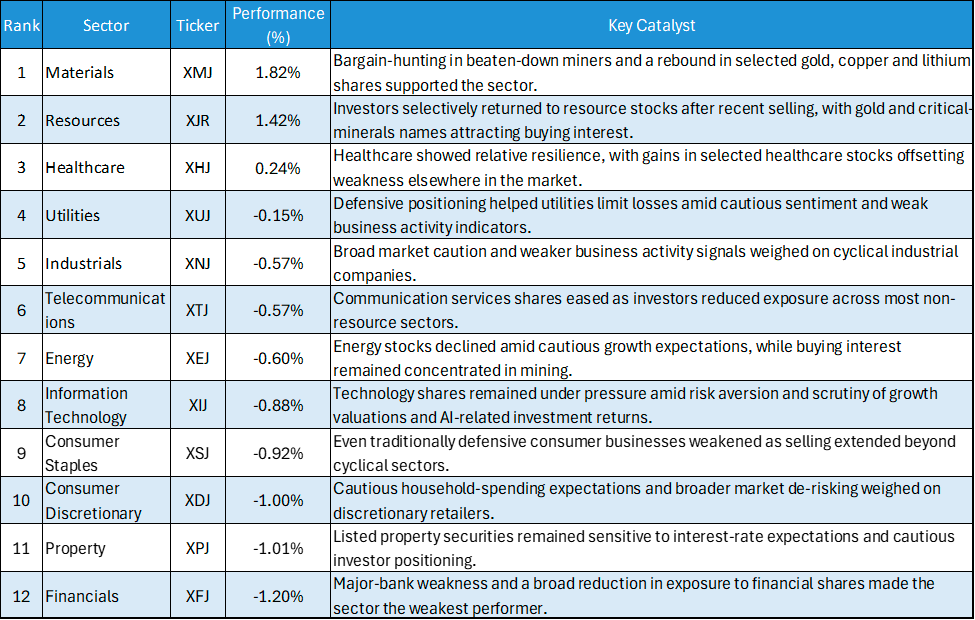
Australian sector performance was mixed on Monday, 23 November 2026, with Materials and Resources leading gains while most other sectors finished lower. The supplied data showed Materials (XMJ) rising 1.82% and Resources (XJR) advancing 1.42%, followed by a smaller 0.24% gain in Healthcare (XHJ). At the weaker end, Financials (XFJ) declined 1.20%, Property (XPJ) lost 1.01% and Consumer Discretionary (XDJ) fell 1.00%. Market reports described a cautious backdrop, with weak business activity data and broader risk aversion weighing on the market. However, bargain-hunting in previously sold-off mining shares supported a notable rotation towards resources.
Daily ASX Sector Performance Summary
Mining Sectors Lead a Selective Rebound
Materials and Resources were clear leaders in the supplied ranking. Materials advanced 1.82%, while Resources gained 1.42%, reflecting renewed interest in mining shares after a period of heavy selling. Market reports described bargain-hunting in gold, copper and lithium names as investors looked for opportunities among companies whose valuations had come under pressure. This rotation occurred despite a cautious macroeconomic backdrop and does not necessarily indicate a broad improvement in Commodity demand. Rather, it suggests that some investors were prepared to selectively rebuild exposure to resource companies after recent weakness. The distinction between a short-term rebound and a sustained recovery will depend on commodity prices, Demand expectations and follow-through buying.
Healthcare and Utilities Show Relative Resilience
Healthcare (XHJ) was the only other sector to record a positive result, although its gain was modest at 0.24%. Its performance suggests that investors continued to favour selected businesses with comparatively resilient demand, while company-specific developments remained important. Utilities (XUJ) declined only 0.15%, making it the strongest performer among the sectors in negative territory. The limited decline was consistent with the sector’s defensive characteristics, particularly during a session marked by caution over the domestic economic outlook. However, the narrow gains in healthcare and the small decline in utilities indicate selective resilience rather than a decisive rotation into defensive assets.
Financials, Property and Consumer Shares Under Pressure
Financials (XFJ) recorded the largest decline in the supplied ranking, falling 1.20%. Market commentary identified weakness among major banks as an important drag on the broader market, with investors continuing to reassess exposure to financial stocks. Property (XPJ) declined 1.01%, reflecting ongoing sensitivity to interest-rate expectations, financing costs and the outlook for listed real estate. Consumer Discretionary (XDJ) lost 1.00%, while Consumer Staples (XSJ) fell 0.92%. The weakness across both consumer categories suggests that selling was not confined to highly cyclical businesses. Cautious sentiment around household spending and broader portfolio de-risking contributed to pressure across the sector groups.
Broad Caution Extends to Technology, Energy and Industrials
Information Technology (XIJ) declined 0.88%, consistent with continued scrutiny of growth-oriented companies and the valuation implications of substantial artificial-intelligence investment. Energy (XEJ) eased 0.60%, while Industrials (XNJ) and Telecommunications (XTJ) each lost 0.57%. Market reports also highlighted weak Australian business activity data, reinforcing concerns about the near-term growth environment. The combination of softer activity indicators and selective buying in mining shares produced a divided market, rather than a uniform move towards either risk-taking or defensive positioning. The sector dispersion underlines the importance of monitoring company-specific Earnings drivers alongside broader macroeconomic conditions.
Bottom Line
Materials (XMJ) led the ASX sector ranking on 23 November 2026, rising 1.82%, followed by Resources (XJR), which gained 1.42%. Healthcare (XHJ) also advanced, while Utilities (XUJ) recorded the smallest decline among the remaining sectors. Financials (XFJ) was the weakest performer, followed by Property (XPJ) and Consumer Discretionary (XDJ). The session reflected selective bargain-hunting in mining shares against a cautious broader market backdrop, with weak business activity data and continued pressure on banks, property and consumer stocks. Investors should monitor commodity-price trends, the sustainability of resource-sector buying, interest-rate expectations and upcoming economic data to assess whether the rotation can persist.


 Nov 24, 2026





 Please wait processing your request...