
 CA
 NZ
 UK
 US
 IND

 AU

 Share
 X (Formerly Twitter)
 Whatsapp
 Facebook
 LinkedIn
 Telegram
 Email This Article
 Copy Link
 Summarize with AI
 Chat GPT
 Perplexity

Gold has done what gold does in periods of macro stress: it has reminded investors why a 5,000-year-old monetary metal still sits at the heart of every serious diversified portfolio. As we look across the ASX gold complex, the question for most retail investors is not whether to have exposure to gold — that ship has largely sailed — but which vehicles to own, in what proportion, and at what point in their development cycle.
This report examines five ASX-listed names that have been screening as "Buy" candidates on a number of broker and quantitative models in recent months. They span the full spectrum of the Australian precious metals and battery-metals investing universe:
- Resolute Mining (ASX:RSG) — a multi-mine African gold producer that has spent the past 18 months rebuilding its credibility after a high-profile dispute with the Government of Mali, and which now offers leveraged exposure to the gold price at a producer multiple that still embeds significant jurisdictional risk.
- Bellevue Gold (ASX:BGL) — a freshly-minted West Australian gold producer transitioning from build to ramp, sitting on one of the highest-grade undeveloped gold endowments to come into commercial production in Australia in the past decade.
- Catalyst Metals (ASX:CYL) — a small-but-growing WA and Tasmanian gold producer that has quietly assembled a portfolio of brownfields assets (Plutonic, Henty) at a fraction of replacement cost, and is now executing on a turnaround/optimisation thesis.
- Pantoro Gold (ASX:APNR) — operator of the historic Norseman Gold Project in Western Australia, a restart story with a long, deep, and genuinely world-class endowment that has been frustratingly difficult to monetise consistently.
- Wildcat Resources (SX:WC8) — included for completeness, a Pilbara-focused lithium explorer (not a gold name) sitting on the Tabba Tabba pegmatite system, with a large drill-out program but no production and no near-term cash flow.
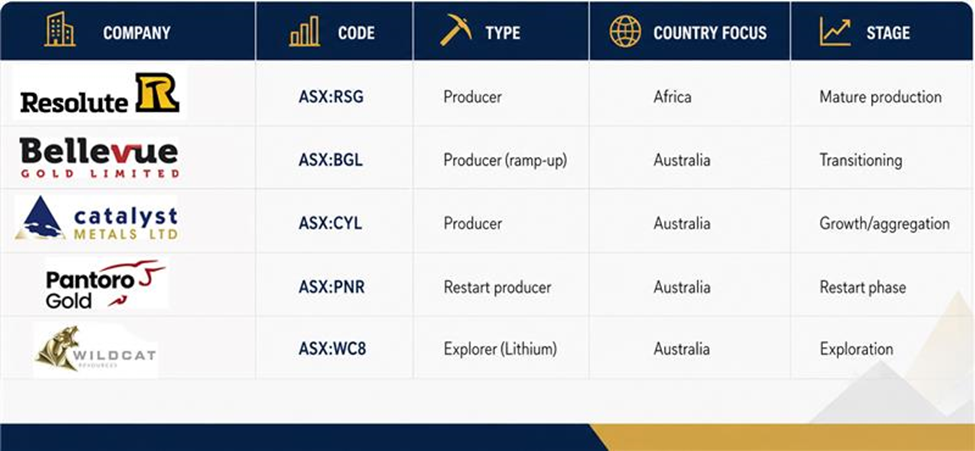
Image source: © 2026 Krish Capital Pty. Ltd.
Across these five names you have producers and explorers, African and Australian operators, restart stories and ramp-up stories, gold and lithium. There is no single "best" pick — there is a best pick for your goals, your time horizon, and your risk tolerance.
Company-by-Company Analysis
1. Resolute Mining Ltd (ASX:RSG) — The Africa Producer Rebuilding Trust
What the business does
Resolute Mining is one of the longest-running Australian-headquartered gold mining companies, with operating history dating back several decades. Despite its ASX listing, Resolute is an African gold producer in operational reality. Its two principal producing assets are:
- Syama Gold Mine (Mali) — a sulphide and oxide gold operation that has long been the company's flagship, with a complex processing flowsheet (sulphide roaster) and a long mine life.
- Mako Gold Mine (Senegal) — acquired through the 2019 Toro Gold transaction, Mako is a more conventional CIL operation with high grades and a shorter expected mine life than Syama.
Resolute also retains a portfolio of African exploration tenements and historical interests.
The Mali story — and why it matters more than anything else
You cannot analyse Resolute without analysing Mali. In late 2024, Resolute's then-CEO and two other senior executives were detained in Bamako during what were initially described as routine discussions with the Government of Mali over tax and royalty matters. The detention triggered a sharp share price collapse — the stock lost roughly half its value in a matter of days — and Resolute ultimately agreed to a settlement payment to the Malian government in order to secure the executives' release and continued operating rights at Syama.
The reverberations of this episode are still being felt in the stock. The market has, broadly, returned to giving Resolute credit for the underlying cash flows from Syama and Mako, but a meaningful "Mali discount" remains embedded in the multiple. For a bull, that discount is precisely the opportunity. For a bear, it is appropriate compensation for genuine, ongoing jurisdictional risk.
Bull case
If you believe the Mali political environment stabilises — and the West African gold mining sector as a whole has been navigating a clear trend of resource nationalism with mixed but ultimately survivable outcomes — Resolute looks materially undervalued on cash flow multiples relative to Australian-domiciled peers. The Syama sulphide expansion potential, the Mako mine life extension drilling, and the broader exploration portfolio all offer optionality that is essentially being given to investors for free at the current discount.
Bear case
Mali remains a high-risk jurisdiction. The settlement with the government in 2024 may not be the last such episode. Royalty regimes can be re-cut. Operating permits can be delayed. The recent trend across West Africa — Mali, Burkina Faso, Niger — has been towards greater state participation and tougher fiscal terms. If you do not want exposure to that risk, no valuation discount is large enough.
Production profile
Group production has historically run in the 300–400koz per year range, with Syama contributing the majority and Mako adding a meaningful high-margin top-up. AISC has been higher than Australian peers, reflecting the complexity of the Syama flowsheet and the operating environment.
Financial position
Resolute was forced to draw down working capital and pay a substantial settlement to the Malian government. The balance sheet has been progressively rebuilt through operating cash flow. Exact net cash/debt figures change quarter to quarter and should be checked against the latest quarterly activities report and half-year/annual financial statements before any investment decision.
Verdict
Resolute is the textbook "value with a hair on it" trade in the Australian-listed gold space. The discount is real, the cash flows are real, and the risks are real. This is a name for investors who genuinely understand frontier markets investing — not a name for someone allocating their first $5,000 of gold exposure.
2. Bellevue Gold Ltd (ASX:BGL) — The Premium WA Grade Story
What the business does
Bellevue Gold owns and operates the Bellevue Gold Project in the northern Goldfields of Western Australia, near Leinster. The project is a redevelopment of a historic high-grade gold mine that was last in production in the late 1990s. The company spent several years drilling out a substantial JORC resource and reserve, then financed and constructed a new processing plant and underground mining operation, achieving first gold pour in the early 2020s.
The grade story
The single most important fact about Bellevue is grade. The mineral resource has been quoted at average grades among the highest of any new Australian gold development of the past decade. High grade matters because it gives you operational margin of safety: when you mine a tonne of rock, you want to get as many ounces out of it as possible. A high-grade deposit has more tolerance for cost inflation, for AUD strength, for short-term gold price weakness, than a low-grade equivalent.
The transition from developer to producer
The most dangerous phase in the life cycle of a gold mining company is the transition from "developer" to "producer." This is when financing is tight, when the market expects perfection from the new operation, and when small operating issues — a ball mill liner failure, a ventilation issue underground, a pit wall instability — get amplified into share price selloffs of 20%+ in a single session.
Bellevue navigated the construction phase and achieved nameplate processing throughput targets, but the journey from first pour to steady-state, guidance-meeting production has been more uneven than the bull case originally envisaged. There have been guidance revisions. There has been hedging that, with hindsight, locked in lower realised prices than the spot market subsequently delivered. There has been balance sheet repair work.
Bull case
The bull case is straightforward: this is one of the best gold deposits in Australia, in a Tier-1 jurisdiction, owned by a company with a market capitalisation that is small relative to peers with comparable in-ground ounces. As the mine settles into steady-state operations and the legacy hedge book unwinds, the cash flow generation should be substantial, and the exploration upside on the broader tenement package is real.
Bear case
The bear case is that "Tier-1 jurisdiction" does not protect you from operational disappointment, that hedging mistakes destroy real shareholder value, and that the gap between geological resource and recoverable, profitable production has caught out many otherwise excellent deposits before. The market has been rewarding Bellevue on the optionality of the deposit — but optionality only converts to value when execution arrives.
Production profile
Steady-state production guidance has been targeted in the 150–200koz per year range, with potential for expansion as the mine plan matures. Investors should check the most recent quarterly report for actual achieved production rates, AISC, and any guidance updates.
Financial position
Bellevue undertook a substantial equity raising during the post-commissioning ramp-up period to repair the balance sheet and refinance debt. The current capital structure should be checked carefully — share count has expanded materially, and that dilution needs to be reflected in any per-share valuation work.
Verdict
Bellevue is the highest-quality individual asset in this list, but the equity has had a bumpier journey than the asset quality alone would predict. For a long-duration investor who is willing to wait through the ramp-up noise, the deposit is genuinely world-class. For a short-term trader, the volatility is real.
3. Catalyst Metals Ltd (ASX:CYL) — The Quiet Aggregator
What the business does
Catalyst Metals is a smaller, less-well-known Australian gold producer that has quietly assembled an interesting portfolio of brownfields assets in Western Australia and Tasmania. Its principal operating assets include:
- Plutonic Gold Operations (Western Australia) — a long-established underground gold mine acquired from Superior Gold in 2023. Plutonic has produced more than five million ounces of gold over its history and has substantial remaining resource and exploration upside. Catalyst paid what most observers regard as a reasonable price for the asset, particularly relative to its in-ground ounce count.
- Henty Gold Mine (Tasmania) — a smaller, narrow-vein high-grade underground operation in western Tasmania. Henty has been a steady, if not large, producer for many years.
In addition, Catalyst holds exploration ground in the Bendigo region of Victoria and elsewhere.
The aggregation thesis
Catalyst's strategy has been to acquire underloved, mature gold assets at low entry multiples, optimise them, and use the cash flows to fund organic growth and further bolt-on M&A. This is not a flashy strategy. It does not generate viral drill hit headlines. But over a multi-year horizon, it is exactly the strategy that has historically built the most durable mid-tier gold producers in Australia.
Bull case
If management can deliver operational improvement at Plutonic — better grade reconciliation, improved ventilation and mining rates, exploration success extending mine life — the cash flow uplift will be substantial relative to today's market capitalisation. The strategy is repeatable. The asset base is real. The price paid for the assets was low.
Bear case
Plutonic has been a difficult asset for prior owners. Underground gold mining at depth, in remote Western Australia, with legacy infrastructure, is operationally hard. There is no guarantee Catalyst will succeed where prior owners struggled. Henty is small and capital-intensive relative to its production rate. And the company is still scaling, which means it lacks the cost-of-capital advantages of the larger ASX gold producers.
Production profile
Group production has been growing, with the Plutonic acquisition materially expanding Catalyst's production base. Investors should look at the most recent quarterly reports for actual production runs, AISC, and forward guidance.
Financial position
Catalyst has historically operated with modest debt and has grown largely through equity-funded acquisitions and operating cash flow. Specific net cash/debt and hedge book disclosures should be checked in the most recent half-year and annual financial statements.
Verdict
Catalyst is the "compounder" candidate of this list — a name that, if everything goes right, could quietly become a meaningful mid-tier producer over the next five years without ever being a high-profile market darling. It is also the name where execution risk on operations is most concentrated, because the entire thesis rests on operational improvement at brownfields assets that prior operators struggled with.
4. Pantoro Gold Ltd (ASX:PNR) — The Norseman Restart
What the business does
Pantoro's flagship asset is the Norseman Gold Project in Western Australia, one of the most historically significant gold districts in the country. Norseman was, for decades, a major producing field, with cumulative historical production measured in the millions of ounces. Pantoro acquired the project area through a series of transactions and is in the process of restarting production from a combination of underground and open-pit sources, processed through a refurbished plant.
The other historic asset — the Halls Creek Project in the Kimberley region — has had a more chequered operational history, and the strategic focus of the company has shifted decisively towards Norseman.
The restart story
Restarts are a particular sub-genre of gold investing, and they have a particular pathology. The bull case writes itself: there's a known endowment, existing infrastructure, decades of geological data, and a defined path to first gold. The bear case is that every restart, without exception, encounters more challenges than initial guidance suggested. Plant performance lags. Grade reconciles down. Capital costs blow out. Working capital requirements expand. The list of restart projects that have hit guidance on time, on budget, and on production is shorter than the list that has not.
Norseman has been no exception. The journey from acquisition to steady-state production has involved more equity raises, more guidance revisions, and more capital than the original investment thesis assumed.
Bull case
If — and it is a meaningful if — Pantoro can stabilise Norseman at a sustainable production rate of 100koz+ per year with reasonable AISC, the asset will generate enough cash to self-fund both mine extension and exploration. The endowment of the broader Norseman field is enormous. There are decades of mine life potential, multiple deposits, and structural settings that historically delivered very high grades.
Bear case
The bear case is that restarts often disappoint, that the gap between historic production grade and what a modern operation can mine economically is real, and that the dilutive funding history at Pantoro means even successful execution from here may not deliver meaningful per-share returns relative to the entry price for new investors.
Production profile
Production has been ramping at Norseman, with quarterly updates showing improving but still volatile performance. Investors should pay close attention to the most recent quarterly activities report for production, AISC, growth capital spend, and forward guidance.
Financial position
Pantoro has raised equity multiple times to fund the Norseman restart and capital expansion. The current share count, debt position, and any hedging arrangements should be reviewed in detail before any investment decision.
Verdict
Pantoro is the highest-beta name on this list within the gold complex. The Norseman district is genuinely world-class. The execution path has been bumpier than ideal. For an investor who believes restart stories ultimately work and who can tolerate volatility, this is the highest-leverage way to play the macro thesis on this list. For an investor who values predictability, it is not.
5. Wildcat Resources Ltd (ASX:WC8) — The Lithium Outlier
A categorisation note before we start. As flagged at the top of this report, Wildcat Resources is included on the user's list as a "precious metals/gold" name but is, in operational reality, a lithium explorer focused on the Tabba Tabba project in the Pilbara region of Western Australia. It does not produce gold. It does not have a gold-focused exploration program of any meaningful size. Its share price drivers are completely different to those of the four preceding names. Readers should treat this section as a comparator rather than a peer analysis.
What the business does
Wildcat Resources holds the Tabba Tabba lithium project, located in the Pilbara region near a number of other established and emerging lithium operations. The project is a hard-rock spodumene-bearing pegmatite system, and Wildcat has been progressively drilling out the resource since acquiring the ground.
The lithium macro context
The lithium sector has, since its 2022 peak, experienced one of the most dramatic boom-bust cycles in the Australian small-cap history. Spot spodumene concentrate prices fell from peaks of well over US$8,000/tonne to levels that pushed even some marginal producers to suspend operations. Several high-profile lithium developers either deferred capital expenditure or were taken over at deep discounts to their peak market capitalisations.
The bull case for the lithium sector rests on the assumption that long-term electric vehicle and grid storage demand growth will eventually re-tighten the market. The bear case is that supply has expanded faster than demand, that demand growth has disappointed, and that the marginal cost curve for lithium is much lower than the bull case requires.
Bull case for Wildcat
The Tabba Tabba ground sits in a proven district with operating mines nearby. Drill results to date have outlined a meaningful spodumene resource. If the lithium price recovers materially, and if Wildcat can deliver a JORC-compliant resource of sufficient scale and grade, the asset becomes attractive either as an independent development or, more likely, as an M&A target for a larger producer in the area.
Bear case for Wildcat
Wildcat is an explorer. It does not produce. It does not generate cash. Its share price is driven by drill results, by the lithium price, and by capital raises. In a soft lithium market, even good drill results have struggled to move share prices meaningfully. The risk of further dilutive equity raises is real. And the addressable market for the asset depends entirely on a lithium price recovery that is, at best, uncertain in its timing.
Production profile
There is no production. Wildcat is an explorer, not a producer.
Financial position
Like all explorers, Wildcat's financial position consists primarily of cash on hand from the most recent equity raise, and a tenement portfolio. Cash burn rate, runway to the next required raise, and likely dilution at each raise are the key metrics for any explorer-stage investor.
Verdict
Wildcat is a different animal to the four gold names above. It belongs in a separate sleeve of any portfolio — a speculative battery metals exposure sleeve, not a precious metals sleeve. A retail investor mixing it into a "gold portfolio" is, knowingly or not, taking an entirely different macro view than they may realise. If the user's intention was to gain gold exposure, this name does not provide it. If the intention was a five-stock basket of "interesting ASX juniors," then it fits — but the bucket should be labelled accurately.
Conclusion
The five names covered in this report illustrate, between them, almost every kind of investment proposition the ASX precious metals (and adjacent battery metals) sector currently offers.
If you are a growth investor seeking durable per-share value creation in a Tier-1 jurisdiction with a high-quality asset, Bellevue Gold is the most defensible single-name pick — provided you have stomach for ramp-up volatility and a multi-year horizon.
If you are a compounder-style investor who values quiet execution over headlines, Catalyst Metals is an interesting candidate at a reasonable multiple, with the caveat that operational improvement at Plutonic is the entire thesis and prior operators have struggled there.
If you are a value investor who is genuinely comfortable with frontier markets, Resolute Mining offers a producer multiple that embeds a meaningful jurisdictional discount. If the discount narrows even modestly, the equity has substantial upside. If Mali deteriorates further, you will lose money.
If you are a speculative investor who likes restart stories and can tolerate dilution, Pantoro Gold offers leveraged exposure to one of the great Australian gold districts, with the understanding that restarts almost always take longer and cost more than initial guidance suggests.
If you are a battery metals speculator looking for high-beta lithium exposure in a Tier-1 jurisdiction, Wildcat Resources offers exactly that — but should not be confused with gold exposure. Position size accordingly.
Across the entire sector, the macro setup remains constructive but no longer cheap. Central bank buying, geopolitical risk premia, and the de-dollarisation narrative continue to provide structural support for the gold price. Producer margin expansion has been the dominant earnings driver and could continue. But the AUD gold price is, by any historical measure, elevated — and a meaningful correction would compress producer margins quickly.


 Nov 12, 2026





 Please wait processing your request...