Highlights
- Negative gearing allows Australian property investors to deduct investment losses from taxable income, potentially reducing overall tax liabilities.
- The strategy is widely used to offset costs but involves significant risks, including cash flow pressures and market volatility.
- Strict regulation and periodic policy review by the Australian Government shape investor outcomes.
Negative gearing occurs when the costs to own an investment property, such as mortgage interest, maintenance, and management fees, exceed the rental income received. Investors can claim these net losses against their total taxable income, which lowers the amount of tax payable to the Australian Taxation Office (ATO) each financial year. Australian tax law recognises negative gearing primarily for residential property, but it can apply to shares and other income-generating assets. The practice remains legal and is governed by clear rules set by the federal government, with ongoing debates regarding its broader impact on the housing market and tax base.
Potential Financial Benefits for Investors
The major benefit of negative gearing is the ability to offset property investment losses against other forms of taxable income, thus reducing the overall tax burden. This feature incentivises investors to persist with property investment, even when outflows exceed inflows in the short term. Additionally, negative gearing has the potential to yield long-term capital gains when property values rise over time, compensating for initial losses incurred. The government allows deductions for relevant property expenses, including loan interest, maintenance, insurance, and council rates, supporting investor cash flow management.
Significant Risks and Drawbacks
Negative gearing entails risks such as sustained cash flow pressures since investors must regularly cover shortfalls between expenses and rental income. Rising interest rates or unexpected maintenance costs can further strain budgets. Moreover, reliance on eventual property price appreciation exposes investors to market downturns or stagnation. Changes in federal policy or amendments to the tax code could alter the treatment of losses and impact investor decision-making, potentially reduce future benefits, or affect property values.
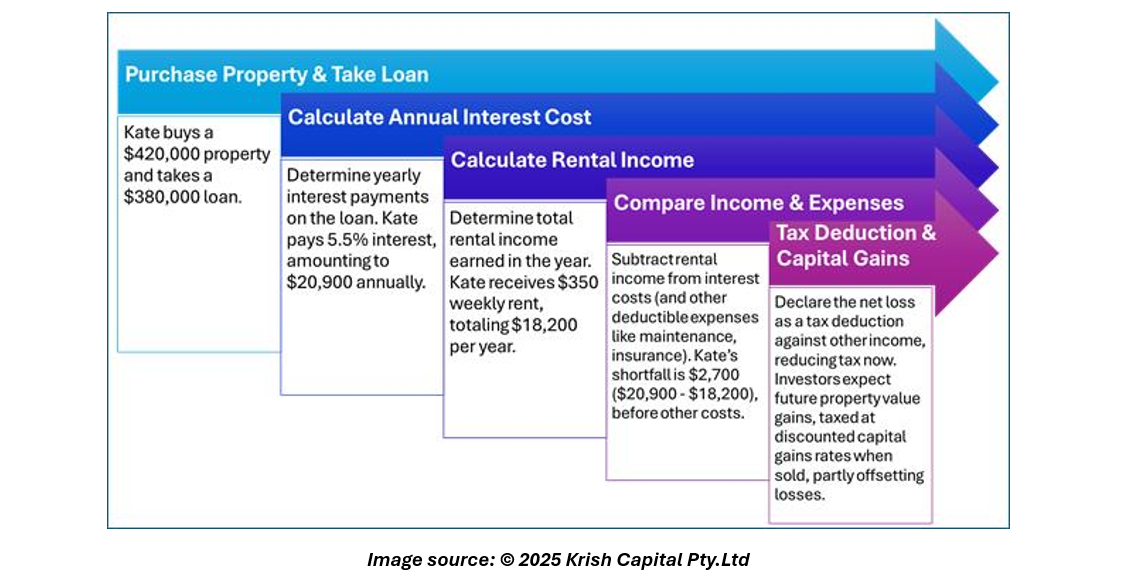
How Negative Gearing Works: A Simple Example
Let’s understand negative gearing with a simple example.
Regulatory Considerations and Policy Landscape
Negative gearing is subject to periodic review and regulation by the Australian Government, reflecting ongoing scrutiny over its economic and social consequences. Reforms proposed in the past have aimed to limit claims, change capital gains tax arrangements, or incentivise investment in new housing stock. Despite these debates, current rules continue to allow negative gearing on investment property, subject to compliance with tax guidelines and reporting obligations. Policy reviews by agencies such as Treasury and the Parliamentary Library influence the future direction of negative gearing, including potential curbs or expanded support for targeted investor groups.
Before employing a negative gearing strategy, investors should consider personal risk tolerance, capacity to fund short-term losses, and potential changes to property values or interest rates. Calculating likely cash flow impacts and consulting with a qualified professional is advised to align with regulatory requirements. Comprehensive record-keeping for all property-related expenses is essential to maximise eligible deductions and facilitate compliance with ATO scrutiny.
Disclaimer:
This article (“Article”) has been prepared by Kalkine Pty Limited (ABN 34 154 808 312) (Australian financial services licence number 425376) (“Kalkine”) and its related bodies corporate who are authorised to provide general financial product advice. Kalkine.com.au and its associated pages are published by Kalkine.
Any information/advice provided in this article is general in nature and does not take into account your objectives, financial situation or needs. You should therefore consider whether the information is appropriate for your objectives, financial situation and needs before acting upon it.
There may be a Product Disclosure Statement, Information Memorandum or other offer document (“Offer Document”) for the securities or other financial products referred to in Kalkine articles. You should obtain a copy of the Offer Document and consider it before making any decision about whether to acquire the security or financial product.
Kalkine strongly recommends that you seek advice from a financial adviser, stockbroker or other professional (including taxation and legal advice) before acting on any advice/information in this Article or on the Kalkine website. Not all investments are appropriate for all people.
The information in this Article and on Kalkine website has been prepared from a wide variety of sources, which Kalkine, to the best of its knowledge and belief, considers accurate. Kalkine has made every effort to ensure the reliability of the information contained in its articles (including this Article), newsletters and websites. All information represents our views at the date of publication and may change without notice.
The information in this Article does not constitute an offer to sell securities or other financial products or a solicitation of an offer to buy securities or other financial products.
Kalkine does not issue, sell or deal in any financial products.
This Article may contain information on past performance of particular investments. Please note past performance is neither an indicator nor a guarantee of future performance.
To the extent permitted by law, and excluding any dishonesty or gross negligence by Kalkine, Kalkine disclaims and excludes all liability for any direct, indirect, implied, punitive, special, incidental or other consequential loss or damage arising from the use of or reliance on this Article, the Kalkine website and any information published on the Kalkine website without any warranties or representations by Kalkine to you. To the extent the law prohibits or limits this exclusion, Kalkine limits its liability to the resupply of services.
Please also read our Terms & Conditions and Financial Services Guide for further information.
Employees and/or associates of Kalkine and its related entities may hold interests in the securities or other financial products covered in this Article or on the Kalkine website. Any such employees and associates are required to comply with certain safeguards, procedures and disclosures as required by law.
Some of the images/music that may be used in the Article are copyright to their respective owner(s). Kalkine does not claim ownership of any of the pictures displayed/music used in the Article unless stated otherwise. The images/music that may be used in the Article are taken from various sources on the internet, including paid subscriptions or are believed to be in public domain. We have used reasonable efforts to accredit the source wherever it was indicated or was found to be necessary.
Kalkine Media Pty Ltd, an affiliate of Kalkine Pty Ltd, may have received, or be entitled to receive, financial consideration in connection with providing information about certain entity(s) covered on its website.
Copyright 2026 Krish Capital Pty. Ltd. (ABN 61629651510). All Rights Reserved. No part of this Article, or its content, may be reproduced in any form without our prior consent.

 AU
AU CA
CA NZ
NZ UK
UK US
US IND
IND

 Share
Share
 X (Formerly Twitter)
 Whatsapp
 Facebook
 LinkedIn
 Telegram
 Email This Article
 Copy Link
 Summarize with AI
 Chat GPT
 Perplexity


 Mar 10, 2026




 Please wait processing your request...