Image Source: Shutterstock
Highlights
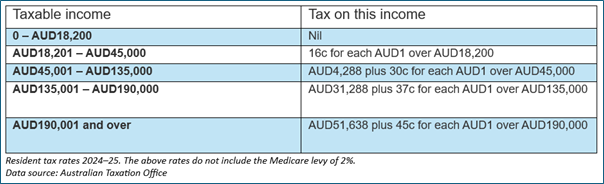
- Australia uses a progressive tax system where higher earners pay a higher percentage of tax.
- Everyone earning above the tax-free threshold, including residents, non-residents, and businesses, must pay tax.
- A Tax File Number (TFN) is essential to avoid higher tax rates and delays in refunds.
- Tax deductions and offsets like work expenses or donations can reduce how much tax you owe.
- Lodging your tax return on time and keeping records year-round helps avoid penalties and boosts refund potential.
Understanding the Australian tax system is essential for every resident, whether you're a student, employee, freelancer, or business owner. While taxes can seem complex, having a clear grasp of how the system works can help you make smarter financial decisions, avoid penalties, and even increase your refund at tax time.
In this article, we’ll break down the key components of Australia’s tax system in a simple and practical way.
What Is the Australian Tax System?
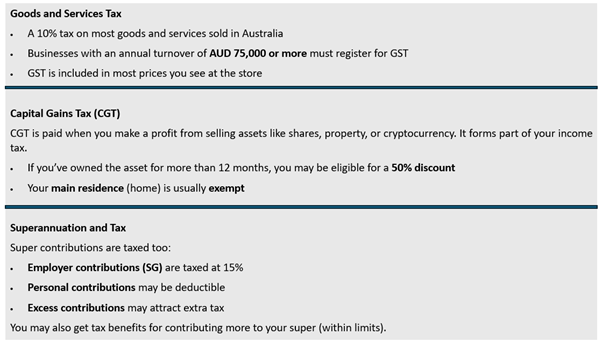
Australia operates under a progressive tax system, which means the more you earn, the higher the rate of tax you pay. The system is managed by the Australian Taxation Office (ATO) and covers income tax, Goods and Services Tax (GST), capital gains tax, superannuation contributions, and more.
Who Needs to Pay Tax?
You must pay tax in Australia if you are:
- An Australian resident for tax purposes and earns above the tax-free threshold
- A non-resident who earns income from Australian sources
- A business or sole trader generating income in Australia
Income Tax: How It Works: Income tax is the most common form of tax paid in Australia. This includes income from salaries and wages, interest and dividends, business income, rental properties and capital gains (e.g. from selling shares or real estate).
Tax File Number (TFN)
A Tax File Number is a unique number issued by the ATO. While not mandatory, it’s highly recommended, as not having a TFN may result in being taxed at the highest marginal rate (47%) and delays in receiving tax refunds. One can apply for a TFN through the ATO or at a participating post office.
Lodging Your Tax Return
Tax returns are lodged annually, with the Australian financial year running from 1 July to 30 June.
- Due Date: 31 October (if self-lodging)
- Tools to Use: ATO’s myTax system or a registered tax agent
- You may be eligible for a tax refund if you've overpaid tax during the year
Keep all income and expense records, including PAYG summaries, bank statements, and receipts for deductions.
Tax Deductions & Offsets
Tax deductions reduce your taxable income, which can increase your refund or reduce the amount you owe. Common deductions include work-related expenses (e.g. uniforms, tools), home office costs, education and training related to your current job, charitable donations.
Data source: Australian Taxation Office
Final Tips for Tax Success
- Keep financial records all year round, don’t wait until June!
- Use tools like ATO myGov, myDeductions app, or consult a tax agent
- Learn about deductions you may be entitled to, they can reduce your taxable income
- Understand your obligations if you're freelancing or running a side hustle
Taxes are part of life in Australia, but they don’t need to be a mystery. With a basic understanding of how the Australian tax system works, you can manage your finances better, avoid surprises at tax time, and possibly even increase your refund. Whether you're just starting your first job or navigating complex investments, staying informed is your best financial asset.
Disclaimer:
This article (“Article”) has been prepared by Kalkine Pty Limited (ABN 34 154 808 312) (Australian financial services licence number 425376) (“Kalkine”) and its related bodies corporate who are authorised to provide general financial product advice. Kalkine.com.au and its associated pages are published by Kalkine.
Any information/advice provided in this article is general in nature and does not take into account your objectives, financial situation or needs. You should therefore consider whether the information is appropriate for your objectives, financial situation and needs before acting upon it.
There may be a Product Disclosure Statement, Information Memorandum or other offer document (“Offer Document”) for the securities or other financial products referred to in Kalkine articles. You should obtain a copy of the Offer Document and consider it before making any decision about whether to acquire the security or financial product.
Kalkine strongly recommends that you seek advice from a financial adviser, stockbroker or other professional (including taxation and legal advice) before acting on any advice/information in this Article or on the Kalkine website. Not all investments are appropriate for all people.
The information in this Article and on Kalkine website has been prepared from a wide variety of sources, which Kalkine, to the best of its knowledge and belief, considers accurate. Kalkine has made every effort to ensure the reliability of the information contained in its articles (including this Article), newsletters and websites. All information represents our views at the date of publication and may change without notice.
The information in this Article does not constitute an offer to sell securities or other financial products or a solicitation of an offer to buy securities or other financial products.
Kalkine does not issue, sell or deal in any financial products.
This Article may contain information on past performance of particular investments. Please note past performance is neither an indicator nor a guarantee of future performance.
To the extent permitted by law, and excluding any dishonesty or gross negligence by Kalkine, Kalkine disclaims and excludes all liability for any direct, indirect, implied, punitive, special, incidental or other consequential loss or damage arising from the use of or reliance on this Article, the Kalkine website and any information published on the Kalkine website without any warranties or representations by Kalkine to you. To the extent the law prohibits or limits this exclusion, Kalkine limits its liability to the resupply of services.
Please also read our Terms & Conditions and Financial Services Guide for further information.
Employees and/or associates of Kalkine and its related entities may hold interests in the securities or other financial products covered in this Article or on the Kalkine website. Any such employees and associates are required to comply with certain safeguards, procedures and disclosures as required by law.
Some of the images/music that may be used in the Article are copyright to their respective owner(s). Kalkine does not claim ownership of any of the pictures displayed/music used in the Article unless stated otherwise. The images/music that may be used in the Article are taken from various sources on the internet, including paid subscriptions or are believed to be in public domain. We have used reasonable efforts to accredit the source wherever it was indicated or was found to be necessary.
Kalkine Media Pty Ltd, an affiliate of Kalkine Pty Ltd, may have received, or be entitled to receive, financial consideration in connection with providing information about certain entity(s) covered on its website.
Copyright 2026 Krish Capital Pty. Ltd. (ABN 61629651510). All Rights Reserved. No part of this Article, or its content, may be reproduced in any form without our prior consent.

 AU
AU CA
CA NZ
NZ UK
UK US
US IND
IND

 Share
Share
 X (Formerly Twitter)
 Whatsapp
 Facebook
 LinkedIn
 Telegram
 Email This Article
 Copy Link
 Summarize with AI
 Chat GPT
 Perplexity


 Mar 10, 2026




 Please wait processing your request...