
 AU
AU CA
CA NZ
NZ UK
UK US
US IND
IND

 Share
Share
 X (Formerly Twitter)
 Whatsapp
 Facebook
 LinkedIn
 Telegram
 Email This Article
 Copy Link
 Summarize with AI
 Chat GPT
 Perplexity
_10_23_2025_06_32_57_139000.png)
Highlights
- Residential properties offer easier management, steady rental income, and lower entry costs.
- Commercial real estate can provide higher returns, long-term leases, and faster appreciation.
- Investment strategies range from buy-and-hold and fix-and-flip to REITs and property development.
- Understanding risks, returns, and management needs helps build a balanced and diversified portfolio.
Real estate has long been viewed as a reliable way to build wealth. Whether your goal is consistent rental income, long-term property appreciation, or diversifying your investment portfolio, real estate can be an important tool for achieving financial objectives. However, one key question often arises before investing: Should you focus on residential or commercial properties? Each type offers distinct benefits, risks, and strategies, and knowing these differences is essential for making an informed investment choice.
Decoding Residential vs Commercial Real Estate
Residential real estate typically includes single-family houses, condominiums, townhouses, and multi-unit apartment buildings, all designed mainly for living purposes.
In contrast, commercial real estate encompasses office buildings, retail centers, warehouses, and industrial facilities, with the main purpose of generating income through business operations rather than providing housing.
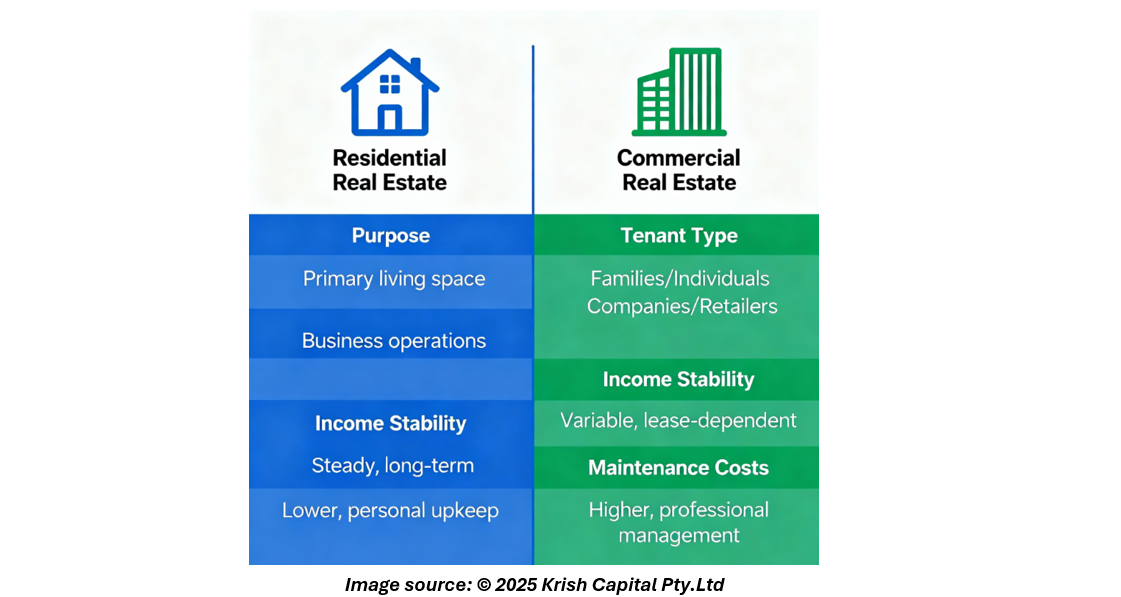
At first glance, residential properties may feel more familiar, while commercial properties can seem more complex. Let’s break down what each investment entails.
Navigating the Risks of Property Investing
Investing in residential property often comes with lower barriers to entry. Single-family homes and small apartments are usually easier to purchase and manage compared to large commercial buildings. However, residential properties are subject to tenant turnover, changes in local housing markets, and seasonal fluctuations.
Commercial real estate usually demands a higher initial investment and more complex management. Leases often span three to ten years, offering more consistent income than shorter residential leases, but these properties are also more vulnerable to economic fluctuations. A retail strip may lose tenants during a recession, or office spaces may remain vacant if businesses downsize or move online.
In short, residential investments are often lower risk but can be affected by frequent tenant turnover, whereas commercial investments may carry higher risk but offer potentially more stable cash flow over the long term.
Rental Income and Appreciation: What to Expect
Residential properties can generate consistent monthly income through rental payments. Additionally, property values may be appreciated over time, offering long-term wealth accumulation. Residential properties also tend to be easier to finance, and lenders often view them as lower risk, making mortgage approvals simpler.
Commercial properties often offer higher rental income and the potential for greater returns, especially if the property is in a prime location or leased to established businesses. Lease agreements usually shift some responsibilities, like property maintenance, to tenants, which can reduce costs for the owner. Furthermore, commercial properties often appreciate faster in growing markets, making them attractive for investors seeking larger gains.
Real Estate Tactics: Choosing the Right Strategy
Residential Strategies:
- Buy-and-Hold: Acquire a property, rent it to tenants, and retain it for long-term value growth.
- Fix-and-Flip: Purchase undervalued properties, renovate them, and sell at a profit.
- Short-Term Rentals: Use platforms like Airbnb to earn higher income from short-term stays, requiring active management.
Commercial Strategies:
- Long-Term Leasing: Invest in office, retail, or industrial properties and sign long-term leases with tenants.
- Property Development: Purchase land or underutilized commercial space, improve it, and lease or sell for profit.
- REITs and Syndications: For those who prefer not to manage properties directly, investing in commercial real estate funds or Real Estate Investment Trusts (REITs) offers exposure to large-scale commercial projects.
Handling and Upkeep: What Investors Should Know
Residential properties are generally easier to manage, particularly if you own one or two units. Many investors hire property managers for multi-unit buildings, but the scale is usually manageable.
Commercial properties often require professional management teams to handle leasing, compliance, maintenance, and tenant relations. While this adds complexity, it can also reduce day-to-day stress for investors willing to delegate.
Which Property Type Fits Your Goals?
The decision between residential and commercial real estate ultimately depends on your goals, resources, and risk tolerance:
- If you’re new to real estate investing or have limited capital, residential properties may be more accessible and easier to understand.
- If you’re seeking higher income potential and can handle higher upfront costs and management complexity, commercial properties may be suitable.
- Consider diversification for better results. Some investors mix both residential and commercial properties to balance income stability and growth potential.
Guiding Your Next Real Estate Move
Choosing between residential and commercial real estate ultimately comes down to your investment goals, risk tolerance, and hands-on capacity. By evaluating the distinct risks, potential returns, and management demands of each property type, you can make a well-informed choice that supports your financial goals. Many successful investors even combine both approaches, using residential holdings for steady cash flow and commercial assets for larger-scale returns. The key is clarity in your strategy and a thoughtful approach to building a diversified real estate portfolio that supports both short-term income and long-term wealth.


 Mar 04, 2026
_02_19_2026_11_50_21_592067.png)

_02_11_2026_07_58_30_526403.png)

 Please wait processing your request...