
 AU
AU CA
CA NZ
NZ UK
UK US
US IND
IND

 Share
Share
 X (Formerly Twitter)
 Whatsapp
 Facebook
 LinkedIn
 Telegram
 Email This Article
 Copy Link
 Summarize with AI
 Chat GPT
 Perplexity
_02_19_2026_11_50_21_592067.png)
Highlights
- HECS-HELP is indexed to inflation, not charged with traditional interest.
- Early investing benefits from long-term compounding.
- Higher indexation years change the repayment vs investing equation.
- Cash flow and borrowing goals play a key decision-making role.
- A blended strategy can balance flexibility and wealth creation.
For many Australians, a HECS‑HELP balance is the first major financial commitment of adulthood. At the same time, the early working years are also the most powerful for compounding investments. This creates a classic dilemma: should extra cash be used to clear student debt early, or directed into wealth-building assets? The answer is not universal—it depends on indexation rates, investment returns, income trajectory, and personal risk tolerance.
Unlike most global student loans, HECS-HELP does not charge interest. Instead, the balance is indexed annually to inflation, meaning its real value is maintained rather than increased in real terms.

Because of these features, HECS-HELP is often considered one of the least aggressive forms of debt in Australia.
The Case for Paying Off HECS Early
There are situations where clearing the balance sooner makes financial sense.
- High Indexation Environments
When inflation spikes, indexation can rise sharply. In such years, making voluntary repayments delivers a risk-free return equal to the indexation rate.
- Borrowing Power for a Home
Lenders assess HECS-HELP as a liability when calculating serviceability. Paying it down can:
- Increase borrowing capacity
- Improve loan approval chances
This is particularly relevant for first-home buyers.
- Psychological Freedom
For some, eliminating debt provides peace of mind and improves cash-flow confidence.
The Case for Investing First
From a pure wealth-building perspective, investing early often has the mathematical edge.
- The Power of Compounding
Money invested in your 20s and early 30s has decades to grow. Even modest, regular contributions can significantly outperform the indexation applied to HECS over time.
- Historically Higher Market Returns
Long-term returns from diversified growth assets—such as shares or superannuation—have typically exceeded inflation.
- Liquidity and Flexibility
Extra repayments into HECS cannot be accessed again, but investments:
- Can be sold if needed
- Can fund emergencies or opportunities
This flexibility has real financial value.
The Indexation vs Returns Comparison
At the heart of the decision is a simple comparison:
- If indexation is lower than expected investment returns → investing usually wins.
- If indexation is unusually high → early repayment becomes more attractive.
However, investment returns are not guaranteed, while the “return” from paying down HECS (avoiding indexation) is certain.
The Property Factor: A Game Changer for Many Australians
In Australia, the property market heavily influences this decision.
If your near-term goal is to buy a home, reducing your HECS balance may:
- Boost borrowing capacity
- Reduce debt-to-income ratios
In this scenario, the financial benefit is not just about indexation—it’s about accessing the property market sooner.
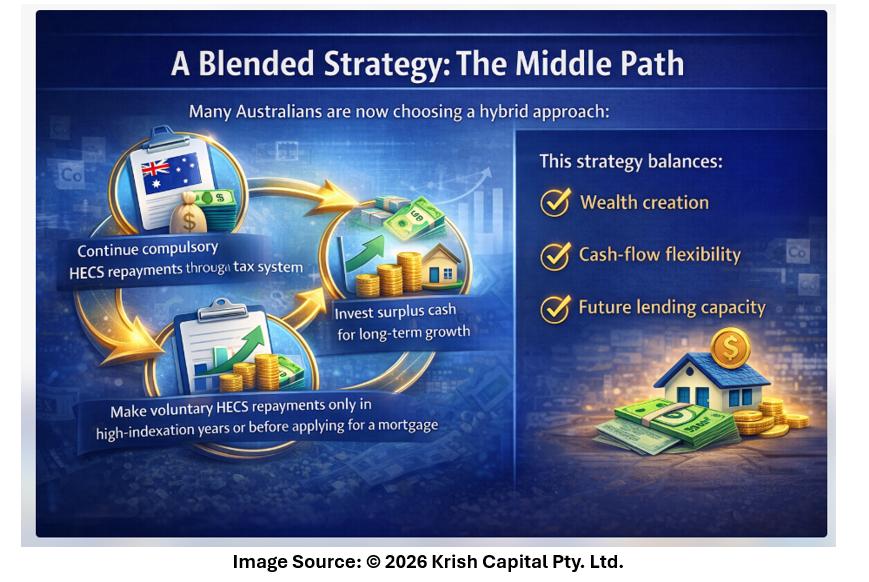
A Blended Strategy: The Middle Path
The Role of Superannuation in the Decision
Because Superannuation offers tax advantages and long-term compounding, additional concessional contributions can sometimes deliver a stronger outcome than early HECS repayment—particularly for higher-income earners.
There Is No One-Size-Fits-All Answer
Choosing between paying off HECS-HELP early and investing is not purely a numbers game. It depends on:
- Your income and career growth
- Risk tolerance
- Time horizon
- Home-buying plans
- Current indexation environment
What is clear, however, is that HECS-HELP’s unique structure means it is rarely a financial emergency. For many Australians, starting to invest early—while managing the debt through the system—creates a stronger long-term position.
The smartest strategy is not about eliminating the debt as fast as possible, but about deploying each extra dollar where it works hardest for your future wealth.


 Mar 04, 2026

_02_11_2026_07_58_30_526403.png)


 Please wait processing your request...