
 AU
AU CA
CA NZ
NZ UK
UK US
US IND
IND

 Share
Share
 X (Formerly Twitter)
 Whatsapp
 Facebook
 LinkedIn
 Telegram
 Email This Article
 Copy Link
 Summarize with AI
 Chat GPT
 Perplexity
(1)_10_14_2025_07_42_36_966925.png)
Highlights
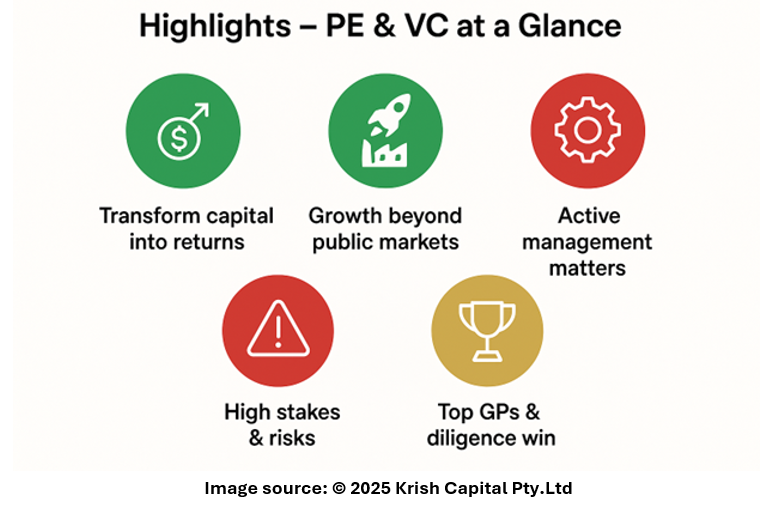
- PE and VC; High-risk strategies that can transform capital into extraordinary returns.
- From startups to established firms, private markets offer growth beyond public exchanges.
- Success hinges on active management, strategic value creation, and careful risk oversight.
- Illiquidity, leverage, and concentration make private investing a high-stakes game.
- Disciplined diversification, top-tier GPs, and rigorous due diligence are what separates winners from losers.
Private equity (PE) and venture capital (VC) have earned reputations as some of the most compelling—but also among the most challenging, investment strategies in finance. Their promise lies in capturing outsised returns by targeting businesses beyond the reach of public markets. Their peril comes from illiquidity, uncertainty, and high stakes. This balance of danger and opportunity is what makes PE and VC “high risk, high reward.”
Demystifying Private Equity and Venture Capital
At their core, both PE and VC involve investing in privately held companies via funds structured as limited partnerships. General Partners (GPs) manage the fund, source investment opportunities, enhance business value, and execute eventual exits. Limited Partners (LPs) contribute capital and rely on the GP’s expertise to generate returns.
Private equity typically targets more mature companies, ranging from underperforming firms to established businesses seeking growth or restructuring. PE funds often employ leveraged buyouts, using debt to increase potential returns.
Venture capital, by contrast, invests in early-stage or startup companies with high growth potential. These companies are often pre-revenue, unproven, or prone to pivoting, making VC inherently riskier. While both fund types share mechanics like capital calls, illiquidity, and active management, they differ in risk exposure, time horizons, and return distributions.
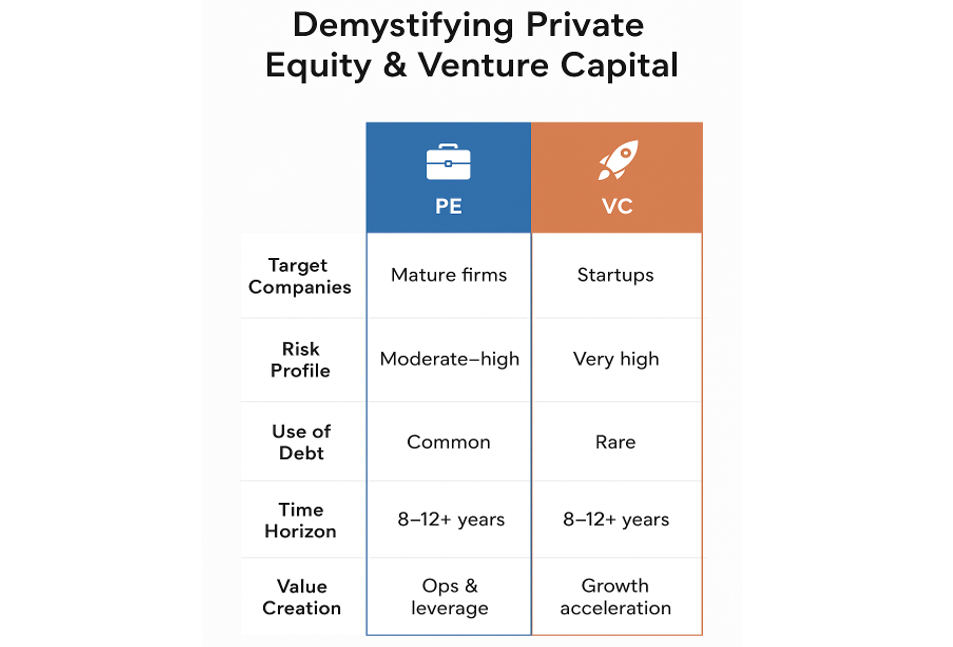
Image source: © 2025 Krish Capital Pty.Ltd
The Mechanics of Value Creation
The value creation process in PE and VC relies on strategic interventions that enhance the portfolio company’s performance:
- Operational Improvements: Enhancing management practices, upgrading systems, enforcing cost discipline, and scaling sales and marketing to drive efficiency and growth.
- Multiple Expansion/Arbitrage: Acquiring companies at a lower valuation multiple and selling them later when market conditions allow for a higher multiple, capturing the difference as profit.
- Leverage / Financial Engineering (mainly in PE): Using debt strategically to amplify equity returns, while managing the associated financial risk.
- Growth Acceleration (VC focus): Supporting startups with capital to fund expansion, hire talent, develop products, and enter new markets, fueling rapid growth.
- Follow-on Support / Reserves: Maintaining the ability to invest additional capital in high-potential portfolio companies to strengthen winners.
- Exit Strategies: Realizing gains through IPOs, trade sales, secondary transactions, or recapitalizations, which convert the enhanced value into returns for investors.
Through these levers, private investors can actively influence outcomes, translating strategic input and capital into financial performance.
The Challenges Behind High Returns
Investing in private markets carries unique risks that must be carefully managed:
- Illiquidity and Long Horizons: PE and VC investments are typically locked in for 8–12 years or more, limiting early exit options.
- Valuation Uncertainty: Portfolio companies are rarely valued at market prices; internal models can understate volatility and risk.
- Concentration and Selection Risk: Fund returns are often skewed, with a few investments driving most gains. Choosing the right GP and deals is critical.
- Leverage Risk (PE): While debt can amplify returns, it also increases vulnerability to cash flow problems or rising interest rates.
- Startup Failure (VC): Many early-stage ventures fail or fail to scale, with a small number of successful companies offsetting losses.
- Market and Regulatory Risks: Economic downturns, credit tightening, regulatory changes, or illiquid markets can delay or reduce exit values.
- Operational and Governance Risks: Private firms may have weaker controls and oversight, raising the potential for mismanagement, misreporting, or fraud.
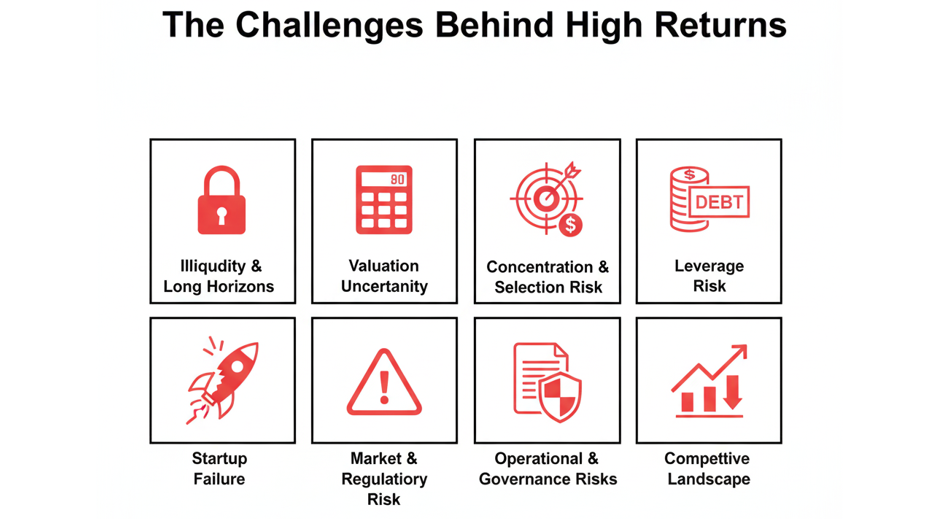
Image source: © 2025 Krish Capital Pty.Ltd
The Pulse of Private Markets
Private markets are influenced by broader economic cycles. In 2025, U.S. PE activity rebounded strongly, with total deal value reaching approximately USD 386.42 billion in the first half of 2025, a 38% increase from USD 325.57 in 2024. Megadeals, defined as transactions exceeding USD 5 billion, also surged.
Venture capital, however, experienced slower deal growth, reflecting caution in the face of higher interest rates, valuation concerns, and more challenging exit environments. Meanwhile, secondary markets are expanding, providing LPs opportunities to access liquidity in otherwise illiquid investments.
Guidelines for Savvy Private Market Investing
Given the risks and rewards, disciplined investment strategies are essential:
- Diversify Across Funds, Strategies, and Geographies: This helps reduce exposure to sector-specific or vintage-year risks.
- Prioritize Top-Tier GPs: Experienced managers with strong track records tend to deliver more consistent results.
- Align GP Incentives: Ensure the GP has a stake in the fund’s success through capital commitments, hurdle rates, and clawback provisions.
- Reserve Capital for Follow-On Investments: Particularly in VC, supporting promising portfolio companies can significantly boost returns.
- Conduct Rigorous Due Diligence: Evaluate governance, operational processes, reporting standards, and valuation practices to mitigate risk.
- Utilize Co-Investments and Secondaries: Co-investments reduce fees, and secondaries provide optional liquidity.
- Stress-Test Scenarios: Model potential challenges, including delayed exits, capital call timing, interest rate shifts, and slower growth, to prepare for downside risks.
Wrapping Up: Lessons from PE and VC
Private equity and venture capital represent two sides of the same coin: instruments to capture excess returns beyond public markets—but only to those who understand and manage the risks. Their high-stakes nature demands discipline, focus, and patience. For investors seeking access, the path is not casual but requires deep diligence, thoughtful structure, and clear expectations. When done well, the rewards can be transformative—and when done poorly, the losses can be stark.


 Mar 04, 2026
_02_19_2026_11_50_21_592067.png)

_02_11_2026_07_58_30_526403.png)

 Please wait processing your request...