
 AU
AU CA
CA NZ
NZ UK
UK US
US IND
IND

 Share
Share
 X (Formerly Twitter)
 Whatsapp
 Facebook
 LinkedIn
 Telegram
 Email This Article
 Copy Link
 Summarize with AI
 Chat GPT
 Perplexity
Highlights
- Insurance plays a risk-management role by transferring financial uncertainty away from households.
- Life, TPD, income protection and private health insurance address different stages and types of financial risk.
- Policy design, exclusions and benefit structures vary significantly across insurance types.
- Insurance complements savings and superannuation rather than replacing them.
Insurance is a foundational element of financial protection in Australia, designed to manage risks that savings alone may not absorb. While investment strategies focus on long-term growth, insurance addresses uncertainty by providing financial support when unexpected life events disrupt income, health, or family security. Understanding how different types of insurance operate helps individuals assess their role within a broader financial framework.
The Role of Insurance in Risk Management
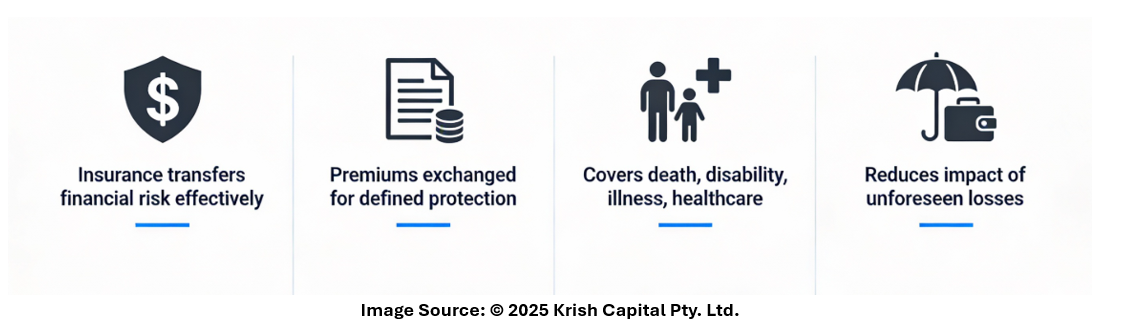
At its core, insurance functions as a risk-transfer mechanism. Policyholders pay premiums in exchange for protection against defined events that could otherwise result in significant financial strain. In Australia, personal insurance products are structured to address risks linked to death, disability, illness, and healthcare costs, each serving a distinct purpose.
Insurance does not eliminate risk, but it can reduce the financial impact of events that are difficult to predict or self-fund, particularly when income is interrupted or large expenses arise suddenly.
Life Insurance: Supporting Dependants and Liabilities
Life insurance provides a lump sum or income stream to beneficiaries if the insured person passes away or is diagnosed with a terminal illness. In the Australian context, life cover is often used to address ongoing financial obligations such as mortgages, childcare costs, or living expenses for dependants.
Many Australians hold life insurance through superannuation, where premiums are deducted from super balances. While this can make cover more accessible, benefit amounts, ownership structures, and tax treatment can differ from policies held outside super. Understanding these differences is important when assessing whether cover aligns with personal circumstances.
Total and Permanent Disability (TPD): Protection Against Long-Term Incapacity
TPD insurance is designed to provide financial support if an individual becomes permanently unable to work due to illness or injury. Benefits are typically paid as a lump sum and may be used to cover medical costs, modify housing, reduce debt, or support long-term living expenses.
In Australia, TPD definitions vary between policies, often distinguishing between “any occupation” and “own occupation” criteria. These definitions affect eligibility and claim outcomes, making policy structure a key consideration rather than premium cost alone.
Income Protection: Managing Short- to Medium-Term Income Disruption
Income protection insurance replaces a portion of regular income when an individual is temporarily unable to work due to sickness or injury. Payments are usually made monthly after a waiting period and continue for a defined benefit period.
Given Australia’s high reliance on employment income and variable sick leave arrangements, income protection can play a role in maintaining cash flow during periods of reduced earning capacity. Policy features such as waiting periods, replacement ratios, and benefit durations directly influence how the cover functions in practice.
Private Health Insurance: Managing Healthcare Costs
Private health insurance operates differently from life and disability cover, focusing on access and cost-sharing rather than income replacement. In Australia’s mixed public–private healthcare system, private health insurance may reduce out-of-pocket expenses, provide access to private hospitals, and limit waiting times for certain treatments.
Policy value depends on individual health needs, age, and usage patterns, as well as government settings such as the Medicare Levy Surcharge and Lifetime Health Cover loading.

Insurance Within a Broader Financial Plan
Insurance works alongside savings, emergency funds, and superannuation rather than acting as a standalone solution. Coverage needs may change over time as income, family responsibilities, and asset levels evolve. Regular review helps ensure that protection remains aligned with financial capacity and risk exposure.
As a financial safety net, insurance supports stability by addressing risks that are difficult to plan for through savings alone, reinforcing resilience in an uncertain environment.


 Mar 04, 2026
_02_19_2026_11_50_21_592067.png)

_02_11_2026_07_58_30_526403.png)

 Please wait processing your request...