
 AU
AU CA
CA NZ
NZ UK
UK US
US IND
IND

 Share
Share
 X (Formerly Twitter)
 Whatsapp
 Facebook
 LinkedIn
 Telegram
 Email This Article
 Copy Link
 Summarize with AI
 Chat GPT
 Perplexity
Highlights
- Job switching can accelerate salary growth, often outpacing incremental raises from long-term loyalty.
- Career loyalty offers income stability and long-term benefits but may risk pay stagnation over time.
- Early-career mobility can significantly boost lifetime earnings through faster compounding.
- A balanced approach—strategic moves followed by stability—can align income growth with financial security.
Career decisions are no longer just about job satisfaction or titles; they have become critical financial choices. One of the most debated questions in modern employment is whether staying loyal to one employer or switching jobs more frequently leads to better long-term financial outcomes. While both approaches have merits, their financial implications differ significantly depending on industry, timing, and individual circumstances.
The Financial Case for Job Switching
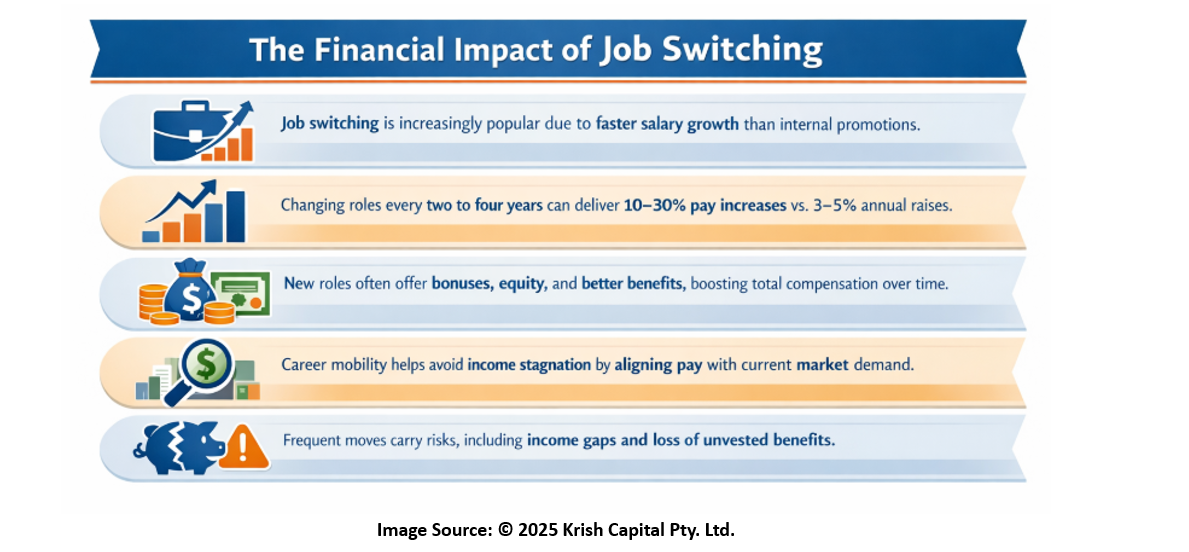
Job switching, often referred to as “career mobility,” has gained popularity over the past two decades. One of the strongest financial arguments for switching jobs is salary growth. External hires frequently receive higher pay increases than internal promotions. In many industries, switching roles every two to four years can result in salary jumps of 10–30%, compared with modest annual raises that typically range between 3–5%.
Beyond base pay, job changes can unlock better compensation structures. New roles may offer performance bonuses, equity participation, or improved benefits such as retirement contributions, health coverage, or flexible work arrangements. Over time, these enhancements can compound into substantial financial gains.
Job switching can also reduce income stagnation. Employees who remain too long in one role may find their skills undervalued or their pay lagging behind market rates. Moving to a new organisation allows professionals to reprice their skill set based on current demand, especially in fast-evolving fields like technology, finance, and healthcare.
However, frequent job changes carry financial risks. Gaps between roles can lead to temporary income loss. Some benefits, such as stock options or retirement matching, may require vesting periods that are forfeited when leaving early. There are also relocation costs, onboarding adjustment periods, and the possibility that a new role may not meet expectations, leading to instability.
The Financial Case for Loyalty
Job loyalty, defined as long-term tenure with a single employer, offers a different set of financial advantages. Stability is the most obvious benefit. Predictable income, consistent benefits, and job security reduce financial stress and make long-term planning—such as home ownership or family expenses—easier.
Loyal employees may gain access to seniority-based rewards that are not immediately visible. These include long-term incentive plans, pension schemes, extended paid leave, and leadership opportunities that come with higher compensation. In some organizations, trust built over years translates into promotions that would be difficult to secure externally.
Loyalty can also lower indirect financial costs. Employees who stay put avoid frequent job searches, relocation expenses, and periods of uncertainty. Over a long career, these savings can be meaningful, particularly for individuals who value work-life balance and predictable career progression.
The downside of loyalty is the risk of under-earning. Employers often prioritize budget constraints over matching external market salaries for existing staff. As a result, loyal employees may find themselves earning significantly less than peers who switch jobs, even when performing similar work.
Long-Term Wealth Impact
From a purely numerical perspective, strategic job switching often leads to higher lifetime earnings, particularly in the early and mid-career stages. Higher salaries achieved earlier allow for greater savings, investing capacity, and retirement contributions, which benefit from compounding over time.
That said, loyalty can still be financially rewarding when paired with the right employer—one that actively invests in employee growth, offers transparent pay progression, and rewards long-term commitment. In such cases, the income gap between switchers and loyalists may narrow considerably.
Finding the Right Balance
The debate between job switching and loyalty is not a one-size-fits-all decision. A hybrid approach is increasingly common: switching roles early in a career to build income and skills, then settling into a stable organization later for security and long-term benefits.
Ultimately, the best financial strategy aligns with personal goals, risk tolerance, and industry norms. Regularly assessing market value, negotiating compensation, and prioritizing skill development are essential—regardless of whether one chooses mobility or loyalty. In today’s dynamic job market, informed career decisions can have as much impact on financial well-being as investment choices themselves.


 Mar 04, 2026
_02_19_2026_11_50_21_592067.png)

_02_11_2026_07_58_30_526403.png)

 Please wait processing your request...