
 CA
 NZ
 UK
 US
 IND

 AU

 Share
 X (Formerly Twitter)
 Whatsapp
 Facebook
 LinkedIn
 Telegram
 Email This Article
 Copy Link
 Summarize with AI
 Chat GPT
 Perplexity

A seven-figure portfolio is no longer the exclusive preserve of senior executives or inheritance beneficiaries. With a disciplined savings rate, broad exposure to the S&P/ASX 200, and a decade of reinvested dividends, the arithmetic of compounding does the heavy lifting for most Australian investors. The challenge is less about finding undiscovered stocks and more about engineering a repeatable capital allocation process that survives market volatility, personal cash-flow shocks, and behavioural missteps. This article lays out a practical ten-year framework for investors who want to reach a $1 million ASX portfolio without relying on speculation.
Why $1 Million Is a Realistic Ten-Year Target
The S&P/ASX 200 Accumulation Index — the total-return benchmark that assumes dividends are reinvested — has delivered a long-run average return of roughly 9% per annum over multi-decade periods. Australian equities benefit structurally from the dividend imputation system, giving local investors access to franking credits that can lift the effective yield on blue-chip names by 100 to 200 basis points. Combine that with the natural tailwind of superannuation contributions, and most salary earners already have a built-in compounding machine before a single share is bought in a personal brokerage account.
At a blended 8% nominal return, an investor contributing roughly $4,700 per month for ten years would cross the $1 million threshold. Halve the contribution and extend the horizon to 15 years and the target remains achievable. The critical variable is not the headline return — it is the contribution rate, the consistency of that rate, and the investor’s ability to stay invested through drawdowns.
The Three Pillars of a $1 Million ASX Portfolio
Pillar 1: Core Index Exposure via ETFs
The foundation of the portfolio should be broad, low-cost exposure to the ASX 200 or ASX 300. Exchange-traded funds such as Vanguard Australian Shares Index ETF (ASX: VAS), BetaShares Australia 200 ETF (ASX: A200), and iShares Core S&P/ASX 200 ETF (ASX: IOZ) all deliver market-cap weighted exposure at management fees below 0.10% per annum. This core allocation reduces single-stock risk, captures the market beta, and harvests franking credits automatically.
Pillar 2: Quality Dividend Compounders
A satellite allocation to quality dividend payers — Commonwealth Bank (ASX: CBA), BHP Group (ASX: BHP), Wesfarmers (ASX: WES), Telstra (ASX: TLS), Transurban (ASX: TCL), and Woolworths (ASX: WOW) — provides a reliable income stream that can be reinvested via dividend reinvestment plans (DRPs). Holding these names directly rather than through an ETF allows investors to use franking credits against personal tax and gives flexibility to rebalance on valuation.
Pillar 3: Growth and Thematic Exposure
A smaller allocation (typically 10–20%) to growth themes — technology, healthcare innovation, lithium and critical minerals, artificial intelligence infrastructure, and global ETFs — provides the upside ballast that lifts the portfolio above benchmark returns in expansion phases. Examples include CSL (ASX: CSL), WiseTech Global (ASX: WTC), NextDC (ASX: NXT), Pilbara Minerals (ASX: PLS), and offshore ETFs such as BetaShares Global Technology (ASX: NDQ) and Vanguard MSCI International (ASX: VGS).
Ten-Year Capital Allocation Roadmap
A disciplined roadmap matters more than a brilliant stock pick. The table below illustrates how monthly contributions compound under realistic return assumptions, assuming an 8% total-return environment with franking credits reinvested and no additional superannuation contributions beyond the statutory minimum.
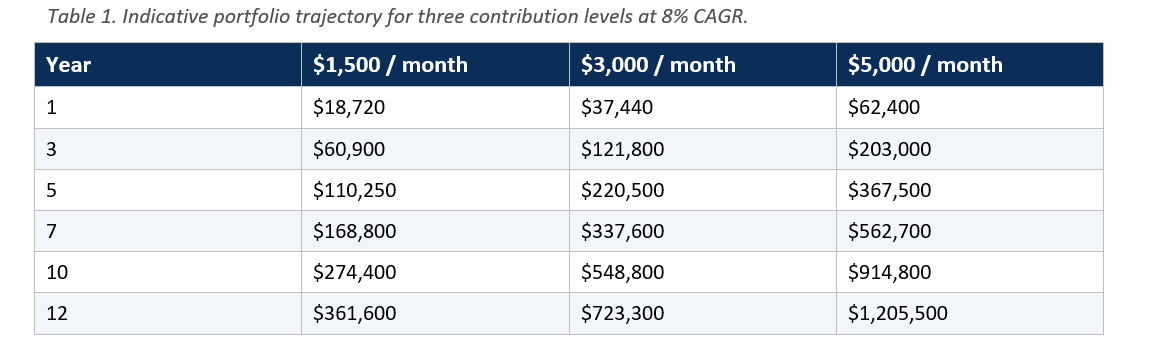
The key insight: contributions in the first five years do the heavy lifting because they benefit from the longest compounding horizon. Investors who front-load contributions — via salary-sacrificed super, tax refunds, or bonuses — reach the $1 million line materially faster than those who backload.
Rebalancing, Tax Efficiency, and Franking Credits
Rebalancing should be rules-based, not emotional. A common approach is a 5% drift band: when an asset class moves more than 5 percentage points from its target weight, trim the overweight and top up the underweight. This enforces discipline and mechanically sells high to buy low. Tax-efficiency levers in Australia include holding high-yielding franked shares in personal names (to use franking credits), holding international equities where the withholding tax treatment is less favourable inside low-tax super accounts, and using capital losses strategically within a 30 June tax year to offset realised gains.
Risks to the Ten-Year Plan
- Concentration risk: The ASX 200 is heavily weighted to financials and materials, which can amplify drawdowns during banking stress or iron ore price slumps.
- Sequence-of-returns risk: A severe bear market late in the ten-year window can disproportionately damage the compounded balance; diversification and cash reserves help cushion this.
- Behavioural risk: Panic selling during corrections remains the single largest destroyer of long-term returns for retail investors.
- Inflation risk: A real return framework (after inflation) should be used alongside nominal targets; $1 million in 2036 dollars is not equivalent to $1 million today.
- Policy risk: Changes to franking credit refunds, superannuation caps, or capital gains tax concessions could alter after-tax outcomes materially.
Forward-Looking View: What Could Drive Returns to 2036
Structural tailwinds for ASX investors over the coming decade include the global energy transition (lifting demand for copper, lithium, nickel, and uranium), the AI infrastructure build-out (supporting data centre REITs and technology exporters), Australia’s sustained net migration (benefiting housing-linked and consumer staples), and the ongoing shift of superannuation assets into domestic listed equities. Headwinds include elevated household debt, sticky services inflation, and the valuation starting point for parts of the banking and consumer-discretionary sectors. The net implication is that equity returns over the next decade may cluster closer to the long-term average than the above-trend post-COVID rebound of 2020-2024.
Frequently Asked Questions (FAQ)
How much do I need to invest each month to build a $1 million ASX portfolio in 10 years?
Assuming an 8% per annum total return (including reinvested franked dividends), an investor would need to contribute approximately $5,500 per month. Lower contributions extend the horizon; $3,000 per month typically reaches $1 million in around 14 years.
Is it better to invest in ASX ETFs or individual dividend stocks?
A hybrid approach works best for most investors. Core ETF holdings provide low-cost diversification, while a satellite allocation to high-conviction dividend payers allows active use of franking credits and rebalancing flexibility.
Should I use superannuation or a personal brokerage account to reach $1 million?
Both. Super’s concessional tax rate (15% on earnings, often 0% in pension phase) is unmatched for long-dated wealth-building, but access is restricted until preservation age. A personal brokerage account complements super by providing liquidity and flexibility.
What happens if the ASX has a major crash during my ten-year plan?
Historically, broad ASX drawdowns of 20–40% have been followed by multi-year recoveries. Continuing to invest during downturns — the essence of dollar-cost averaging — typically improves long-term returns because shares are being acquired at lower prices.
Are franking credits critical to reaching $1 million?
They are a meaningful accelerator. A fully franked 4% yield is broadly equivalent to a 5.7% pre-tax yield for many Australian investors, lifting the effective compounding rate by roughly 100–150 basis points per annum on the income portion of the portfolio.
Conclusion
Building a $1 million ASX portfolio in a decade is an arithmetic outcome of consistency, diversification, and patience. Investors who automate contributions, rebalance on rules rather than headlines, and take full advantage of Australia’s franking and superannuation systems tilt the probabilities strongly in their favour.
The most common failure mode is not poor stock selection — it is abandoning the plan during drawdowns. A portfolio that captures market returns, pays reinvested franked dividends, and withstands sequence risk will reach seven figures more reliably than one chasing the next thematic rally. The ten-year roadmap is less about prediction and more about process.
Important Disclaimer
Disclaimer: The content of this article is for general informational and educational purposes only and does not constitute personal financial, investment, tax, or legal advice. The information has been prepared without taking into account the objectives, financial situation, or needs of any particular individual. Readers should consider the appropriateness of the information in light of their own circumstances and, before acting, seek personal advice from a licensed Australian financial adviser. Past performance is not a reliable indicator of future performance. Share prices, dividend yields, and market data are indicative only and may change without notice. All investments carry risk, including potential loss of capital. Neither the author nor the publisher accepts any liability for losses arising from reliance on this content.


 Nov 19, 2026





 Please wait processing your request...