
 CA
 NZ
 UK
 US
 IND

 AU

 Share
 X (Formerly Twitter)
 Whatsapp
 Facebook
 LinkedIn
 Telegram
 Email This Article
 Copy Link
 Summarize with AI
 Chat GPT
 Perplexity

Key Highlights
- Australia generally permits covered Short Selling and restricts naked short selling.
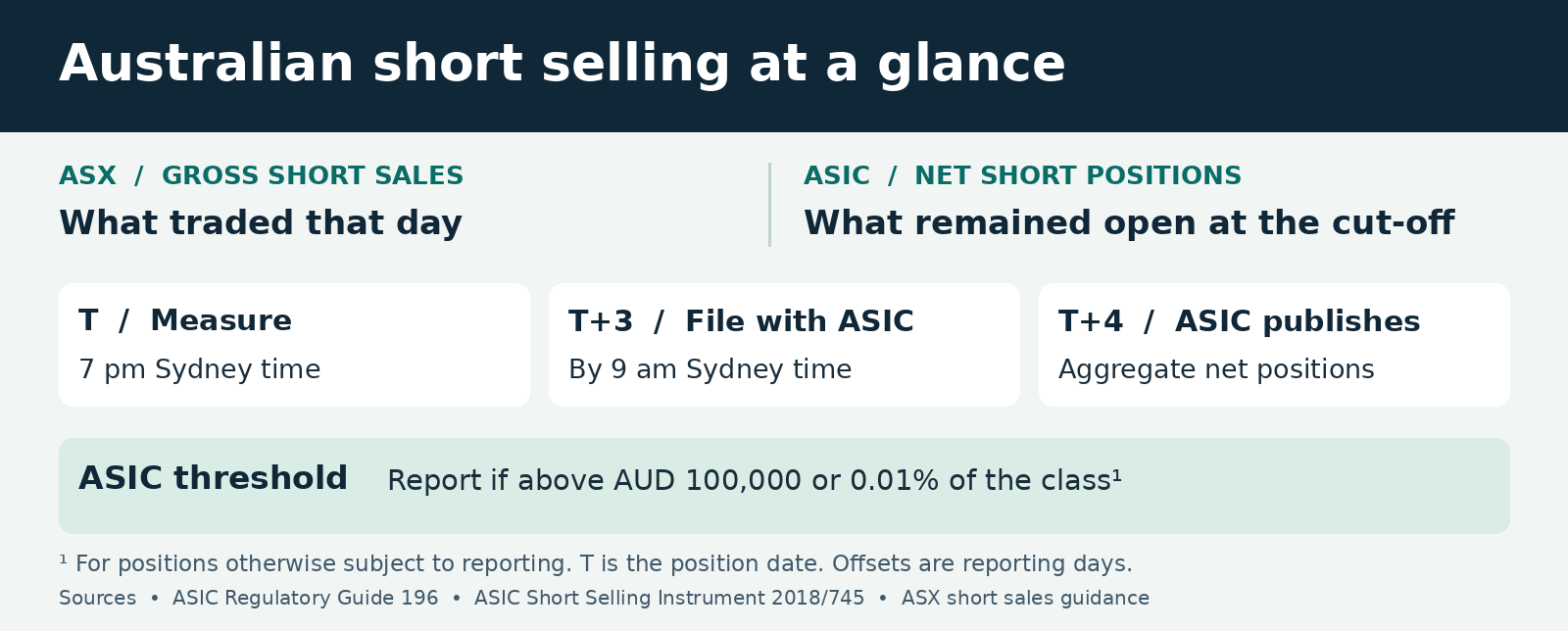
- ASX reports daily gross short-sale volume. ASIC aggregates reported net short positions.
- A qualifying position is reportable if it exceeds AUD 100,000 or 0.01% of its product class.
- The standard ASIC deadline is 9 am Sydney time on T+3, with publication on T+4.
A short sale can appear in ASX trading data even if the seller closes the position before the reporting cut-off. Australia’s disclosure rules capture both transactions and open positions, with separate reporting obligations for Brokers and short sellers. The Corporations Act 2001 sets out the legal framework, and the Australian Securities and Investments Commission (ASIC) provides practical guidance in Regulatory Guide 196.
AI Generated Image
When a short sale is covered
A covered short seller arranges to borrow the product before selling so it can be delivered to the buyer. Section 1020B generally requires a presently exercisable and unconditional right to deliver the product when the sale is made. The rule covers products such as shares, debentures and managed Investment products. ASIC’s Regulatory Guide 196 outlines the prohibition and disclosure duties.
Conditional exceptions include certain market-making activities and deferred-settlement trades. Effective 3 February 2026, ASIC extended relief for specified precious-metal structured products and for qualifying hedges by appointed market makers in Options over Global X Physical Gold Structured. The amendments also extended transaction-reporting relief to market makers in specified structured products.
Who reports short sales and positions
Under section 1020AB, a seller generally discloses a covered short sale to its broker. Section 1020AE requires the broker to ask about the disclosure obligation and record the seller’s answer before making the sale. Section 1020AC requires the broker to pass the transaction details to the market operator. A broker selling short for its own account generally reports directly to the market operator. ASX publishes the daily gross totals, generally on the next trading day for trade information received by the broker before 7 pm.
Net position reporting to ASIC also operates under section 1020AB, together with the Corporations Regulations 2001 and the ASIC short selling instrument. The standard measurement time is 7 pm Sydney time. The initial report is due by 9 am Sydney time on the third reporting day. Daily reporting continues while a position qualifies, even if its size stays the same. An effective global end-of-day nomination can change the measurement time and, where it falls after 11:59 pm Sydney time on day T, the filing deadline to T+2. Overseas sellers can also be subject to the obligation. Reports are lodged electronically using the FIX protocol.
How the reporting thresholds work
For eligible securities and managed investment products, small-position relief applies when the net position is worth AUD 100,000 or less and is 0.01% or less of the quantity in the same product class. A position otherwise subject to reporting must be filed if either limit is exceeded. For example, a net short worth AUD 80,000 that represents 0.02% of the class exceeds the Volume limit.
Suppose a fund has delivery obligations for 160,000 shares and holds 110,000 shares of the same class in the same capacity, with no other relevant rights or obligations. Its net short position is 50,000 shares. Positions held in different capacities are assessed separately for netting.
How to read the public figures
ASIC’s daily table shows the product name and code, the reported net short quantity, the quantity on issue and the short percentage. The percentage divides the reported short quantity by the quantity on issue. ASIC aggregates reports without naming individual sellers. The total depends on what sellers submit, and ASIC says it cannot verify every submission or whether every seller has filed.
Use the position date when comparing the data with market events. A security can record substantial gross short sales and end the day with lower net short interest if traders also close positions. A reported position can reflect hedging as well as a view on the share price. Product eligibility and stock availability are separate practical checks. The applicable venue rules and the seller’s ability to arrange a borrow determine whether a proposed covered sale can proceed.
Days to cover puts reported short interest in the context of trading liquidity. Dividing the reported short quantity by Average Daily Volume over a stated period gives an estimate in trading days. It assumes all that volume could be used to close short positions, so actual covering could take a different amount of time.


 Nov 19, 2026





 Please wait processing your request...