
 AU
AU CA
CA NZ
NZ UK
UK US
US IND
IND

 Share
Share
 X (Formerly Twitter)
 Whatsapp
 Facebook
 LinkedIn
 Telegram
 Email This Article
 Copy Link
 Summarize with AI
 Chat GPT
 Perplexity
Highlights
- Central bank policies shape how money flows through the economy, influencing everything from interest rates to investment trends.
- Every rate change sends ripples through stocks, bonds, and currencies, affecting investor confidence and market direction.
- Interest rates determine how easily businesses can borrow and how much consumers choose to spend or save.
- For investors and savers, understanding monetary policy is key to making smarter financial decisions.
Central banks — such as the U.S. Federal Reserve, the European Central Bank, and the Bank of England — may seem like distant institutions that make decisions behind closed doors, but their actions influence every corner of the financial world. When central banks change their policies, they do far more than adjust interest rates. They affect how companies borrow money, how investors assess risk, and even how households choose to save or spend. Their decisions ripple through stock markets, bond markets, currencies, and the broader economy.
Inside the Engine Room of the Economy
Central banks have two main responsibilities: keeping inflation under control and supporting stable economic growth. To achieve these goals, they use a set of powerful tools that shape the flow of money in an economy.
A key tool is setting short-term interest rates, which determines how expensive borrowing will be for banks and consumers. They also buy or sell government securities, known as open market operations, to influence money supply and long-term rates. Additionally, central banks communicate their expectations about future policy to guide financial market behavior. In exceptional cases, such as economic crises, they may use large-scale asset purchases, known as quantitative easing, to inject liquidity and encourage lending.
In short, by deciding how costly or affordable money should be, central banks influence how households, businesses, and investors behave.
When Central Banks Move, Markets React
When central banks adjust policy, the effects spread widely through financial markets through several channels.
- Interest-Rate Changes
When a central bank raises its policy rate, borrowing becomes more expensive. Businesses may delay investments, and consumers may spend less. Higher rates push up bond yields and often reduce stock valuations, especially for growth companies whose profits are expected in the future. Conversely, when rates are lowered, borrowing costs fall, spending increases, and asset prices generally rise.
- Asset-Price and Credit Channels
Central banks also influence the “risk premium” investors' demand. Monetary policy affects not only government bond yields but also the extra return investors expect from riskier assets such as corporate bonds or equities. For instance, when central banks buy long-term bonds, yields fall, prompting investors to shift money into stocks or corporate debt. This supports asset prices but, if sustained too long, can fuel bubbles.
- Currency and Global Flows
Central bank actions also move currencies. When a central bank raises interest rates, its currency usually strengthens as investors seek higher returns. A stronger currency makes imports cheaper but can hurt exporters. Conversely, rate cuts tend to weaken the currency, helping exporters but making imports costlier. These shifts affect global trade and investment flows.
- Market Expectations and Sentiment
Markets react not only to what central banks do but also to what they say. Clear communication reduces uncertainty, while vague or unexpected moves create volatility. Forward guidance — signaling likely future policy — helps markets adjust smoothly. Poor communication can, however, spark sharp swings in asset prices and investor sentiment.
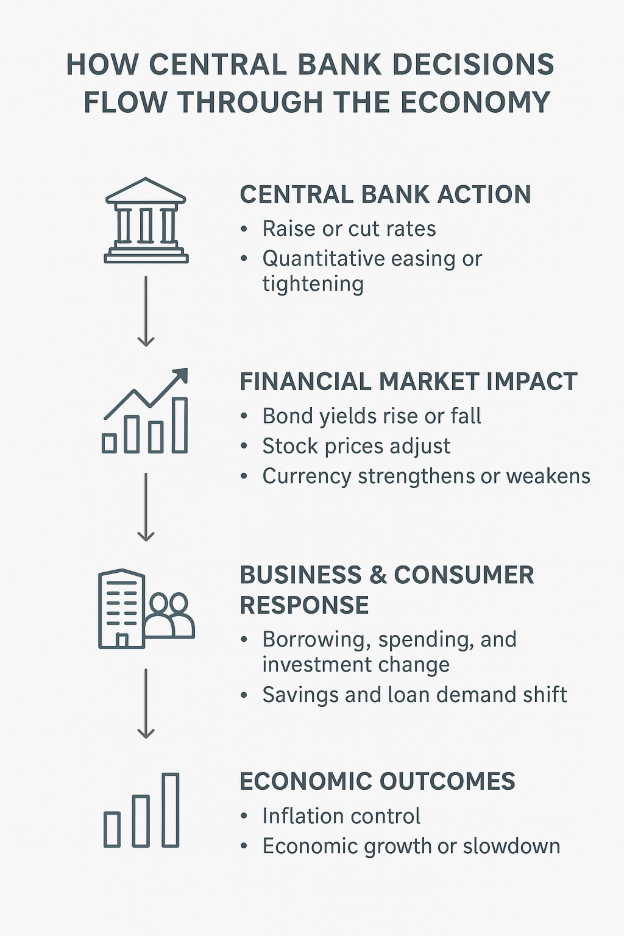
Image source: © 2025 Krish Capital Pty.Ltd
Why Investors Watch Central Banks So Closely
Central bank policy influences nearly every part of the financial system. Bond yields provide a baseline for expected returns. When yields rise, stock valuations typically fall as investors demand higher returns. Credit conditions determine how easily companies can borrow and expand, while currency movements shape global investments and trade competitiveness. When inflation rises sharply and central banks tighten policy, capital markets often face pressure from higher yields and lower equity valuations. Sudden policy shifts can also heighten volatility, making it crucial for investors to stay informed and flexible.
The Double-Edged Sword of Central Bank Policies
Central bank actions bring both benefits and trade-offs.
- The good side: When inflation is too high, raising interest rates or reducing money supply prevents runaway price increases and protects savings. During weak growth, lowering rates or buying assets supports investment and reduces unemployment.
- The not-so-good side: Tightening policy too aggressively can slow growth, raise unemployment, and create financial stress for borrowers. Research from the Federal Reserve Bank of San Francisco suggests overly restrictive policy can even lower long-term economic potential. Conversely, keeping policy too loose for too long may inflate asset prices and distort risk-taking, leading to bubbles. Since monetary policy affects many markets at once, small missteps can cause outsized reactions.
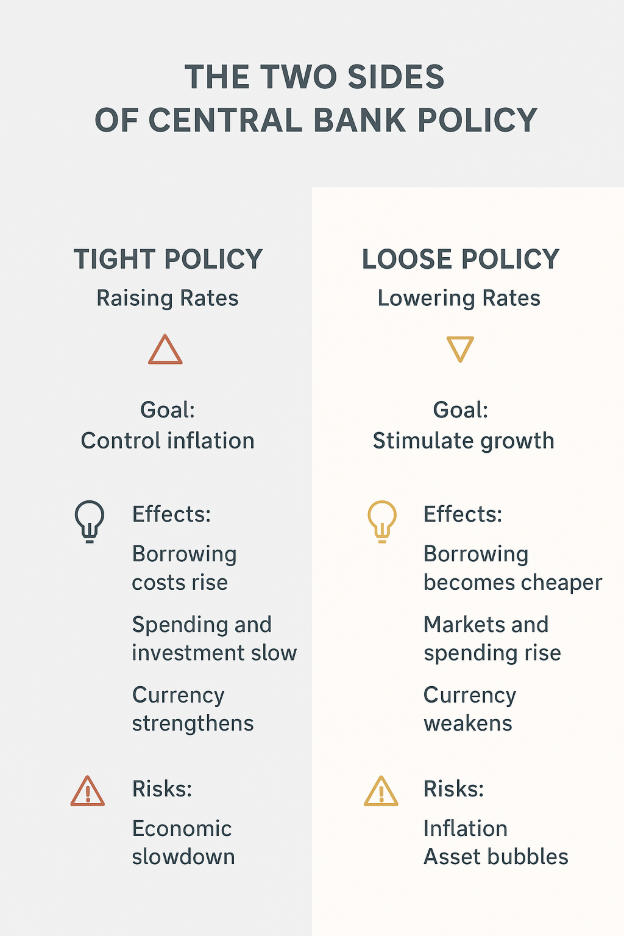
Image source: © 2025 Krish Capital Pty.Ltd
Turning Central Bank Decisions into Smart Financial Moves
Investors and savers can take practical steps to navigate central bank shifts. Staying alert to announcements is essential — rate hikes often push bond yields higher and pressure stock prices, while easing tends to lift risk assets. Diversification helps manage the varying impacts on bonds, equities, and currencies. Maintaining a long-term perspective smooths short-term volatility, and keeping some liquidity allows flexibility when markets move unexpectedly.
Bringing It All Together
Central bank policies are not distant or mysterious forces. They shape how money flows through the economy, how companies borrow and invest, and how investors value assets. By adjusting interest rates, managing liquidity, and guiding expectations, central banks play a vital role in maintaining financial stability and economic growth.
For everyone — from everyday savers to professional fund managers — understanding how central bank decisions affect financial markets is essential. With a clear grasp of these dynamics and a long-term approach, individuals can turn awareness of monetary policy into a strategic advantage rather than a source of uncertainty.


 Mar 04, 2026
_02_19_2026_11_50_21_592067.png)

_02_11_2026_07_58_30_526403.png)

 Please wait processing your request...