
 AU
AU CA
CA NZ
NZ UK
UK US
US IND
IND

 Share
Share
 X (Formerly Twitter)
 Whatsapp
 Facebook
 LinkedIn
 Telegram
 Email This Article
 Copy Link
 Summarize with AI
 Chat GPT
 Perplexity
In the world of investing, the Greek letter “beta” (β) holds a significant meaning. Simply put, a stock’s beta is a numerical way to compare how volatile the stock is relative to the overall market. If the market is taken as a benchmark (let’s say an index like the S&P 500, which is often assigned a beta of 1.0), then a stock’s beta tells you how much its price might move when the market moves.
Interpreting Beta: The Simple Rules
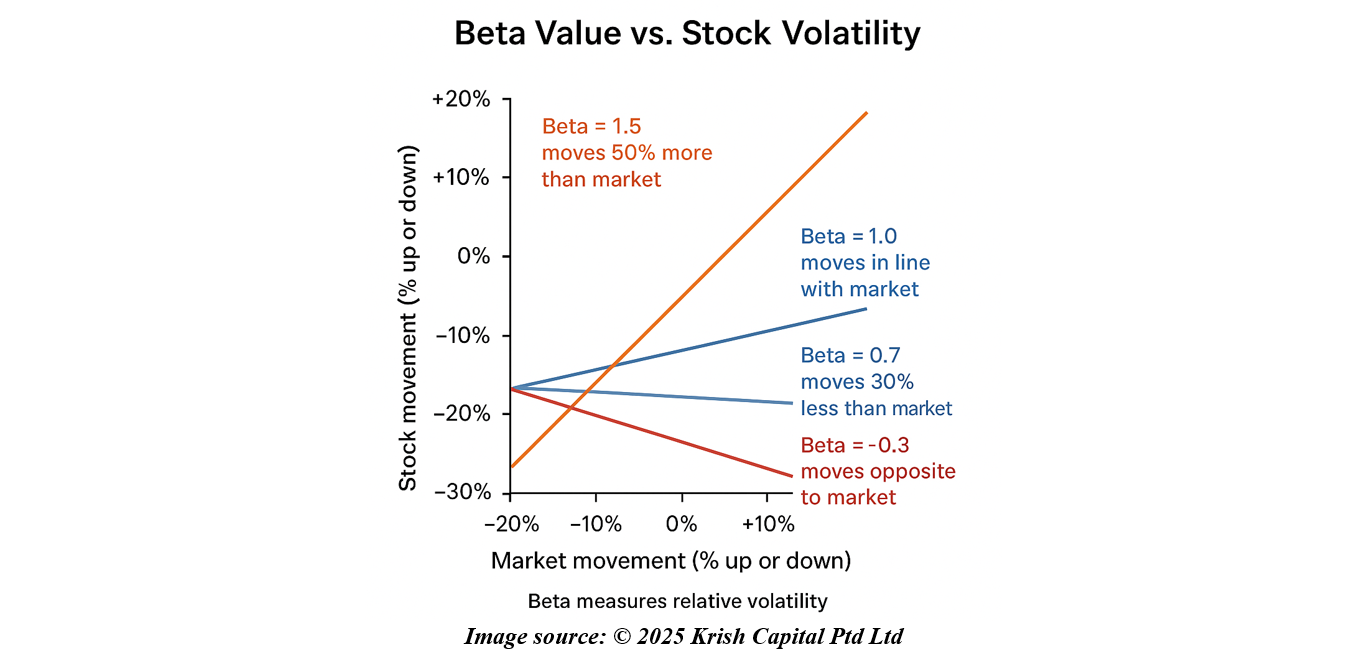
- A beta of 0 means the stock tends to move roughly in line with the market, if the market rises 5%, the stock might also rise about 5%.
- A beta greater than 1 suggests that the stock is more volatile than the market. For example, a beta of 1.5 implies it might move 1.5% when the market moves 1%.
- A beta less than 1 means the stock is less volatile, moves less dramatically than the market. A beta of 0.7 might move only 0.7% when the market moves 1%.
- A negative beta is rare but possible — it means the stock tends to move opposite to the market. For instance, if the market goes up, the stock might go down.
Why It Matters
Beta gives you a snapshot of the market‑related risk of a stock. Investors use it to answer questions like: if the market dips 10%, how might this stock behave?
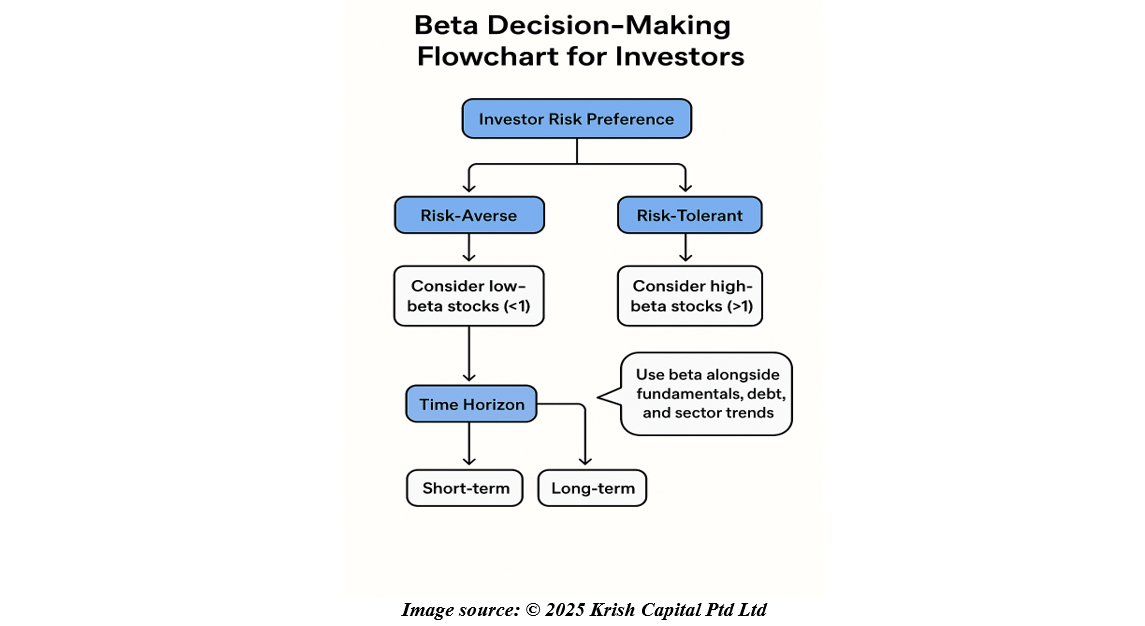
If you are risk‑averse and prefer less dramatic swings, you might favour stocks with lower betas. On the other hand, if you’re comfortable with bigger swings and chasing higher returns, you might look at higher‑beta stocks.
How Is Beta Calculated?
Behind the scenes, beta is calculated using statistical tools: you take the historical returns of the stock, compare them with returns of the benchmark market index, and derive how much the stock moves in relation to the market. This involves covariance and variance calculations.
In plain language:

Many investment websites calculate it for you, so you don’t have to do the heavy math yourself.
Practical Example
Imagine a stock with a beta of 1.3. If the market goes +10%, you might expect the stock to rise about +13% (since 1.3 × 10% = 13%). Conversely, if the market drops 10%, the stock might drop about 13%.
In contrast, a stock with a beta of 0.6 might go up only about +6% when the market rises 10% and fall about −6% when the market falls 10%.
Important Limitations to Keep in Mind
While beta is a useful tool, it has its caveats:
- It’s backward‑ It uses historical data, so it reflects what has happened rather than what will happen.
- It only measures one kind of risk — that is, market‑wide or systematic risk. It doesn’t capture company‑specific events e.g., sudden management changes, legal troubles which may affect a stock’s price.
- The benchmark matters. If you use a benchmark index that doesn’t match the stock market or region, beta may misrepresent the risk.
- Young companies or thinly traded stocks may not have reliable beta values due to limited historical data.
How to Use Beta in Portfolio Planning
- If you already have a portfolio and want to limit overall risk, you might include more stocks with betas of less than 1.
- If you’re looking for growth with higher risk, you may tilt toward stocks with betas above 1 — but be aware the risk is greater.
- Consider your time horizon: if you’re investing in the long run and can tolerate ups and downs, high‑beta stocks may be acceptable. If you need stability (e.g., nearing retirement), low‑beta stocks may be preferable.
- Always use beta alongside other measures: fundamentals, valuation, debt, sector trends — don’t rely on beta alone.
The Bottom Line
The metric of beta offers a straightforward way to gauge how a stock might move relative to the overall market. It helps you frame how much “market‑swing” risk you are signing up for. But it’s not a crystal ball — it doesn’t tell you everything, and it doesn’t replace careful research into the company and its sector. Use it as one tool in your investing toolkit, and pair it with a broader understanding of what the stock is, how the business works, and how the market might react.
By understanding beta, you gain a clearer sense of how a stock might behave when the market takes off — or when the market stumbles. And that can help you build a portfolio that better matches your comfort with uncertainty.


 Mar 04, 2026
_02_19_2026_11_50_21_592067.png)

_02_11_2026_07_58_30_526403.png)

 Please wait processing your request...