
 CA
 NZ
 UK
 US
 IND

 AU

 Share
 X (Formerly Twitter)
 Whatsapp
 Facebook
 LinkedIn
 Telegram
 Email This Article
 Copy Link
 Summarize with AI
 Chat GPT
 Perplexity

Key highlights
- By Monday, 02 March 2026, the Middle East war expanded to at least nine countries.
- Saudi Arabia was forced to shut its largest refinery at Ras Tanura.
- Shipping through the Strait of Hormuz, a vital artery for 20% of global oil, came to a virtual halt.
- Brent surged roughly 9%, trading as high as $80.26 during the session,
- WTI jumped about 8%, hitting intraday highs above $75.00.
Escalating conflicts in the Middle East drove oil prices upward on 02 March 2026. This analysis examines subsequent price action from a technical perspective.
The Impact of Middle East Conflict on Oil
- The ongoing conflict in the Middle East has injected a massive "geopolitical risk premium" into the energy markets, primarily due to the immediate threat to global supply chains and critical infrastructure.
- As hostilities expanded to include strikes on Iranian leadership and retaliatory attacks on Saudi Arabian refineries, such as the major facility at Ras Tanura, the physical availability of crude became a primary concern for traders. This tension was further amplified by the logistical paralysis in the Strait of Hormuz, a chokepoint responsible for a fifth of the world's oil flow.
- On March 2, 2026, these fears manifested in a dramatic "gap up" in prices, with Brent crude surging nearly 9% to test the psychological $80 resistance level, while WTI saw similar double-digit gains.
- From a market perspective, the war has shifted the focus from long-term demand fundamentals to immediate supply-side shocks, leaving prices highly sensitive to every headline regarding regional escalation or potential blockades.
Technical Outlook
Brent Crude Oil Spot
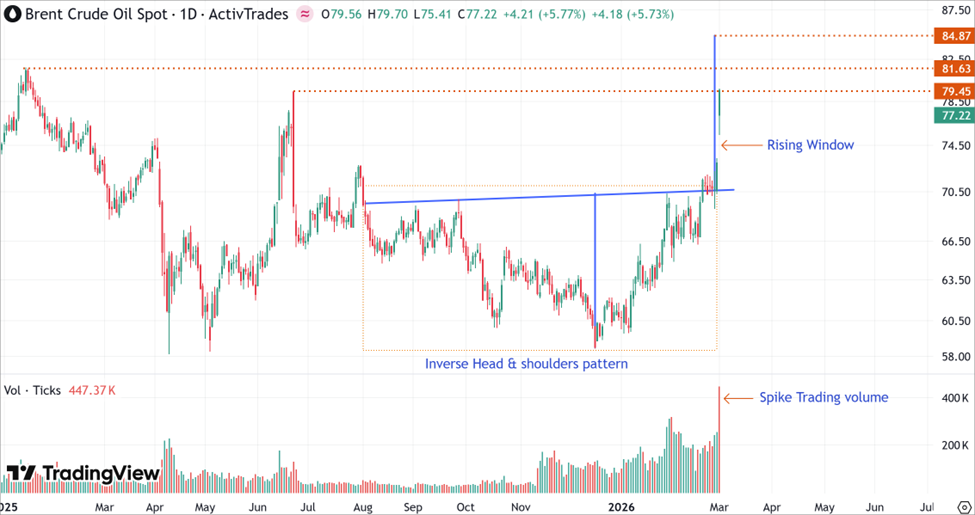
Brent’s Daily Price Chart (at the market price of 02nd March 2026). Powered by: tradingview.com
US Crude Oil Spot
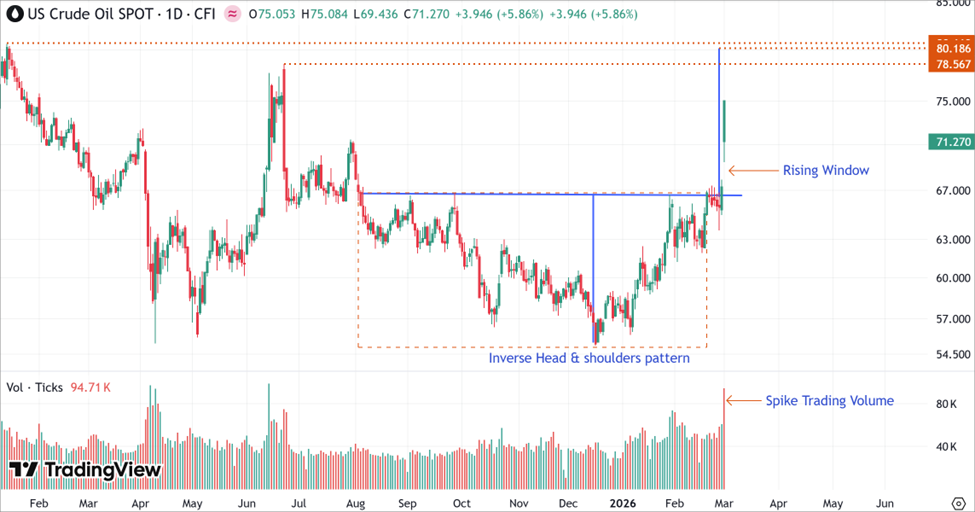
WTI’s Daily Price Chart (at the market price of 02nd March 2026). Powered by: tradingview.com
- On the daily chart, both Brent and WTI completed Inverse Head and Shoulders patterns on 17 and 27 February 2026, respectively, indicating a short-term trend reversal from downward to upward.
- On 02 March 2026, following the escalation of the war, both spot prices formed a Rising Window coupled with spiking trading volume, implying strong short-term momentum that could push prices higher.
- The projected targets for these patterns are $84.87 for Brent and $80.82 for WTI. These can be viewed as short-term targets, though selling pressure may emerge at significant resistance levels near their previous peaks.
- Notably, although short-term trends have turned positive, their long-term trends remain bearish, characterized by sequential lower peaks and troughs.
Bottom Line
- While the expansion of Middle East conflicts to at least nine countries has triggered a sharp, news-driven rally, the long-term market structure for oil remains bearish. Although both Brent and WTI have confirmed short-term trend reversals through Inverse Head and Shoulders patterns and high-volume Rising Windows, these movements are currently seen as a "geopolitical risk premium" rather than a permanent shift in fundamentals.
- Traders should look toward short-term targets of $84.87 for Brent and $80.82 for WTI though selling pressure might appear near their previous peaks.


 Nov 12, 2026





 Please wait processing your request...