
 CA
 NZ
 UK
 US
 IND

 AU

 Share
 X (Formerly Twitter)
 Whatsapp
 Facebook
 LinkedIn
 Telegram
 Email This Article
 Copy Link
 Summarize with AI
 Chat GPT
 Perplexity

Key Highlights
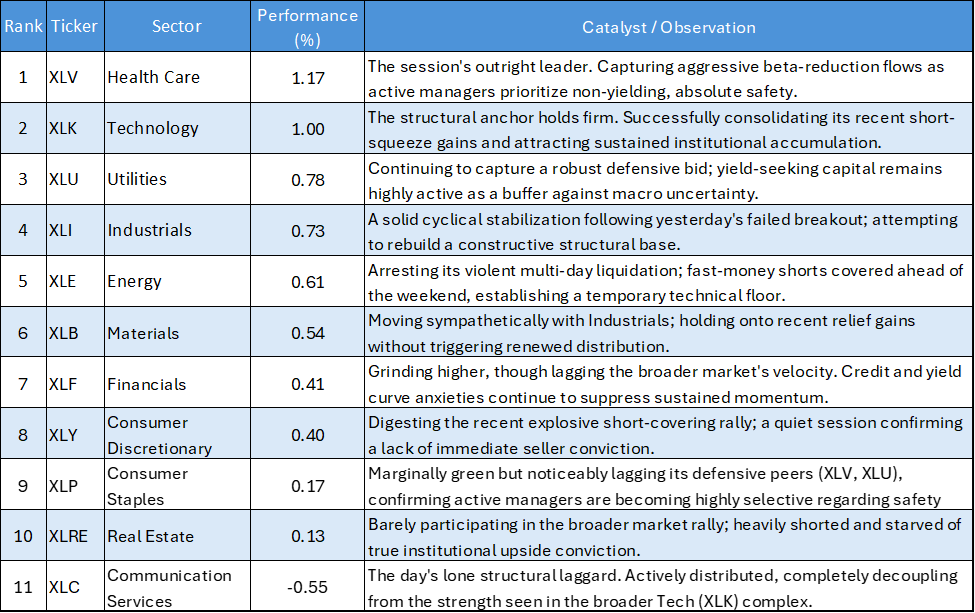
- The "Tech + Safety" Barbell Returns: Following a week of extreme rotational whiplash, institutional Capital settled back into a familiar, highly defensive posture. Health Care (XLV) led the tape with a 1.17% gain, working in tandem with the structural anchor, Technology (XLK, 1.00%).
- Energy Arrests the Bleeding: After suffering severe, multi-day institutional Liquidation, Energy (XLE) finally found a floor. Posting a 0.61% gain, the sector temporarily halted its structural collapse, though it remains far from its previous "singularity" Leadership.
- Broadening Breadth: For the first time this week, the tape was not driven by zero-sum capital extraction. Ten of the eleven S&P 500 sectors closed in the green, indicating a cessation of forced liquidations and a tentative, broad-based accumulation phase heading into the weekend.
- Communications Decouples: In a tape dominated by green, Communication Services (XLC) was the solitary holdout, dropping -0.55%. This stark divergence from the broader mega-cap growth complex suggests highly concentrated profit-taking within specific index heavyweights.
The US Equity market session on May 22, 2026, delivered a much-needed reprieve from the violent, zero-sum Volatility that defined the week. The empirical data points to a market transitioning from panic-driven repositioning to measured consolidation. Rather than ruthlessly cannibalizing one sector to fund another, institutional capital broadly underwrote the market, heavily favoring a "Tech + Safety" barbell that prioritizes fortress balance sheets and non-yielding defensive bunkers.
Daily US Sector Performance Summary
The following table summarizes the day's performance across the 11 major US S&P 500 sectors, ordered from strongest to weakest:
Key Market Themes
The Return of the Mega-Cap / Defensive Barbell
The most actionable quantitative data point on the May 22 tape is the precise pairing at the top of the leaderboard: Health Care (XLV) and Technology (XLK). This is the classic footprint of late-cycle institutional anxiety. Active managers are not blindly buying index Beta; they are bifurcating their portfolios. They are utilizing XLK to capture the Alpha of secular, cash-rich monopolies, while deploying XLV to drastically suppress portfolio volatility. This specific rotation signals that while systemic panic has subsided, genuine "risk-on" economic confidence has not returned.
Energy Stops the Hemorrhaging
After back-to-back sessions of catastrophic distribution (-2.43% and -1.12%), Energy (XLE) managed a 0.61% relief bounce. While this provides immediate technical relief, empirical discipline is required. A +0.61% gain does not repair the massive structural damage inflicted earlier in the week. This price action carries the mathematical characteristics of mechanical short-covering heading into the weekend, rather than the rebirth of the Inflation-hedge singularity.
A Fragmented Growth Triad
Throughout previous bull cycles, Technology (XLK), Consumer Discretionary (XLY), and Communication Services (XLC) moved with an incredibly tight correlation. The May 22 tape proves that correlation is currently broken. While XLK posted a robust +1.00% and XLY held its ground at +0.40%, XLC suffered a localized liquidation event, dropping -0.55% in a tape that was otherwise universally green. This zero-sum divergence within the growth complex indicates that algorithms are actively pairs-trading mega-cap tech stocks against one another, rotating Liquidity purely based on relative valuation rather than a broad growth mandate.
Cyclical Consolidation
The physical economy trade managed to pause its erratic whiplash. The modest but respectable gains in Industrials (XLI, +0.73%) and Materials (XLB, +0.54%) suggest that the cyclical complex is attempting to carve out a tradable bottom. By neither exploding higher in a short squeeze nor collapsing into a new liquidation phase, these sectors are quietly trying to rebuild institutional trust.
The empirical data from May 22 dictates a transition toward measured structural accumulation. The violent rotational whiplash has exhausted itself, leaving behind a tape that clearly favors the "Tech + Health Care" barbell. Active managers should utilize this stabilizing breadth to cleanly align with the quantitative signals: maintain core exposure to the resilient anchor in Information Technology (XLK), utilize Health Care (XLV) for optimized defensive ballast, and treat the bounce in Energy (XLE) with extreme tactical skepticism until secondary momentum confirmation is achieved.


 Nov 12, 2026





 Please wait processing your request...