
 CA
 NZ
 UK
 US
 IND

 AU

 Share
 X (Formerly Twitter)
 Whatsapp
 Facebook
 LinkedIn
 Telegram
 Email This Article
 Copy Link
 Summarize with AI
 Chat GPT
 Perplexity

Highlights
- Three ETFs offering global and domestic long-term diversified exposure.
- Mix of S&P 500, wide-moat, and Australian quality factor strategies.
- Suitable for those seeking multi-decade, broad-based equity exposure.
Long-term investing often favours simple, diversified portfolios that capture broad economic growth over decades. Among the many ETFs on the ASX, three continue to stand out for their clear strategy, transparent construction, and consistent performance trends: IVV, MOAT, and AQLT. These ETFs provide access to major global and Australian equity markets, each following a different investment approach: broad indexing, quality-screening, and competitive-advantage selection.
ETF Snapshot
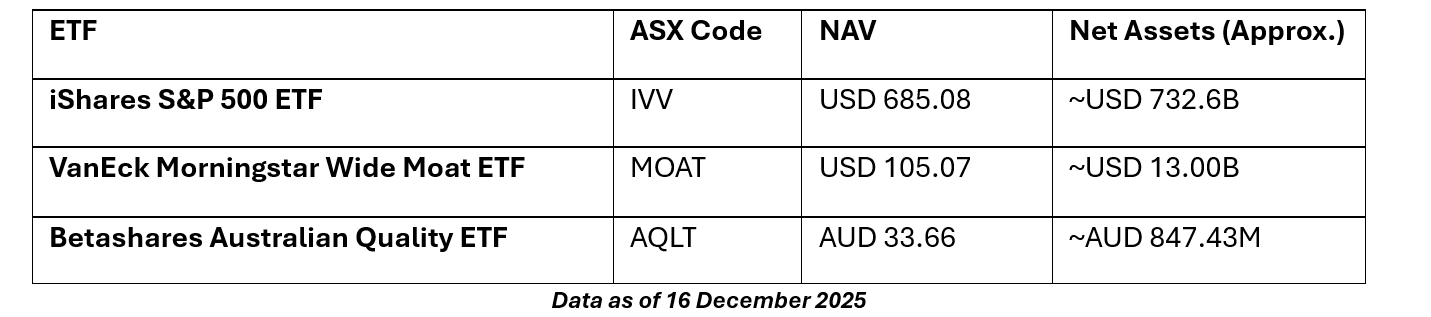
IVV – iShares S&P 500 ETF
IVV tracks the S&P 500 Index, offering exposure to 500 large-cap US companies across technology, financials, healthcare, consumer sectors, and more. With a very low fee and broad diversification, it represents a long-term core holding for investors seeking global exposure through US markets.
IVV records a 15.66% year-to-date return, a 1-year return of 16.31%, and a 3-year annualised return of 24.28%, based on data to 20/10/2025.
MOAT – VanEck Morningstar Wide Moat ETF
MOAT invests in companies identified as having durable competitive advantages, or “wide moats.” This quality-centric strategy focuses on businesses with strong pricing power, stable cashflows, and defensible market positions. Its concentrated portfolio makes it more selective than broad-market ETFs.
MOAT shows a 9.52% year-to-date return, a 1-year return of 5.42%, and a 3-year annualised return of 20.36%, based on data to 20/10/2025.
AQLT – Betashares Australian Quality ETF
AQLT provides targeted exposure to high-quality Australian companies using a profitability and balance-sheet screen. It offers a domestic tilt while avoiding some concentration risks present in Australia’s major indices. With consistent multi-year returns, AQLT has gained traction among quality-focused investors.
As of as of 10/20/2025, AQLT reports a 17.41% year-to-date return, a 1-year return of 18.71%, and a 3-year annualised return of 21.62%.
It's important to remember that past performance is not a reliable indicator of future results. When selecting an ETF, it's essential to consider individual sector preferences, risk tolerance, and the specific performance of the underlying index.
Technical Indicators Defined: -
Support: A level at which the ETF prices tend to find support if they are falling, and a downtrend may take a pause, backed by demand or buying interest. Support 1 refers to the nearby support level for the ETF and if the price breaches the level, then Support 2 may act as the crucial support level for the ETF.
Resistance: A level at which the ETF prices tend to find resistance when they are rising, and an uptrend may pause due to profit booking or selling interest. Resistance 1 refers to the nearby resistance level for the ETF, and if the price surpasses the level, then Resistance 2 may act as the crucial resistance level for the ETF.
Abbreviations
CMP: Current Market Price
SMA: Simple Moving Average
RSI: Relative Strength Index
AUD: Australian Dollar


 Nov 12, 2026





 Please wait processing your request...