
 CA
 NZ
 UK
 US
 IND

 AU

 Share
 X (Formerly Twitter)
 Whatsapp
 Facebook
 LinkedIn
 Telegram
 Email This Article
 Copy Link
 Summarize with AI
 Chat GPT
 Perplexity

Highlights
- RWC’s FY25 net sales increased 5.5% year-on-year to USD 1,314.7 million.
- Vanguard Group raised its substantial holding in RWC from 5.001% to 6.032% in November 2025.
- RWC’s shares have fallen 24.90% over the past year, trading at AUD 4.160 on 26 November.
Reliance Worldwide Corporation Limited (ASX:RWC) is an ASX-listed company specialising in the design, production, and distribution of water flow, control, and monitoring solutions for the plumbing and heating sectors. Founded in 1949 in Brisbane, Australia, RWC has evolved into a fully integrated manufacturer with a significant footprint across the Americas, Asia-Pacific, and the EMEA (Europe, Middle East, and Africa) regions.
Financial Update
For the financial year 2025 (FY25), RWC reported net sales of USD 1,314.7 million, representing a 5.5% YoY increase compared with USD 1,245.8 million in FY24. In FY25, volumes were higher in the Asia-Pacific region, although sales in the Americas and EMEA regions were lower. Adjusted EBITDA rose slightly to USD 277.7 million in FY25, up 1.1% YoY from USD 274.6 million in FY24. Adjusted net profit after tax (NPAT) reached USD 147.7 million in FY25, a marginal rise of 0.5% YoY compared with USD 146.9 million in the prior year. Excluding contributions from Holman and Supply Smart, sales were 0.5% lower than the prior corresponding period, while the adjusted EBITDA margin, excluding Holman, remained stable at 22.3%.
Business Update
On 11 November 2025, RWC announced a change in substantial holdings. Vanguard Group and its associated entities, a significant shareholder in the company, increased their stake from 5.001% as of 13 October 2022 to 6.032% as of 5 November 2025.
Key Positives and Negatives
For FY25, the company reported a YoY revenue increase of 5.5% and the return on equity improved from 8.8% in FY24 to 9.4% in FY25. On the other hand, the company experienced a slight decline in its current ratio, which decreased from 2.77x in FY24 to 2.73x in FY25. Additionally, operating cash flow fell from USD 274.4 million in FY24 to USD 233 million in FY25.
Business Outlook
Management remains cautious due to economic uncertainty and has provided guidance only for H1FY26. Group sales are expected to be flat or slightly lower year-on-year. In the Americas, low single-digit declines are anticipated, reflecting prior sales pull-forward and product line exits in Canada, while APAC and EMEA sales are expected to remain broadly stable.
Operating earnings and margins are likely to be pressured by tariffs, particularly in the Americas. Tariff-mitigation measures, including shifting sourcing from China and selective price increases, will be implemented gradually. Consequently, the consolidated EBITDA margin for H1FY26 is expected to be weaker than the prior corresponding period.
Share Performance of RWC
RWC’s shares were trading at AUD 4.160 per share on 26 November 2025, with an intraday gain of 1.96%. RWC’s stock has declined by 1.88% in the last three months, 5.88% over the six months and 24.90% over the past year. RWC’s 52-week high is AUD 5.600, recorded on 03 December 2024, and the 52-week low is AUD 3.730, recorded on 09 April 2025.
Support and Resistance Summary
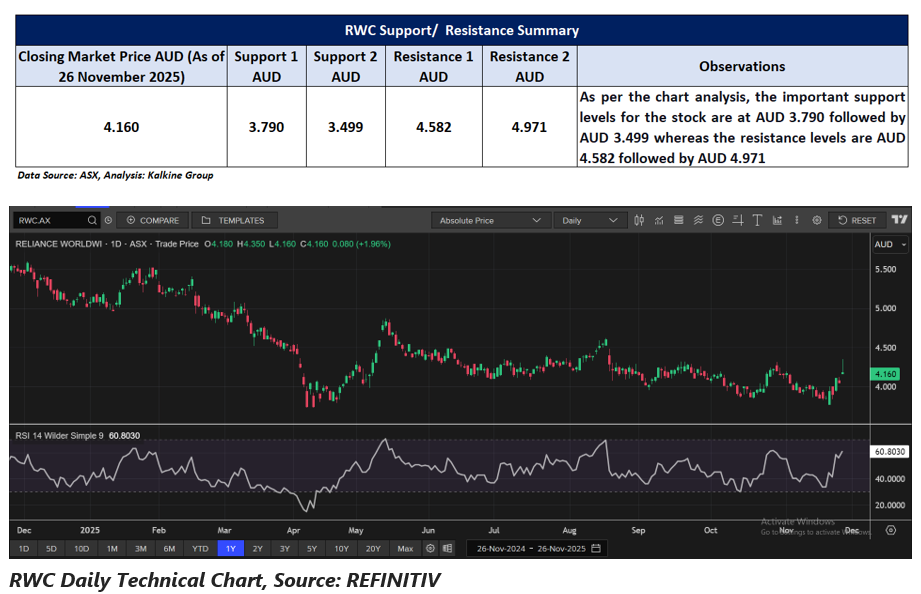
Note 1: Past performance is neither an Indicator nor a guarantee of future performance.
Note 2: The reference date for all price data, and currency, is 26 November 2025. The reference data in this report has been partly sourced from EODHD/Others.
Technical Indicators Defined:
Support: A level at which the stock prices tend to find support if they are falling, and a downtrend may take a pause backed by demand or buying interest. Support 1 refers to the nearby support level for the stock and if the price breaches the level, then Support 2 may act as the crucial support level for the stock.
Resistance: A level at which the stock prices tend to find resistance when they are rising, and an uptrend may take a pause due to profit booking or selling interest. Resistance 1 refers to the nearby resistance level for the stock and if the price surpasses the level, then Resistance 2 may act as the crucial resistance level for the stock.


 Nov 12, 2026





 Please wait processing your request...