
 CA
 NZ
 UK
 US
 IND

 AU

 Share
 X (Formerly Twitter)
 Whatsapp
 Facebook
 LinkedIn
 Telegram
 Email This Article
 Copy Link
 Summarize with AI
 Chat GPT
 Perplexity

Key Highlights
- Qantas Airways Limited (ASX:QAN) has formed a bullish Inverse Head & Shoulders pattern on the daily chart, indicating a potential reversal of the corrective trend that has persisted since early 2026.
- The stock is currently testing the critical $9.50 neckline resistance, with a confirmed breakout likely to attract additional buying interest.
- The pattern has developed following several months of consolidation, suggesting accumulation by longer-term investors.
- Based on the measured move projection of the formation, QAN carries a potential upside target near $10.70, representing approximately 13% upside from the neckline breakout level.
- Improving travel demand, resilient passenger volumes, and strong domestic market positioning continue to underpin the company's longer-term fundamentals.
Australia's Flag Carrier Continues to Benefit from Travel Demand Recovery
Qantas Airways is Australia's largest airline group, operating domestic and international passenger services through the Qantas and Jetstar brands. The company remains a dominant player in the Australian aviation market, benefiting from strong brand recognition, an extensive route network, and significant scale advantages.
The aviation sector has experienced a substantial recovery following the pandemic-era disruptions, with passenger demand remaining resilient despite elevated interest rates and cost-of-living pressures.
Several factors continue to support Qantas' investment appeal:
- Strong Domestic Market Position: Qantas maintains a leading share of the Australian domestic aviation market through both its premium Qantas brand and low-cost Jetstar operations.
- International Travel Recovery: Ongoing growth in international travel demand continues to support passenger volumes and yields.
- Loyalty Business Strength: The Qantas Frequent Flyer program remains a highly profitable business segment that generates recurring earnings and cash flow.
- Fleet Modernisation: Investment in new-generation aircraft is expected to improve fuel efficiency and enhance operational performance over the long term.
- Pricing Power: Capacity discipline across the aviation industry has supported relatively strong ticket pricing compared with pre-pandemic levels.
Associated Risks
Despite the constructive outlook for the aviation sector, investors should remain mindful of several risks. Higher fuel prices could place pressure on airline profit margins, particularly if increased costs cannot be fully passed on to customers through higher fares. Economic slowdowns may reduce both leisure and corporate travel demand, affecting passenger volumes and revenue growth. Operational disruptions, labour shortages, maintenance issues, or industrial action could also negatively impact earnings and service reliability. In addition, increased competition across domestic and international routes may pressure ticket pricing and profitability. Geopolitical tensions, changes in travel regulations, and broader global economic uncertainty could further influence international travel activity and create volatility in the company's operating performance.
Technical Outlook
The daily chart for Qantas Airways displays a developing Inverse Head & Shoulders accumulation pattern, suggesting that the correction that began in March 2026 may be nearing completion.
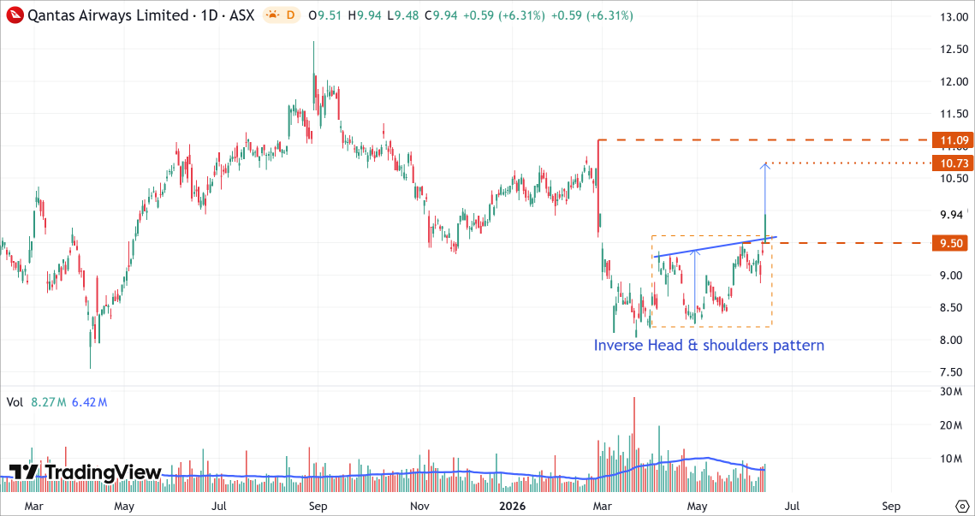
QAN's Daily Price Chart (at the closing price of 15/06/2026). Powered by: TradingView
- On the daily chart, QAN’s stock price completed an Inverse head and shoulders pattern, suggesting a potential short-term trend reversal from downward to upward.
- With a decisive break-out above $9.50 is now confirmed, the measured move derived from the Inverse Head & Shoulders formation projects a potential upside objective near $10.73, representing the next major resistance target.
- In this case, any short-term retracements toward the breakout zone would be considered constructive, provided the stock maintains support above the former neckline resistance.
Bottom Line
Qantas Airways Limited (ASX:QAN) is displaying increasingly constructive technical characteristics as it approaches a potential breakout from a well-defined Inverse Head & Shoulders reversal pattern. The combination of resilient travel demand, a strong market position, a valuable loyalty business, and improving chart structure suggests the stock may be preparing for its next upward leg.
Investors should closely monitor the critical $9.50 neckline resistance. A sustained breakout above this level would confirm the bullish reversal pattern and increase the probability of a medium-term advance toward the $10.73 target.


 Nov 12, 2026





 Please wait processing your request...