
 CA
 NZ
 UK
 US
 IND

 AU

 Share
 X (Formerly Twitter)
 Whatsapp
 Facebook
 LinkedIn
 Telegram
 Email This Article
 Copy Link
 Summarize with AI
 Chat GPT
 Perplexity

The World's Biggest Bond Manager Sends a Warning
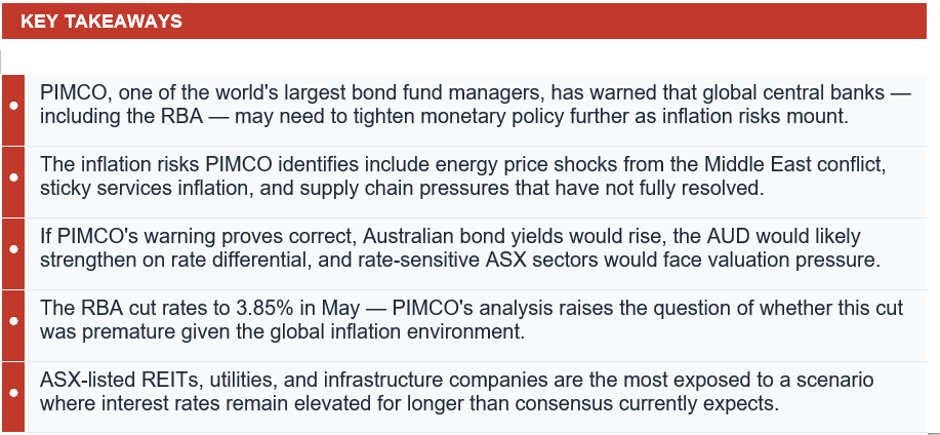
When PIMCO speaks, global markets listen. As one of the world's largest fixed income fund managers — overseeing trillions of dollars in bond portfolios — PIMCO's views on Inflation and Central Bank policy carry weight that extends well beyond academic commentary. Its warning that global central banks may need to tighten Monetary Policy further — rather than continuing to ease — represents a meaningful challenge to the dovish consensus that has dominated rate markets for much of 2026.
The specific inflation concerns PIMCO has identified align precisely with the risks that have been visible in the Australian economic data. Energy prices driven higher by the US-Iran conflict have fed directly into transport costs — a dynamic illustrated by the March 2026 ABS data showing a 5.1 per cent monthly surge in household transport spending. Services inflation, covering rents, insurance, healthcare, and other non-tradeable items, has proven persistently above target across most developed economies. And while goods inflation has moderated, the services component remains the dominant driver of CPI overshoot.
Implications for the RBA
The RBA's position in the context of PIMCO's warning is delicate. The Bank cut rates to 3.85 per cent in May 2026, and the market had been pricing in a further easing cycle through the remainder of the year. PIMCO's warning — combined with NAB's revised rate call and sticky services inflation data — raises the uncomfortable question of whether that May cut was premature.
The RBA operates under a dual mandate: price stability and Full Employment. At 3.85 per cent, the cash rate is below the neutral rate that most models suggest would neither stimulate nor restrain the economy. If inflation — particularly services inflation — remains above target, the RBA faces a choice between maintaining its easing bias (accepting above-target inflation in the near term) or reversing course with a pause or hike (risking further stress on households and the economy). PIMCO's warning suggests that the global environment is tilting toward the latter outcome for central banks broadly.
Impact on Australian Bond Yields and the AUD
The Bond Market's reaction to PIMCO's warning, if it is taken seriously by institutional investors, would be to sell Australian government bonds — pushing yields higher. Australian 10-year government bond yields have been a critical reference rate for property valuations, REIT discount rates, and corporate borrowing costs. A rise in long-end bond yields would increase the discount rate applied to income-generating Assets, reducing their present values even if the income itself hasn't changed.
For the Australian dollar, a scenario where the RBA holds or hikes relative to global central banks that are also pausing would be AUD-supportive through the Interest Rate differential. A stronger AUD creates mixed outcomes for Australian equities: it reduces the AUD value of offshore Earnings (negative for miners with USD revenues), but it also signals that Australia's monetary credibility is intact (broadly positive for sovereign risk assessments). The net impact depends on the mix of each individual company's exposure.
ASX Sector Implications
For ASX investors, PIMCO's warning is most directly relevant to rate-sensitive sectors. REITs — particularly those with high Leverage and longer-duration income streams — are the most exposed. Scentre Group, Vicinity Centres, Charter Hall, and Dexus all carry meaningful sensitivity to the discount rate applied to their asset values. A sustained rise in long bond yields from PIMCO's scenario would create valuation headwinds for the entire sector even if underlying property fundamentals remain healthy.
Infrastructure and utilities — Transurban, APA Group, AGL Energy — face similar dynamics. These companies are valued on discounted Cash Flow bases with long projection horizons; any increase in the discount rate reduces the present value of their asset bases. Banks face the more nuanced scenario described earlier: Margin improvement from higher rates versus Credit quality risk from borrower stress. At 3.85 per cent, systemic credit risk remains low, but any further tightening would increase the stress on variable rate Mortgage holders.


 Nov 12, 2026





 Please wait processing your request...