
 CA
 NZ
 UK
 US
 IND

 AU

 Share
 X (Formerly Twitter)
 Whatsapp
 Facebook
 LinkedIn
 Telegram
 Email This Article
 Copy Link
 Summarize with AI
 Chat GPT
 Perplexity

Income investing has long been one of the most popular strategies among Australian investors. With interest rates fluctuating, inflation affecting purchasing power, and global markets experiencing volatility, many investors are increasingly looking toward dividend- paying stocks and income-focused exchange-traded funds (ETFs) as a way to generate stable cash flow.
Australia is known for its dividend-friendly equity market, largely due to the franking credit system and the strong dividend culture among large listed companies. Major sectors such as banking, energy, telecommunications, and infrastructure have historically delivered consistent income to shareholders.
In 2026, several ASX-listed securities are drawing attention because of their high dividend yields and attractive income potential. Among these are:
- Ophir High Conviction Fund (ASX:OPH)
- Nine Entertainment Holdings (ASX:NEC)
- SPDR MSCI Australia Select High Dividend Yield ETF (ASX:SYI)
These three investments represent different income strategies.
One is an actively managed investment fund, one is a media company with strong cash flow, and one is an ETF specifically designed to capture high dividend yields from Australian companies.
Understanding how these investments generate income and what risks they carry is essential for investors seeking to build a sustainable dividend portfolio.
Why Dividend Investing Is Popular in Australia
Before examining the three securities individually, it is important to understand why dividend investing is particularly popular among Australian investors.
- Strong Dividend Culture - Many Australian companies prioritise returning capital to shareholders through Unlike many US growth companies that reinvest earnings, Australian firms often distribute a large portion of profits.
- Franking Credits - Australia’s tax system allows investors to receive franking credits on dividends paid by companies that have already paid corporate This effectively avoids double taxation and increases the attractiveness of dividend-paying stocks.
- Income for Retirees - Dividend stocks are particularly popular among retirees and self-managed super funds (SMSFs) seeking stable income streams.
- Defensive Investment Strategy - Dividend-paying companies are often mature businesses with stable cash flows, making them attractive during periods of market
Overview of the Three High Dividend Investments
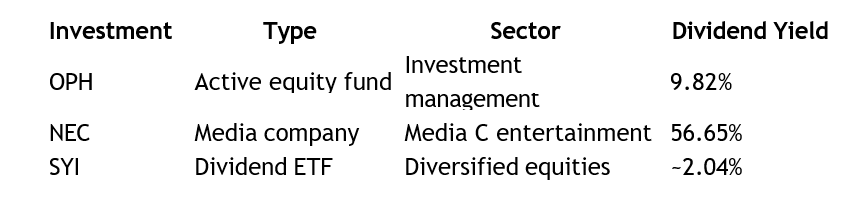
Each security offers a different way to generate income.
Ophir High Conviction Fund (ASX:OPH)
Overview of the Fund
The Ophir High Conviction Fund is an actively managed investment vehicle that focuses on identifying high-growth companies listed on the Australian Securities Exchange.
The fund invests in a concentrated portfolio of equities selected by experienced portfolio managers.
According to the ASX listing information, the fund was listed on 1G December 2018 and invests primarily in listed securities.
As of 06 March 2026, key metrics include:
- Share price: $2.85
- Market capitalisation: approximately $614 million
The fund has attracted attention among investors due to its relatively high dividend yield compared with many managed funds.
Dividend Yield and Distribution History
One of the key reasons investors follow OPH is its dividend yield. The fund recently declared:
- Dividend amount: $0.271
- Annual yield: about 82%
A yield close to 10% places OPH among the higher-income investment vehicles available on the ASX.
However, investors should remember that dividends from funds can fluctuate depending on realised capital gains and investment performance.
Financial Performance
The fund has reported strong financial metrics. Key figures include:
- Revenue: $168.3 million Net profit: $154.49 million EPS: $0.473
- P/E ratio: 79
A relatively low price-to-earnings ratio suggests the fund may be trading at a modest valuation relative to earnings.
Investment Strategy
Ophir Asset Management focuses on identifying companies with strong growth potential. The investment philosophy includes:
- identifying scalable business models
- investing in emerging industry leaders
- focusing on companies with strong earnings
The fund typically holds a relatively concentrated portfolio, meaning each investment can have a meaningful impact on overall returns.
Portfolio Characteristics
Typical investments in the fund may include:
- technology companies
- healthcare innovators
- consumer growth businesses
- emerging industrial
This strategy aims to capture capital appreciation alongside income distributions.
Advantages of Investing in OPH
There are several potential benefits associated with the Ophir High Conviction Fund.
- High Dividend Yield - The near-10% dividend yield is attractive to income-focused
- Active Management - Professional portfolio managers actively select investments rather than passively tracking an
- Exposure to Emerging Companies - The fund often invests in high-growth companies before they become widely
Risks to Consider
Despite its benefits, investors should also consider several risks.
- Market Volatility - Because the fund invests heavily in equities, its performance can be affected by stock market
- Concentration Risk - A concentrated portfolio means performance can depend heavily on a small number of
- Dividend Variability - Unlike traditional dividend-paying companies, distributions from investment funds may vary year to
Nine Entertainment Co. Holdings (ASX:NEC)
Nine Entertainment is one of Australia’s largest media companies. The company operates across multiple media platforms including television broadcasting, streaming services, and publishing.
The company was listed on the ASX in December 2013. Key market metrics include:
Share price: approximately $1.01 Market capitalisation: about $1.6 billion
Business Segments
Nine Entertainment operates across several major divisions.
- Television Broadcasting
- Streaming Platforms
- Publishing
Financial Performance
Nine Entertainment has generated substantial revenue from its diversified media operations.
Key figures include:
- Revenue: $2.68 billion
- Net profit: around $100 million
- P/E ratio: 14.86
The company’s free cash flow yield is estimated at approximately 16%, reflecting strong cash generation relative to market value.
Dividend Policy
Nine Entertainment has historically paid dividends to shareholders when cash flow allows. Recent dividend information includes:
Dividend amount: $0.045 per share Dividend type: interim dividend
The company’s dividend yield typically falls within the mid-single-digit range, depending on the share price.
Growth Drivers
- Digital Advertising - As advertising shifts from traditional television to online platforms, digital media assets may become increasingly valuable.
- Streaming Expansion - Stan continues to grow its subscriber base and expand its content
- Subscription Revenue - Digital subscriptions from newspapers and online publications contribute recurring revenue.
Challenges Facing the Media Sector
Despite growth opportunities, the media industry faces several challenges.
- Competition from Global Streaming Platforms
- Advertising Cycles
- Changing Consumer Behaviour
SPDR MSCI Australia Select High Dividend Yield ETF (ASX:SYI)
The SPDR MSCI Australia Select High Dividend Yield ETF is designed to track the MSCI Australia Select High Dividend Yield Index.
The ETF focuses on companies that are expected to generate higher dividend yields than the broader market.
The fund was admitted to trading on the ASX in September 2010.
Key Metrics
Important metrics for the ETF include:
Price: approximately $30.74 Fund size: $615 million Management fee: 0.20%
The relatively low management fee makes the ETF attractive for long-term investors.
Dividend Yield
The ETF distributes income generated from the underlying portfolio. Recent distribution information includes:
Distribution amount: $0.372 Annual yield: about 12.04%
Portfolio Composition
The ETF invests primarily in large-cap Australian companies. Top holdings include:
- Commonwealth Bank
- National Australia Bank
- ANZ Group
- Westpac Banking Corporation
- Macquarie Group
- Telstra Group
- Woodside Energy
- Coles Group
- QBE Insurance
- Santos
These companies are known for consistent dividend payments.
Sector Allocation
The ETF has a heavy allocation toward financial stocks. Sector distribution includes:
Financial services: 65%
Energy: 9%
Communication services: 6%
Consumer defensive: 4%
The strong weighting toward banks reflects the fact that Australian banks are among the highest dividend-paying companies.
Benefits of Dividend ETFs
- Diversification - Investors gain exposure to multiple companies through a single
- Passive Strategy - The ETF tracks an index rather than relying on active
- Consistent Income - Dividends from many companies are pooled together to create regular
Risks of Dividend ETFs
However, investors should also consider potential risks.
- Sector Concentration - High-dividend ETFs often have large exposures to financial
- Interest Rate Sensitivity - Dividend stocks may underperform if interest rates rise
- Market Volatility - Although dividend stocks are often considered defensive, they can still decline during market
Which Investment May Suit Different Investors?
- Income-focused investors - Investors seeking high income may prefer the SYI ETF due to its strong dividend yield and
- Growth-oriented investors - OPH may appeal to investors seeking both income and capital appreciation through active stock
- Sector exposure investors - NEC may interest investors looking for exposure to the Australian media sector with dividend
Key Risks for Dividend Investors in 2026
Dividend investing is not without risks.
Major factors that could impact dividend stocks include:
- economic slowdown
- interest rate changes
- corporate earnings declines
- global market
Investors should diversify their portfolios and avoid relying on a single income source.
Outlook for High Dividend Investments in Australia
The outlook for dividend investments remains strong in Australia due to several structural factors.
These include:
- strong corporate cash flows
- the franking credit system
- investor demand for income
However, dividend sustainability ultimately depends on company profitability and economic conditions.
Final Thoughts
High dividend investments continue to attract investors seeking income and stability in uncertain markets.
Among the options discussed:
- OPH offers high income through an actively managed
- NEC provides exposure to the Australian media sector with dividend
- SYI delivers diversified income through an ETF focused on high-yield
Each investment carries its own advantages and risks, and investors should carefully evaluate their financial goals before making investment decisions.


 Nov 12, 2026





 Please wait processing your request...