
 CA
 NZ
 UK
 US
 IND

 AU

 Share
 X (Formerly Twitter)
 Whatsapp
 Facebook
 LinkedIn
 Telegram
 Email This Article
 Copy Link
 Summarize with AI
 Chat GPT
 Perplexity

Highlights
- Lindsay Australia’s operating revenue increased by 5.6% to AUD 849.7 million in FY25, driven by growth in transport and rural segments.
- Underlying EBITDA declined 11.7% year-on-year in FY25, reflecting higher input costs and softer consumer demand in a competitive market.
- Cash and cash equivalents surged 139.3% to AUD 108.9 million, while the company expanded into three new regions to enhance revenue and cost synergies.
Lindsay Australia Limited (ASX:LAU), an ASX-listed company specialising in integrated transport, logistics, and rural supply services, posted an operating revenue of AUD 849.7 million for the fiscal year ending June 2025 (FY25). This marks a 5.6% increase from AUD 804.3 million recorded in FY24. The group revenue growth was primarily driven by expansion in transport and rural segments, supported by recent acquisitions.
EBITDA Declines While Strategic Acquisitions Progress
Despite revenue growth, underlying EBITDA fell 11.7% year-on-year in FY25. This decrease aligns with the company’s guidance and reflects higher industry capacity, elevated input costs, and softer consumer demand within a competitive market. The group invested AUD 50.8 million in fleet and infrastructure in FY25 and completed strategic acquisitions across Western Australia and Tasmania.
Key Business Moves and Expansion
In November 2025, the company announced that it has expanded its operations into three new regions: South West Western Australia, Victoria’s Goulburn Valley, and Tasmania. These expansions aim to drive earnings growth through revenue and cost synergies. The company's strategy continues to focus on transport-led operations, with rural and packaging businesses providing integration opportunities to enhance customer value.
Financial Position and Risks
Cash and cash equivalents surged by 139.3% to AUD 108.9 million in FY25, compared to AUD 45.5 million in FY24. The group maintained net leverage at 1.53x and secured a new four-year Enterprise Agreement covering over 1,800 employees.
Outlook for FY26
For FY26, the company plans to focus on integrating the SRT acquisition to unlock network-wide synergies. The company also intends to embed the GJ Freight acquisition and commission the new Hazelmere (Perth) terminal. Management prioritizes transformation initiatives, margin recovery, and capital efficiency to deliver sustainable growth in a competitive environment.
Key Positives and Negatives
Positives:
- Higher Gross Margin: 73.3% in FY25 vs. Industry Median of 38.3%
- Higher Asset Turnover Ratio: 1.46x in FY25 vs. Industry Median of 0.73x
Negatives:
- Lower Net Margin: 2.0% in FY25 vs. Industry Median of 4.7%
- Increase in Assets-to-Equity Ratio: 4.01x in FY25 vs. 3.68x in FY24
Share Performance of LAU
LAU shares closed at AUD 0.675, down 0.74% intraday as of 22 January 2026. Over the past year, the stock has declined by 24.16%. It fell 4.26% over the past month and 1.46% over the last week. However, the stock showed a positive return of 8.00% over the past three months. The 52-week high for Lindsay Australia Ltd is AUD 0.900, recorded on 22 January 2025, while the 52-week low is AUD 0.580, reached on 14 November 2025.
Support and Resistance Summary
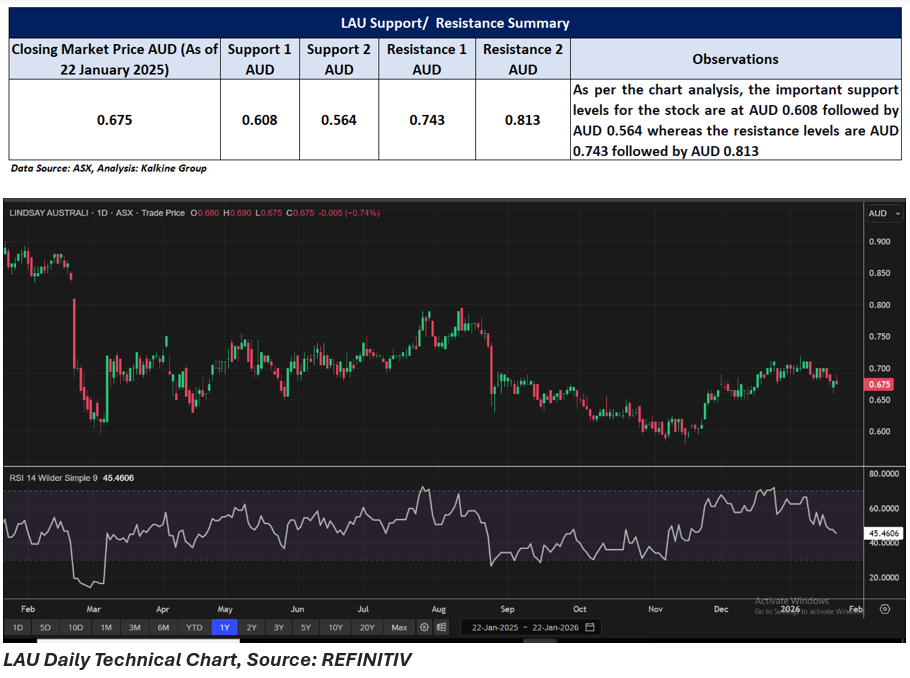
Note 1: Past performance is neither an Indicator nor a guarantee of future performance.
Note 2: The reference date for all price data, and currency, is 22 January 2026. The reference data in this report has been partly sourced from EODHD/Others.
Technical Indicators Defined:
Support: A level at which the stock prices tend to find support if they are falling, and a downtrend may take a pause backed by demand or buying interest. Support 1 refers to the nearby support level for the stock and if the price breaches the level, then Support 2 may act as the crucial support level for the stock.
Resistance: A level at which the stock prices tend to find resistance when they are rising, and an uptrend may take a pause due to profit booking or selling interest. Resistance 1 refers to the nearby resistance level for the stock and if the price surpasses the level, then Resistance 2 may act as the crucial resistance level for the stock.


 Nov 12, 2026





 Please wait processing your request...