
 CA
 NZ
 UK
 US
 IND

 AU

 Share
 X (Formerly Twitter)
 Whatsapp
 Facebook
 LinkedIn
 Telegram
 Email This Article
 Copy Link
 Summarize with AI
 Chat GPT
 Perplexity


Key takeaways
- Karoon Energy shares trading at $1.97, up 4.22% on the day.
- The rally came amid broad ASX 200 energy sector strength.
- Higher Brent crude oil prices and firm product spreads are supportive of KAR’s Brazilian production economics.
- Karoon’s production from the Baúna field and the Patola tie-back continues to underpin its earnings story.
- Key risks include oil price volatility, project delivery, and single-country operational exposure to Brazil.

The Karoon Energy share price (ASX:KAR) Thursday’s session firmly higher, adding $0.08 to trading at $1.97, a daily gain of +4.22%. Karoon’s move was part of another strong day for ASX 200 energy shares, with small and mid-cap oil producers riding a wave of firmer crude oil prices and improving investor sentiment toward the sector.
After a volatile start to 2026, today’s rally in KAR reinforces the view that small-cap Australian oil producers are back in favour. Below we explore the likely reasons for the move, the company’s operational backdrop, and the risks and opportunities shareholder should be watching.
Company overview: Who is Karoon Energy?
Karoon Energy Limited is an Australian-listed oil and gas exploration and production company with operations centred on Brazil. The company was historically a pure explorer, but in 2020 it transitioned to producer status with the acquisition of the Baúna field in the offshore Santos Basin. Karoon has since expanded its Brazilian footprint through the Patola field development, which ties back to Baúna’s existing infrastructure, and through an interest in the Who Dat oilfield in the US Gulf of Mexico.
Karoon’s strategy is to deliver reliable production, steady cash flows, and disciplined capital returns. Management has publicly focused on increasing free cash flow yield to shareholders, reducing debt, and exploring bolt-on opportunities to extend reserve life. The company has introduced a dividend and launched on-market buybacks in response to shareholder feedback about capital management.
For investors, Karoon offers something rare on the ASX: a liquid, small to mid-cap oil producer with operating assets in a reputable hydrocarbon province and reasonable cost structures. Its earnings are highly leveraged to Brent crude prices, making it an option on the global oil cycle for retail and institutional investors alike.
Why Karoon Energy shares went up today
Several factors help explain the Karoon Energy share price rally today.
1. Broad energy sector rally
The ASX 200 energy sector has rallied strongly over recent weeks on firmer Brent crude prices, improving product margins, and renewed institutional interest in cash-generating oil producers. Sector-wide moves of this kind tend to pull small and mid-cap producers like KAR sharply higher, often outpacing the large-cap leaders on a percentage basis.
2. Firmer Brent crude prices
Brent crude, the global benchmark most relevant to Karoon’s Brazilian production, has been trading at levels that support strong free cash flow generation at current volumes. Even small movements in Brent can have meaningful impacts on KAR’s earnings given its cost structure and tax profile.
3. Value rotation into producers
Investors looking for tangible cash flow and capital returns have been rotating into oil producers in recent weeks. KAR offers a relatively unique combination of mid-cap liquidity, producing assets, and a capital management framework that includes both dividends and buybacks.
4. Technical breakout
Karoon’s share price had been consolidating in a narrow range before today’s move. A breakout above short-term resistance levels likely triggered momentum and algorithmic buying, amplifying the sector-driven rally.
5. Speculation on bolt-on deals and cash returns
Market speculation around potential bolt-on acquisitions, contract renewals, or additional capital returns can feed into buying pressure even without formal announcements. KAR’s management has been active in messaging its commitment to shareholder returns, and that narrative continues to support the stock.
News, announcements, and market catalysts to watch
There was no price-sensitive ASX announcement from Karoon Energy during the session. Today’s move is therefore best understood as a sector rally combined with stock-specific enthusiasm for KAR’s cash flow story. Nonetheless, several ongoing themes are shaping the Karoon Energy share price narrative.
Baúna and Patola production
Karoon’s flagship Baúna field, along with the Patola tie-back, is the core of the company’s production base. Investors watch production rates, uptime, and operating costs closely. Any update on these metrics is a meaningful share price catalyst.
Who Dat interest
Karoon’s interest in the Who Dat field in the US Gulf of Mexico provides geographic diversification away from Brazil. While still a smaller contributor to the group, Who Dat adds reserve life and optionality.
Capital management
Karoon has publicly committed to shareholder returns, including through dividends and buybacks. Any update on these programs tends to move the share price.
Exploration and appraisal
Karoon’s exploration portfolio is not the main driver of short-term earnings, but any successful well results or contract awards could unlock longer-term value.
Brazilian regulatory environment
Brazilian regulators and royalty structures affect Karoon’s economics. Any change in the regulatory or tax regime could impact earnings and cash flows.
Sector and macro factors affecting the move
The broader context matters for any small-cap oil producer, and Karoon is no exception.
Global oil prices
Brent crude has been firm on the back of supply discipline among major producers and steady demand. The relationship between crude prices and KAR’s earnings is close to linear, which makes Brent the single most important external variable for the stock.
ASX 200 energy sector strength
ASX 200 energy shares have risen meaningfully over the past month, with producers like Woodside and Santos leading a sector-wide rally. Small-caps like KAR tend to ride those rallies with high beta.
Investor appetite for value
Markets have periodically rotated out of expensive technology names and into cheaper value stocks with tangible assets. Oil producers with reliable cash flows have benefited from that rotation.
Currency dynamics
Karoon’s revenue is US dollar-linked, while many of its operating costs are in Brazilian real. The interplay between these currencies and the Australian dollar can affect reported earnings in meaningful ways.
Interest rates and cost of capital
The RBA’s easing cycle has lowered the cost of capital for equity investors and made higher-beta stocks like KAR relatively more attractive. Lower discount rates also support the present value of long-dated oil reserves.
Geopolitical backdrop
Oil markets are always sensitive to geopolitical events, whether in the Middle East, Russia, Latin America, or West Africa. Incidents that disrupt supply can rapidly lift Brent and, by extension, KAR’s earnings outlook.
What investors are watching next
Investors in the Karoon Energy share price are watching for several catalysts that could confirm or challenge today’s rally.
Investors will be watching next for quarterly production and cost updates, Brent crude price trends, any capital management announcements including buybacks and dividends, exploration well results, and broker target price revisions following the recent rally.
Capital return framework
Management has emphasised discipline on capital returns. The next dividend declaration and any update on buyback activity will be a major focus. Consistency and credibility on this front are critical to the long-term thesis.
Reserve life and project pipeline
Investors want to see that Karoon can extend its reserve life organically and through smart bolt-on deals. Updates on near-field exploration and infill drilling are relevant to this question.
Cost performance
Even in a firmer oil price environment, cost discipline matters. Any deterioration in operating costs at Baúna would weigh on sentiment. Any improvement, such as through production optimisation or lower lifting costs, would be supportive.
Peer benchmarking
Karoon is sometimes compared with other small-cap ASX oil producers and with global peers operating in Brazil. When KAR outperforms those peers on cash flow or capital return metrics, it attracts additional institutional interest.
M&A and consolidation themes
Global and regional oil and gas M&A activity has been steady, with larger producers continuing to look for bolt-on acquisitions to extend reserve life and improve production economics. Karoon, as a small, profitable producer with a defined asset base, could either be a consolidator or eventually a target in such activity. Market speculation about corporate interest in KAR periodically adds a bid to the share price. While no such activity is confirmed, investors should be aware that M&A dynamics are part of the narrative around ASX-listed small-cap producers.
Decommissioning and rehabilitation liabilities
Oil producers carry decommissioning and rehabilitation liabilities that can be meaningful in absolute dollar terms. Investors should pay attention to how these liabilities are disclosed, how they are accruing, and how they compare with the reserve base. For a company like Karoon, sustained production and reserve replacement reduce the risk that decommissioning costs become disproportionately large relative to remaining cash flows. This is an important line item for long-term valuation work.
Dividend policy context
Karoon’s dividend policy has evolved as the company transitioned from pure explorer to producer. Investors comparing KAR with other ASX income stocks should recognise that its dividend is supported by Brent-linked cash flows and is therefore more variable than a utility or a bank. In strong oil price environments the dividend is comfortable; in weaker environments the board retains flexibility to prioritise balance sheet strength. That variability is a feature of energy sector income investing, not a bug, and investors should set their expectations accordingly.
Risks to the current momentum
Even though the Karoon Energy share price has been supported by the sector rally, several risks could cap further upside.
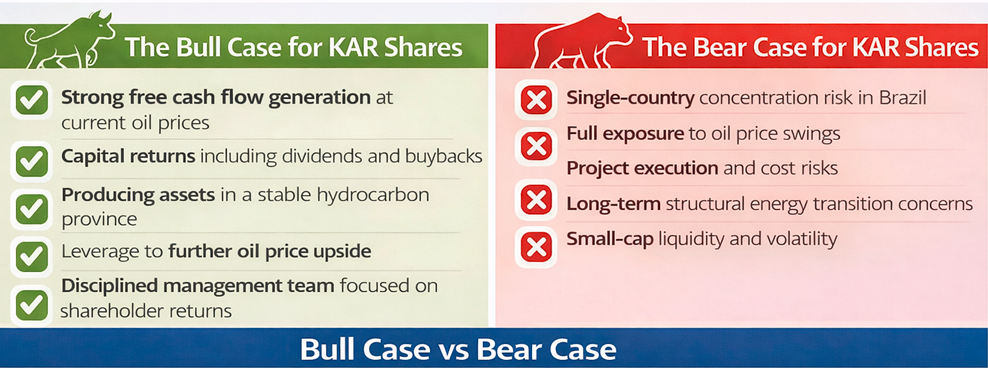
The most obvious is oil price volatility. KAR is highly leveraged to Brent, and any sharp pullback in crude would weigh directly on earnings forecasts and share price sentiment.
Single-country concentration risk is another factor. With most of Karoon’s production in Brazil, any operational, political, or regulatory issue in that country has an outsized impact on the business. While Brazil is a stable and well-regulated hydrocarbon province, investors should be aware of the concentration.
Project execution risk applies to any new developments or infill drilling programs. Cost overruns, delays, or unexpected subsurface issues can quickly erode the value of a project.
Currency risk, particularly the Brazilian real, can cause unexpected swings in earnings and cash flow.
Finally, the broader energy transition poses a long-term risk for oil producers. While the transition is unlikely to derail the investment case over the next few years, it is a factor that investors should weigh when thinking about terminal value.
Macro and liquidity risks
Because KAR is a small-cap stock, liquidity can be thinner than in large-cap peers. That means share price moves can be more volatile and trading can be more impactful. A broader risk-off environment could see small-caps sell off harder than the rest of the market, even if KAR’s fundamentals remain unchanged. Investors should factor that liquidity risk into their position sizing.
Conclusion: What today’s Karoon rally means
Today’s 4.22% gain in the Karoon Energy share price is a reminder that small-cap oil producers can move sharply when sector sentiment turns. With no price-sensitive announcement on the day, the rally reflects broader strength in ASX 200 energy names, firm Brent crude prices, and investor appetite for cash-generating producers with credible capital return frameworks.
For long-term investors, KAR remains a play on oil prices, disciplined capital management, and Brazilian project execution. Shareholders should welcome the move but remain focused on the underlying metrics that matter most: production volumes, cost per barrel, and realised prices. When those metrics hold up, the Karoon Energy share price can continue to reward patient holders.
At $1.97, KAR trades at what many investors view as a modest multiple relative to its free cash flow yield. Whether that valuation is justified depends on how confident you are in the oil price outlook and the company’s ability to continue delivering on its commitments to shareholders.


 Nov 12, 2026





 Please wait processing your request...