
 CA
 NZ
 UK
 US
 IND

 AU

 Share
 X (Formerly Twitter)
 Whatsapp
 Facebook
 LinkedIn
 Telegram
 Email This Article
 Copy Link
 Summarize with AI
 Chat GPT
 Perplexity

A Treasurer Under Fire on Tax Data
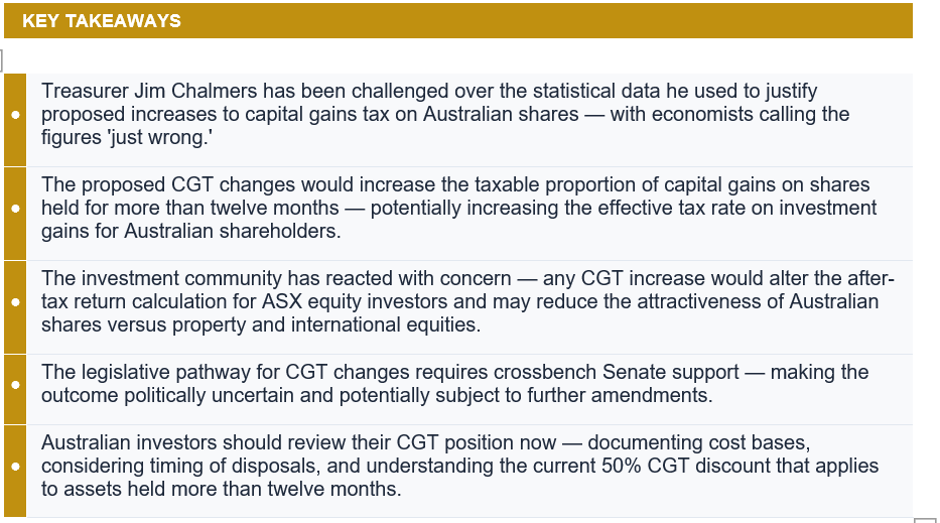
Treasurer Jim Chalmers has found himself in the unusual position of having his own statistical justification for a tax policy proposal challenged publicly by economists and Market Participants. The controversy centres on data that Chalmers cited to support proposed changes to Capital Gains Tax on Australian shares — data that critics, including several prominent economists, are describing as 'just wrong.' The episode raises important questions not just about the specific policy, but about the quality of the analytical foundation for tax reform proposals in Australia.
The specific data dispute involves the characterisation of who benefits from the current CGT discount. The 50 per cent CGT discount — which reduces the taxable component of capital gains on Assets held for more than twelve months — was introduced in 1999 as part of the Ralph Review reforms. The Treasurer has been using figures that allegedly overstate the concentration of CGT discount benefits among high-income earners, a framing designed to build the political case for reducing or eliminating the discount for shares. Critics argue these figures misrepresent the distribution of share ownership in Australia and incorrectly characterise who would be affected by the proposed changes.
The Policy Proposal: What Is Actually Being Proposed
The proposed CGT changes for Australian shares would increase the percentage of a Capital Gain that is included in assessable income. Under the current framework, if you sell shares held for more than twelve months at a profit, only 50 per cent of the gain is added to your Taxable Income — effectively halving the tax rate on long-term Investment returns. The proposal reportedly involves increasing that inclusion rate, which would increase the effective tax rate on capital gains for investors in all income brackets.
For an investor in the top marginal tax rate of 47 per cent, the current framework creates an effective CGT rate of approximately 23.5 per cent on long-term gains (50% of 47%). Under a reformed model with a higher inclusion rate, that effective rate would rise proportionally. For investors relying on capital gains from shares as part of their retirement funding strategy — including self-managed super fund trustees and high-net-worth investors — the change would meaningfully reduce after-tax returns on ASX Equity investments.
Market and Investment Community Reaction
The investment community has reacted with a combination of concern and lobbying intensity. Industry bodies including the Financial Services Council and the SMSF Association have argued that any increase in CGT rates on shares would distort investment decisions — pushing capital toward property (which has a natural CGT advantage through the principal place of residence exemption) and away from productive equity investment. The argument is not just about fairness to existing investors; it is about the structural incentives that determine where Australian savings are allocated.
ASX-listed companies would face the second-order effect of reduced domestic investor appetite for equities if CGT rates increase. Retail investor participation in the Australian sharemarket — which has been a significant driver of market depth and Liquidity, particularly through the growth of self-managed super funds — could moderate if the after-tax return disadvantage versus other asset classes widens.
What Australian Investors Should Do Now
Regardless of the ultimate legislative outcome, the CGT debate creates an important prompt for Australian investors to review their own positions. The key actions to take before any policy changes are implemented include: documenting the cost base of all share holdings accurately (the purchase price and purchase date for each parcel), understanding which holdings are currently in or out of the twelve-month Holding Period, considering whether any planned disposals should be accelerated before legislation changes, and reviewing super contribution strategies that may reduce exposure to personal CGT.
The legislative pathway remains highly uncertain. CGT changes require Senate support, and the crossbench — particularly the Greens and the independent senators — will each have conditions. The Greens are likely to push for more comprehensive reform; the independents may Demand carve-outs for small investors or SMSF holders. This political complexity means the final legislation, if any passes at all, may look quite different from the original proposal.


 Nov 12, 2026





 Please wait processing your request...