
 CA
 NZ
 UK
 US
 IND

 AU

 Share
 X (Formerly Twitter)
 Whatsapp
 Facebook
 LinkedIn
 Telegram
 Email This Article
 Copy Link
 Summarize with AI
 Chat GPT
 Perplexity

Highlights
- GTK’s FY25 revenue reached NZD 230.2 million, up 7.9% YoY, with NPAT more than doubling to NZD 20.9 million
- Recurring revenue increased 13% YoY to NZD 155.4 million in FY25, driven by g2.0 and Veovo deployments
- Cash position of NZD 84.8 million and strategic leadership appointments is expected to support future growth
Gentrack Group Limited (ASX:GTK), an ASX-listed company providing software solutions for utilities and airports, has reported encouraging financial results for the full year ended 30 September 2025 (FY25). With over 35 years of experience, the company continues to support utilities in meeting evolving business and sustainability goals while driving innovation in airport digital operations.
For FY25, the company achieved revenue of NZD 230.2 million, representing a 7.9% increase from NZD 213.2 million in FY24. Recurring revenue for the period rose 13% YoY to NZD 155.4 million. Net profit after tax (NPAT) more than doubled in FY25, reaching NZD 20.9 million, compared to NZD 9.5 million in the prior year.
Growth Driven by Recurring Revenue and Digital Transformation
The company’s FY25 growth was largely fuelled by expanding recurring revenues across its Utilities segment and Veovo airport solutions. Increased customer renewals, deployments of the g2.0 platform, and demand for airport digital transformation initiatives contributed to the performance. Gentrack also benefited from operating leverage, an improved revenue mix, and foreign exchange gains.
These gains were partially offset by ongoing investments in product development and sales capability. Despite these investments, cash on hand increased to NZD 84.8 million by the end of FY25, up NZD 18.1 million from the previous year.
Strategic Updates and Leadership Moves
Gentrack made notable strategic moves in late 2025 and early 2026. Regal Partners increased its stake in GTK to 9.79% through net on-market purchases.
Additionally, the company appointed John Scott as a non-executive director effective 1 January 2026. With extensive experience in global technology and digital transformation, Scott has led high-growth teams and scaled multiple businesses, including Invenco, EROAD, and AoFrio, strengthening Gentrack’s leadership expertise and strategic capabilities.
Positive Outlook for FY26 and Beyond
Looking ahead, the company expects FY26 revenue growth to exceed FY25, driven by a mature project pipeline, increasing adoption of the g2.0 platform, rising engagement in EMEA and APAC markets, and Veovo’s expanding airport customer base. The company targets mid-term revenue growth of over 15% CAGR.
The company stated that the combination of scale benefits, increasing SaaS penetration, and recurring revenue growth is expected to drive EBITDA margins toward a mid-term target of 15–20%. With a cash position of NZD 84.8 million and no dividend payout, GTK has the flexibility to fund organic growth, platform enhancements, and potential strategic acquisitions without straining its balance sheet.
Share Performance of GTK
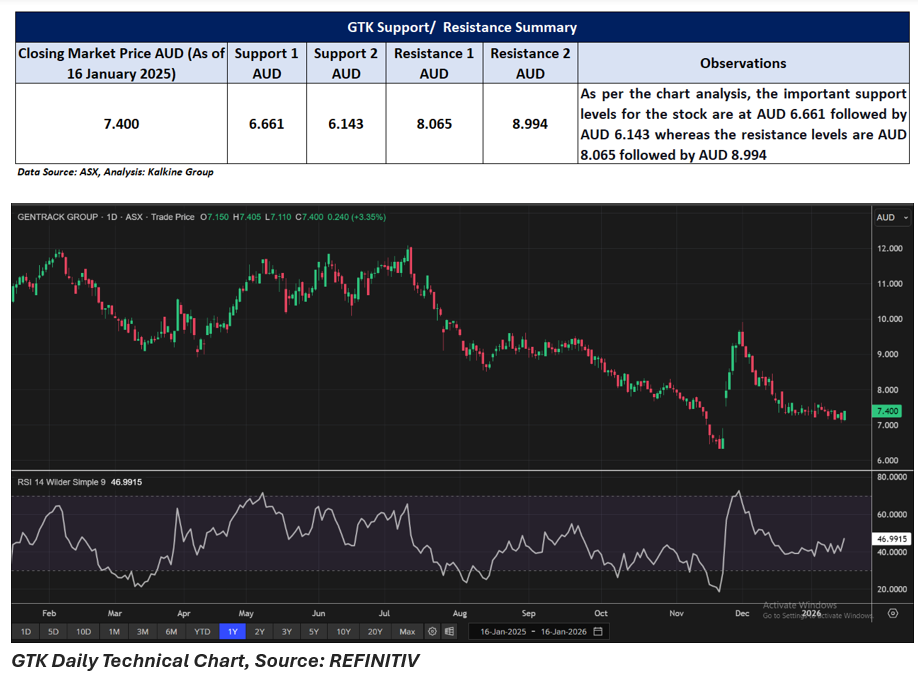
GTK shares rose by 3.35% to close at AUD 7.40 per share on 16 January 2026. Over the past year, the stock has declined 32.30%. It is down 8.64% over the past three months and 31.92% over the past six months. The 52-week high for GTK is AUD 12.080, recorded on 10 July 2025, and the 52-week low is AUD 6.340, reached on 21 November 2025.
Support and Resistance Summary
Note 1: Past performance is neither an Indicator nor a guarantee of future performance.
Note 2: The reference date for all price data, and currency, is 16 January 2026. The reference data in this report has been partly sourced from EODHD/Others.
Technical Indicators Defined:
Support: A level at which the stock prices tend to find support if they are falling, and a downtrend may take a pause backed by demand or buying interest. Support 1 refers to the nearby support level for the stock and if the price breaches the level, then Support 2 may act as the crucial support level for the stock.
Resistance: A level at which the stock prices tend to find resistance when they are rising, and an uptrend may take a pause due to profit booking or selling interest. Resistance 1 refers to the nearby resistance level for the stock and if the price surpasses the level, then Resistance 2 may act as the crucial resistance level for the stock.


 Nov 12, 2026





 Please wait processing your request...