
 CA
 NZ
 UK
 US
 IND

 AU

 Share
 X (Formerly Twitter)
 Whatsapp
 Facebook
 LinkedIn
 Telegram
 Email This Article
 Copy Link
 Summarize with AI
 Chat GPT
 Perplexity

A Political Concession That Matters
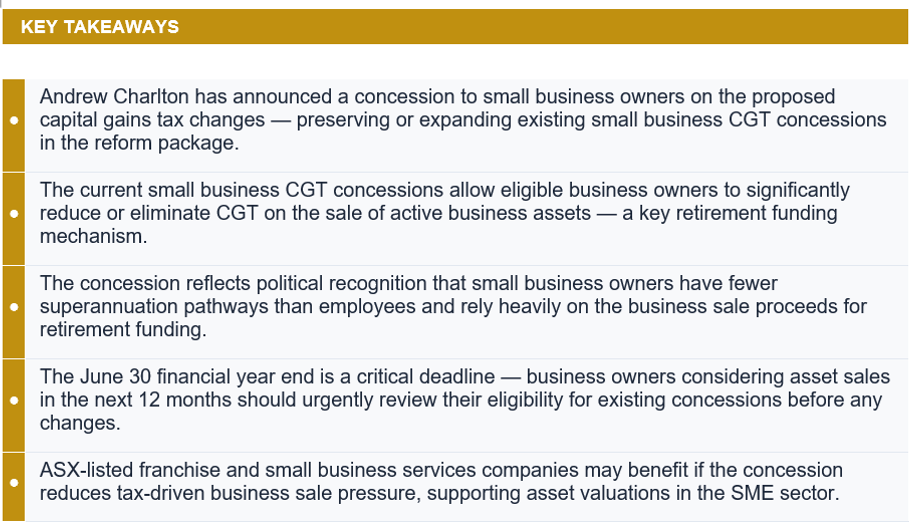
In the volatile debate surrounding Capital Gains Tax reform in Australia, Andrew Charlton's concession to small Business operators represents a meaningful political acknowledgement that one-size-fits-all tax reform risks causing significant unintended damage to a segment of the economy that contributes enormously to employment, innovation, and community economic activity. The concession — preserving or enhancing the existing small business CGT framework within the broader reform package — is both a political necessity and a sound policy outcome for the approximately 2.5 million active small businesses in Australia.
To understand why this concession matters, it is necessary to first understand how the existing small business CGT concessions work and who relies on them. Under the current framework, small business owners who sell active Business Assets can access four CGT concessions: the 15-year exemption (for assets held for at least fifteen years, providing a complete CGT exemption on sale for owners aged over 55 or retiring due to permanent incapacity), the retirement exemption (up to A$500,000 of capital gains can be disregarded if contributed to Superannuation or taken as a retirement benefit), the small business rollover (deferring CGT by reinvesting sale proceeds into replacement active assets), and the 50 per cent active asset reduction (halving the Capital Gain that would otherwise be included in assessable income).
Why Small Business Owners Are in a Different Position
The political and policy justification for a small business CGT Carve-Out is straightforward: small business owners fund their retirement differently from salaried employees. Employees accumulate superannuation contributions from employers throughout their working life — by retirement, the superannuation balance is typically the primary retirement asset. Small business owners, particularly those who self-employ rather than running incorporated businesses with regular salaries, often have minimal superannuation savings and rely instead on the eventual sale of the business as their primary retirement asset.
For a small business owner who has built a business over twenty years, the sale proceeds represent the accumulated value of their life's work. Applying a higher CGT rate to that sale — under the proposed CGT changes — would effectively reduce the retirement savings of people who chose to build a business rather than accumulate super. This is the argument that Charlton has acknowledged, and that makes the small business concession both politically necessary and substantively justified.
The June 30 Deadline: Why Action Is Urgent
The concession announcement creates an important time pressure for small business owners who are considering selling assets in the next twelve to eighteen months. The current CGT concession framework — before any changes — is the most generous it has ever been for qualifying businesses. Business owners who are considering a sale, whether of the entire business, a property used in the business, or Goodwill and intellectual property, should urgently review their eligibility for the existing concessions and consider whether the timing of any sale should be accelerated to lock in current tax treatment.
The key eligibility criteria for the small business CGT concessions include: the entity must satisfy the 'small business entity' test (aggregated annual turnover less than A$10 million), or the net asset value test (net assets of the business including related entities less than A$6 million), and the asset must be an 'active asset' — used in the carrying on of a business. The 15-year exemption additionally requires the asset to have been owned for at least fifteen continuous years, and the relevant individual to be aged 55 or retiring. Meeting these criteria before June 30 and well in advance of any legislative changes provides the clearest path to current concession access.
Implications for the SME Sector and ASX
The concession's announcement is broadly positive for ASX-listed companies that provide services to the SME sector — accounting firms, legal services companies, and financial planning businesses that advise small business owners on business sales and succession. If the concession successfully reduces the tax burden on business sales, it may increase the Volume of business transactions as owners who were deferring decisions due to CGT uncertainty proceed with planned exits.
For the broader economy, a healthy business sale market supports entrepreneurship — it enables successful business owners to exit at Fair Value, providing capital for reinvestment and confidence for the next generation of business founders. Any policy that unnecessarily suppresses business sale activity reduces economic dynamism and ultimately costs the government more in reduced business Investment and employment than it gains in incremental CGT Revenue.


 Nov 12, 2026





 Please wait processing your request...