
 CA
 NZ
 UK
 US
 IND

 AU

 Share
 X (Formerly Twitter)
 Whatsapp
 Facebook
 LinkedIn
 Telegram
 Email This Article
 Copy Link
 Summarize with AI
 Chat GPT
 Perplexity

For a long stretch, real estate stocks weren't where the heat was. Investors chased AI, lithium, uranium, and high-growth tech. Property — slow, boring, "old economy" property — got pushed to the side.
That story is starting to flip.
As interest-rate expectations stabilise, Inflation cools, and investors get tired of paying premium multiples for stocks that pay no income at all, the conversation is shifting back to something investors used to love: Cash Flow. Specifically, property cash flow. Rent. Dividends. Tangible buildings that produce real, recurring income.
Suddenly, the ASX real estate sector — which contains some of the most reliable income-generating businesses on the market — is being talked about again. And not just by retirees and Yield-hungry boomers. Younger investors, ETF buyers, and even momentum traders are circling property names because they're seeing something familiar coming back into fashion: Dividend yield.
This article focuses on 8 ASX-listed real estate stocks that the consensus rating currently rates as a Buy. They span the full spectrum of the sector — from giant retail landlords to office space operators, residential developers, retirement living specialists, and even a digital property marketplace.
The 8 stocks we'll break down are:
- Scentre Group (SCG:ASX)
- Servcorp Ltd (SRV:ASX)
- Cedar Woods Properties Ltd (CWP:ASX)
- Eureka Group Holdings Ltd (EGH:ASX)
- Charter Hall Group (CHC:ASX)
- Ingenia Communities Group (INA:ASX)
- Aspen Group Ltd (APZ:ASX)
- REA Group Ltd (REA:ASX)
Some of them pay big juicy yields. Some of them are smaller, sleepier names. Some are Blue-Chip giants. One of them is a tech-flavoured property platform that doesn't even own buildings.
What unites them? They all sit inside the ASX real estate sector, they all carry a Buy consensus rating, and they're all worth a closer look as property income forces its way back into the spotlight.
A quick note before we dive in: "Buy" is a consensus rating, not a guarantee. Markets move. Ratings change. This article is for general information only and is not personal financial advice. Always do your own research and, if needed, talk to a licensed financial professional before making Investment decisions.
With that out of the way — let's get into it.
Why Real Estate Stocks Can Appeal To Income-Focused Investors
If you've ever owned a rental property, you already understand the basic appeal of real estate. You buy a building. The tenant pays rent. After expenses, what's left is income.
Listed real estate companies — particularly Real Estate Investment Trusts (REITs) — give investors a way to get exposure to that same income stream without buying a physical property. Instead of being a hands-on landlord, you own a slice of a portfolio that might include shopping centres, office towers, logistics warehouses, retirement villages, or residential developments.
REITs in particular are structured to distribute most of their Taxable Income to shareholders, which is why so many of them pay dividends — sometimes generous ones. That's exactly what income-focused investors want: a regular, predictable cash flow that lands in your account whether the share price is up, down, or sideways.
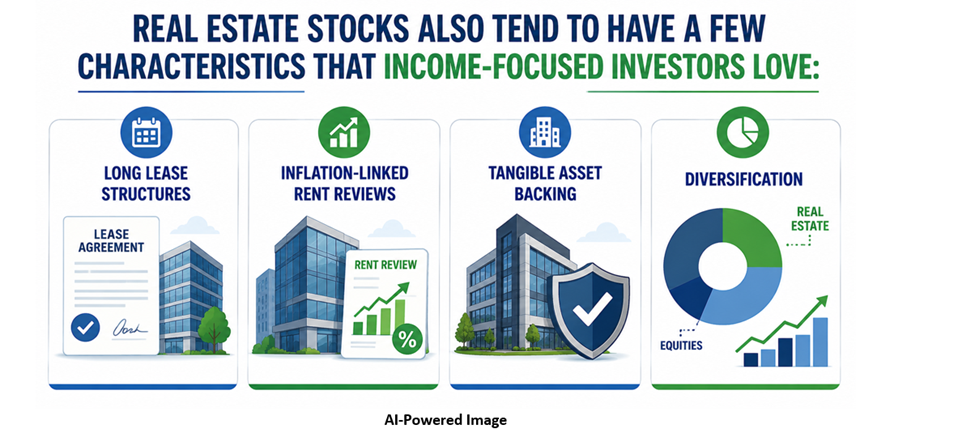
But — and this is important — real estate stocks are not bonds. They are equities. Their share prices move with sentiment, interest rates, leasing Demand, and broader economic conditions. A high yield is not a guaranteed yield. A "stable" REIT can still drop 20% in a bad month.
Income-focused investing is about capturing reliable cash flow over time — not chasing the highest number on the screen. With that mindset, ASX real estate currently offers an interesting menu.
Dividend Yield Explained — And Why Higher Yields Can Be Both Attractive And Risky
Let's break this down properly because it's the single most important number in this article.
Dividend yield is calculated as the annual Dividend per share divided by the current share price. If a company pays $1 in annual dividends and the share price is $20, the dividend yield is 5%.
A higher yield means you're getting more income per dollar invested today. That sounds great, and often it is. But yield can be deceiving.
Here's why.
Yield can rise for two very different reasons:
- The company increased its dividend. That's a good reason. The Business is generating more cash and rewarding shareholders.
- The share price fell. That's not necessarily a good reason. The market might be pricing in declining Earnings, financial stress, or a coming dividend cut.
The second case is what investors call a yield trap. The number on the screen looks juicy, but the underlying company is struggling and the dividend may be slashed. When that happens, you get a one-two punch: the yield disappears and the share price keeps falling.
This is why income-focused investors look beyond the headline yield and dig into:
- Payout Ratio — what percentage of earnings is being paid as dividends?
- Distribution coverage — does Operating Cash Flow comfortably cover the payout?
- Debt levels — high Leverage can stress dividend reliability when rates rise.
- Occupancy and Lease metrics — are the buildings actually full of paying tenants?
- Track record — has the company consistently paid and grown the distribution?
A 4.74% yield from a financially solid landlord is very different from a 4.74% yield from a struggling business about to refinance its debt at a much higher rate.
In this article, we'll flag the yields for each stock — but always remember: yield is one input. It's not the whole story.
Stock #1 — Scentre Group (SCG:ASX)
- Country: Australia
- Sector: Real Estate
- Industry: Real Estate Investment Trusts
- Market cap: about A$20.2 billion
- 5-year Beta: 36
- Dividend yield: 74%
- Consensus rating: Buy
Scentre Group is the giant of Australian shopping centres. It owns and operates the Westfield-branded centres in Australia and New Zealand — the kind of malls most Aussies have walked through dozens of times without realising who actually owns the property.
In an era when "the death of retail" was a constant headline, Scentre quietly kept doing what it does: collecting rent from a portfolio of high-traffic, high-quality shopping centres. The thesis here is simple. Premium retail real estate, located in the right population centres, doesn't really die — it adapts. Online retailers still need physical showrooms. Restaurants, services, entertainment, and experiential retail can't be ordered in a brown box on your doorstep.
With a market cap of about A$20.2 billion, SCG is a heavyweight. Its dividend yield of 4.74% is the highest of the 8 stocks featured here, and that's part of why the name is back in the conversation. A beta of 1.36 suggests it tends to be more volatile than the broader market, which can cut both ways — bigger gains in good times, deeper drawdowns in bad ones.
Consensus rating: Buy.
The risk to keep in mind is that Scentre's earnings are tied to consumer spending, retailer health, and foot traffic. If discretionary spending takes a hit, retail landlords feel it. But for investors looking for a serious income payer with serious scale, SCG is hard to ignore.
Stock #2 — Servcorp Ltd (SRV:ASX)
- Country: Australia
- Sector: Real Estate
- Industry: Real Estate Investment and Services
- Market cap: about A$663 million
- 5-year beta: 3035
- Dividend yield: 67%
- Consensus rating: Buy
Servcorp is a different animal entirely. Rather than owning massive shopping centres, Servcorp is in the flexible workspace and serviced office business — think premium office suites, virtual offices, and meeting rooms operated across multiple countries.
In a world where the office market has been completely reshaped by hybrid work, Servcorp's model is interesting. Companies don't necessarily want to lock into long, expensive office leases anymore. They want flexibility — and that's exactly what Servcorp sells.
Servcorp is much smaller than Scentre at around A$663 million market cap, but it carries a chunky 4.67% dividend yield and consensus rating of Buy. Notably, its 5-year beta is just 0.3035, meaning historically it has been significantly less volatile than the broader market. For income-focused investors who don't love big swings, that's worth a second look.
Lower beta also tends to mean the share price is less reactive to broad market sell-offs — though it can also mean the stock is less liquid and may not bounce as quickly in a market rally. Like all real estate names, Servcorp's profitability depends on occupancy. If demand for flexible workspace softens, so does the income.
Still, with a high yield, low beta, and a Buy consensus, Servcorp is one of the more interesting smaller-cap names on this list.
Stock #3 — Cedar Woods Properties Ltd (CWP:ASX)
- Country: Australia
- Sector: Real Estate
- Industry: Real Estate Investment and Services
- Market cap: about A$593 million
- 5-year beta: 28
- Dividend yield: 66%
- Consensus rating: Buy
Cedar Woods is a residential property developer — one of the more pure plays on Australian housing demand on this list. Rather than collecting rent from existing buildings, Cedar Woods makes its money by acquiring land, developing it, and selling residential properties.
That's a fundamentally different business model from a REIT, and it comes with different drivers. Cedar Woods benefits when:
- Australian housing demand is strong
- Population growth keeps pressure on Supply
- Buyer sentiment is positive
- Mortgage rates are manageable
It struggles when housing transactions slow, regulatory changes hit the market, or construction costs blow out budgets.
At a market cap of about A$622 million, Cedar Woods is mid-tier. Its dividend yield of 4.66% is very close to Servcorp's, putting it firmly in the income-friendly bracket. Its 5-year beta of 1.28 suggests it has been more volatile than the market — not surprising for a property developer whose earnings are sensitive to housing cycles.
Consensus rating: Buy.
Investors interested in CWP are typically betting on Australia's structural housing story. If you believe demand for housing will continue to outpace supply over the long run, Cedar Woods is a name worth understanding.
Stock #4 — Eureka Group Holdings Ltd (EGH:ASX)
- Country: Australia
- Sector: Real Estate
- Industry: Real Estate Investment and Services
- Market cap: about A$257 million
- 5-year beta: 1134
- Dividend yield: 52%
- Consensus rating: Buy
Eureka Group is the smallest name on the list by market cap — about A$257 million — and arguably the most distinctive. Eureka focuses on affordable seniors' rental accommodation. We're talking village-style independent living for older Australians on lower incomes.
Why is this interesting? Two huge demographic and economic trends are working in Eureka's favour:
- Australia's population is ageing. The number of seniors keeps growing every year.
- Affordability pressures are rising. Many seniors are looking for cost-effective housing Options that aren't aged-care facilities.
Eureka sits exactly at the intersection of those two trends.
Its dividend yield is a more modest 2.52%, but the standout number here is the 5-year beta of just 0.1134 — astonishingly low. That suggests the share price has historically moved much less than the broader market. For investors seeking a defensive, demographic-driven exposure, that's an attractive profile.
Consensus rating: Buy.
The trade-off is that Eureka is small, less liquid, and operates in a niche corner of the property market. Smaller stocks can move sharply on relatively small Volume. But for investors looking for differentiated exposure to Australia's ageing population, EGH is a name worth digging into further.
Stock #5 — Charter Hall Group (CHC:ASX)
- Country: Australia
- Sector: Real Estate
- Industry: Real Estate Investment Trusts
- Market cap: about A$9.8 billion
- 5-year beta: 00
- Dividend yield: 46%
- Consensus rating: Buy
Charter Hall is one of Australia's largest property fund managers and one of the most prominent names in Commercial Real Estate on the ASX. Its business spans office, industrial, retail, and social infrastructure Assets — and crucially, it doesn't just own buildings, it manages funds for other investors too.
That dual model — direct property income plus funds management fees — is what makes Charter Hall stand out. When property markets are healthy and assets under management grow, Charter Hall makes money on both ends.
At a market cap of about A$9.8 billion, CHC is the third-largest name on this list. Its dividend yield of 2.46% is more moderate, reflecting partly that it's not a pure-play passive landlord.
Now here's the wild card: a 5-year beta of 2.00. That's high. Very high. It suggests Charter Hall has historically moved twice as much as the broader market in either direction. That kind of Volatility is a feature, not a bug — Charter Hall's model has more leverage to property cycles than your average rent-collecting REIT.
Consensus rating: Buy.
For investors comfortable with bigger swings in pursuit of broader exposure to Australian commercial property and asset management, Charter Hall is a high-conviction name. For risk-averse income seekers, the volatility profile is something to take seriously.
Stock #6 — Ingenia Communities Group (INA:ASX)
- Country: Australia
- Sector: Real Estate
- Industry: Real Estate Investment and Services
- Market cap: about A$1.67 billion
- 5-year beta: 33
- Dividend yield: 32%
- Consensus rating: Buy
Ingenia is another demographic-driven name on this list. The company develops, owns, and operates lifestyle and holiday communities across Australia — including land-lease communities popular with retirees and tourist parks aimed at the domestic holiday market.
The land-lease model is structurally interesting. Residents own their home but lease the land underneath — which means lower entry costs for buyers and ongoing rental income for the operator. As Australia's population continues to age and as more retirees seek affordable, community-style living, the demand for this model has been growing.
Ingenia's holiday park business adds a tourism Kicker. When domestic travel is strong, Revenue picks up. When the economy softens, more Australians swap overseas trips for domestic getaways — which can actually help this segment.
At a market cap of about A$1.67 billion, Ingenia is a mid-cap. Its dividend yield of 2.32% is on the lower end of this list, but the growth story is part of the appeal — the development pipeline is intended to translate into more units, more residents, and more long-term cash flow.
5-year beta of 1.33 suggests slightly higher than average volatility. Consensus rating: Buy.
If you like demographic megatrends — ageing population plus domestic tourism — Ingenia is a creative way to play both at once.
Stock #7 — Aspen Group Ltd (APZ:ASX)
- Country: Australia
- Sector: Real Estate
- Industry: Real Estate Investment Trusts
- Market cap: about A$1.15 billion
- 5-year beta: 8365
- Dividend yield: 16%
- Consensus rating: Buy
Aspen Group is focused on affordable accommodation and residential property across Australia. The company's strategy targets the "essential" end of the market — homes and rentals at price points designed for everyday Australians, including younger workers, families, and retirees.
Affordable housing in Australia has become an enormous policy and economic conversation. With the supply of affordable stock chronically tight, operators positioned to deliver lower-cost housing have a structurally interesting tailwind.
At a market cap of about A$1.15 billion, Aspen is a mid-cap. Its dividend yield of 2.16% is moderate. The beta of 0.8365 is notably below 1.0, suggesting a less volatile profile than the market average. That can be appealing for investors who want real estate exposure without the wild swings of higher-beta names.
Consensus rating: Buy.
Aspen sits in a niche many investors overlook. But with affordability pressures unlikely to ease overnight, names focused on the cheaper end of the housing spectrum may continue to attract attention.
Stock #8 — REA Group Ltd (REA:ASX)
- Country: Australia
- Sector: Real Estate
- Industry: Real Estate Investment and Services
- Market cap: about A$23.8 billion
- 5-year beta: 14
- Dividend yield: 50%
- Consensus rating: Buy
REA Group is the wildcard. While the other names on this list either own buildings or develop them, REA owns something arguably more powerful: realestate.com.au, Australia's dominant property listings platform.
REA isn't a landlord. It's a digital marketplace. Real estate agents pay to list properties on its platform. Buyers browse. Vendors get exposure. And REA monetises the entire flow.
The result is a high-Margin, Capital-light business that benefits whenever Australians buy, sell, or rent property — without REA having to actually own any of it. That's a fundamentally different economic profile from a REIT, and it's why REA tends to trade at growth-stock valuation multiples rather than property income multiples.
At a market cap of about A$23.8 billion, REA is the largest name on this list. Its dividend yield is the lowest of the eight at 1.50% — typical for a high-growth digital platform that reinvests heavily in product, technology, and international expansion.
5-year beta is 1.14, slightly above market average. Consensus rating: Buy.
For investors who want exposure to Australian property without taking direct property risk — and who care more about Long-term Growth than headline dividend yield — REA is a uniquely powerful business model on the ASX.
Comparing The Highest-Yielding Names
If income is your priority, the three highest-yielding stocks on this list jump out:
- Scentre Group (SCG:ASX) — 4.74%
- Servcorp Ltd (SRV:ASX) — 4.67%
- Cedar Woods Properties Ltd (CWP:ASX) — 4.66%
That's a tight cluster. Less than 0.1% separates them. But the businesses underneath those numbers couldn't be more different.
Scentre Group is a giant retail REIT — one of the biggest property owners in Australasia. Its 4.74% yield is backed by rental income from Westfield-branded shopping centres. That income stream is sensitive to consumer spending and retail health, but it's a deep, mature, and high-quality portfolio.
Servcorp is a small-cap flexible workspace business. Its 4.67% yield is delivered by a much smaller company in a niche but growing segment of the office market. The lower beta (0.3035) suggests historically smoother price action.
Cedar Woods is a residential property developer. Its 4.66% yield comes from a fundamentally cyclical business model that depends on residential settlements. When housing demand is strong, Cedar Woods does well. When housing transactions slow, the income picture shifts.
So if you're choosing between them purely on yield, you're really choosing between three very different exposures: large-cap retail real estate, niche flexible workspace, or residential development. The yield is similar. The risk profile is not.
This is exactly why looking past the headline number matters. A 4.74% yield from a giant blue-chip is structurally different from a 4.66% yield from a developer.
Comparing The Largest Names By Market Cap
If you prefer the comfort of scale, the three biggest names on this list are:
- REA Group (REA:ASX) — about A$23.8 billion
- Scentre Group (SCG:ASX) — about A$20.2 billion
- Charter Hall Group (CHC:ASX) — about A$9.8 billion
These three combined represent the lion's share of the market cap on this list. And again — three completely different business models.
REA Group is the digital property platform. High-margin, capital-light, growth-oriented, lower yield. The largest name on this list reflects the market's enthusiasm for digital marketplaces with dominant network effects.
Scentre Group is the dominant retail landlord. Massive portfolio of high-traffic shopping centres. Higher yield. Sensitive to consumer spending cycles.
Charter Hall Group combines direct property exposure with a funds management business. Higher beta. Moderate yield. More cyclical earnings due to performance fees and funds growth.
Larger market caps generally come with advantages: better Liquidity, more analyst coverage, and inclusion in major indices and ETFs. They're also typically less volatile than micro-caps simply because there's more buying and selling absorbing day-to-day moves — though as Charter Hall's beta of 2.00 reminds us, size doesn't automatically equal stability.
Investors who want big, well-known names with deep liquidity might gravitate toward REA, SCG, or CHC. Investors hunting for higher yields, niche exposure, or under-the-radar opportunity might look further down the cap spectrum at names like Eureka, Aspen, Ingenia, or Servcorp.
Beta — What It May Suggest About Volatility
Let's spend a moment on beta, because the variation across these 8 names is striking.
Beta measures how much a stock's returns move relative to the broader market. A beta of 1.0 means the stock has historically moved roughly in line with the market. A beta above 1.0 means it has been more volatile. A beta below 1.0 means it has been less volatile.
Across the 8 stocks on this list, the betas vary enormously:
- Charter Hall Group: 2.00 — historically about twice as volatile as the market
- Scentre Group: 1.36
- Ingenia Communities Group: 1.33
- Cedar Woods Properties: 1.28
- REA Group: 1.14
- Aspen Group: 0.8365
- Servcorp: 0.3035
- Eureka Group Holdings: 0.1134 — historically very low volatility relative to the market
Two extremes stand out.
Charter Hall Group's beta of 2.00 is high — meaningfully high. It suggests that historically, when the market moved 1%, Charter Hall moved about 2%. That can be exhilarating in a bull run and brutal in a sell-off. Investors should be honest with themselves about whether they can stomach that kind of swing.
Eureka Group's beta of just 0.1134 is the opposite end of the spectrum. The stock has historically been extraordinarily insulated from market-wide moves. That can be a feature for risk-averse investors — but low beta can also reflect lower liquidity, less broad market interest, or simply a smaller, more idiosyncratic price profile.
A few key caveats about beta:
- Beta is backward-looking. It tells you what did happen, not what will
- Beta doesn't measure all risk. It captures market-relative volatility, not company-specific risk like Fraud, regulation, or business disruption.
- Beta can change. Especially when business models, leverage, or sector dynamics shift.
Used carefully, beta is a useful input. Used carelessly, it can give you false comfort.
Interest-Rate Sensitivity — Why Real Estate Stocks Move With Bond Yields
If you only remember one thing about real estate stocks, make it this: real estate is interest-rate sensitive.
There are a few reasons why:
- Borrowing costs. Most property businesses use leverage — they borrow money to acquire and develop assets. When interest rates rise, debt becomes more expensive. That can squeeze margins, reduce returns on new acquisitions, and pressure dividend payouts.
- Property valuations. Commercial property is often valued using cap rates, which move inversely to property prices. Higher interest rates push cap rates up and property values down. Lower interest rates do the opposite. This is why property valuations can swing dramatically with rate cycles even if rents barely move.
- Yield comparisons. When government bond yields rise, the relative attractiveness of dividend yields falls. Why take property risk for a 4% yield when you can get a similar yield from a "risk-free" government bond? When bond yields fall, the maths reverses and high-yielding real estate becomes more appealing again.
- Inflation. This one cuts both ways. Inflation can hurt real estate because it pushes rates higher, raising borrowing costs. But many leases are linked to inflation, so rents step up with CPI. The net effect depends on which force dominates.
- Market sentiment and rate expectations. Real estate stocks often move before central banks act, because investors price in expected rate moves rather than waiting for them to happen.
That's why "property income coming back into focus" is such a meaningful narrative right now. As inflation eases and rate expectations stabilise, the case for income-paying real estate strengthens. Lower rate volatility tends to be supportive for property valuations, dividend coverage, and investor sentiment toward yield-paying sectors.
But rates are not predictable. Surprises happen. A sudden inflation shock, an aggressive Central Bank pivot, or a global rates re-pricing can all reset the entire sector quickly. Investors in real estate need to keep an eye on the macro backdrop just as much as on the individual companies.
Risks To Be Aware Of
Real estate isn't a free lunch. Here are the major risks every investor should weigh before buying any of these 8 names — or any real estate stock at all.
- Dividend sustainability risk. A high yield today doesn't guarantee that yield tomorrow. Companies can — and do — cut distributions when earnings deteriorate. Look at payout ratios, cash flow coverage, and management commentary to assess durability.
- Debt and refinancing risk. Property businesses typically carry significant debt. As loans mature, they need to be refinanced — often at whatever Interest Rate is currently available. If rates have risen meaningfully since the original borrowing, refinancing can be painful.
- Property valuation risk. Property values are not fixed. Economic conditions, interest rates, supply, demand, and tenant quality can all push valuations up or down. Mark-to-market revaluations can cause big accounting swings even if rents are stable.
- Occupancy risk. Empty buildings don't pay rent. Office, retail, and industrial property are all sensitive to occupancy levels. A drop in occupancy from 95% to 85% can flip a profitable asset into a loss-making one.
- Tenant risk. A property is only as strong as the tenants paying rent. Concentration in a small number of tenants can magnify risk. If a major tenant fails or vacates, the income hit can be significant.
- Refinancing risk in a rising-rate environment. Worth repeating: when rates rise sharply, the cost of rolling over debt can compress margins and force capital raises or distribution cuts.
- Online property market exposure. For digital platforms like REA Group, the risk profile is different but not zero. Listing volumes can fall during housing slowdowns. Competitors can emerge. Regulatory changes can affect monetisation.
- Liquidity Risk. Smaller real estate names can have low daily trading volumes. That can make it hard to enter or exit positions at the price you want — especially in a stressed market.
- Market volatility. Real estate stocks are still equities. They are not immune to broad market sell-offs. Even high-quality REITs can drop sharply when sentiment turns.
- Concentration risk. Putting too much of a portfolio into one sector — even a "stable" one like real estate — increases sector-specific risk. Diversification still matters.
None of these risks are reasons to avoid the sector outright. They're just reasons to enter with eyes open, do real research, and size positions appropriately.
Investor Takeaway
So how should investors think about these 8 ASX real estate stocks as a group?
If you want the highest yield, look at Scentre Group, Servcorp, and Cedar Woods — but understand the very different business models behind those similar yield numbers.
If you want scale and liquidity, look at REA Group, Scentre Group, and Charter Hall Group. These are the heavyweight names with deep markets and broad analyst coverage.
If you want demographic tailwinds, Eureka Group and Ingenia Communities Group are interesting plays on Australia's ageing population.
If you want affordable housing exposure, Aspen Group is one of the more direct ways to invest in that theme on the ASX.
If you want a digital platform play rather than a traditional landlord exposure, REA Group is unique on this list.
If you want lower historical volatility, Eureka Group's 0.1134 beta and Servcorp's 0.3035 beta stand out — though always remember that low historical beta doesn't guarantee a smooth ride going forward.
If you're comfortable with higher volatility for broader exposure, Charter Hall Group's 2.00 beta reflects a business with more leverage to property cycles.
The common thread? All eight names currently carry a Buy consensus rating. That's a useful signal — it means the analysts following these companies, on aggregate, see them as attractive at current levels. But a Buy rating is not a guarantee. Ratings are educated guesses about the future, not promises.
Smart investors use consensus ratings as one input among many. They also look at the company's financials, the management team, the competitive position, the macro backdrop, and — most importantly — how the stock fits into their own portfolio and goals.
Conclusion: Property Income Is Back In Focus — And These 8 Stocks Are In The Spotlight
For the first time in a while, ASX real estate is genuinely interesting again.
Inflation is cooling. Rate expectations are stabilising. Investors are rediscovering the appeal of cash-flow-generating businesses with Tangible Asset backing. And property income — boring, dependable, dividend-paying property income — is creeping back to the centre of the conversation.
The 8 stocks on this list represent a wide range of ways to play that theme:
- Scentre Group — the giant retail landlord with the highest yield on this list
- Servcorp — a smaller, lower-beta flexible workspace operator
- Cedar Woods Properties — a residential developer offering exposure to Australian housing
- Eureka Group Holdings — an under-the-radar play on affordable seniors' rental
- Charter Hall Group — a heavyweight commercial property and funds manager
- Ingenia Communities Group — a demographic and tourism story rolled into one
- Aspen Group — focused on the affordable end of the residential market
- REA Group — the digital platform tying it all together
Each of them carries a Buy consensus rating at the time of writing. Each of them has a different story, a different risk profile, and a different role they could play in a diversified portfolio.
Whether you lean toward the high-yielding heavyweights, the lower-beta smaller caps, or the growth-flavoured digital platform, the broader takeaway is the same: ASX real estate has earned a fresh look.
Property income is back in focus. The big question is whether investors will take advantage of the moment — or whether they'll be looking back in a year wishing they'd paid more attention.
Important Disclaimer
This article is for general information and educational purposes only. It is not personal financial advice and should not be relied upon as such. The author is not your financial adviser, and this content does not take your personal financial situation, goals, or Risk tolerance into account.
"Buy" ratings referenced in this article reflect a consensus rating, not a guarantee. Ratings can and do change. Past performance, dividend yields, beta values, and market caps are based on figures referenced at the time of writing and may have changed since.
Investing in shares — including real estate stocks — involves risk, including the potential loss of capital. Dividend yields are not guaranteed and can be cut, suspended, or removed entirely. Share prices fluctuate and may decline.
Before making any investment decision, readers should do their own thorough research, review primary disclosures and financial reports, and consider speaking with a licensed financial professional in their Jurisdiction. The information here should be treated as a starting point for further research — not as a recommendation to buy, sell, or hold any specific security.
Always invest within your means. Never invest money you can't afford to lose. And remember — the best investors are usually the ones doing the most homework, not the ones chasing the loudest headlines.


 Nov 12, 2026





 Please wait processing your request...