
 CA
 NZ
 UK
 US
 IND

 AU

 Share
 X (Formerly Twitter)
 Whatsapp
 Facebook
 LinkedIn
 Telegram
 Email This Article
 Copy Link
 Summarize with AI
 Chat GPT
 Perplexity

Highlights
- Astron, Calix, Dyno Nobel, and Nufarm all currently carry Buy consensus ratings from analysts.
- The four companies provide exposure to different chemicals-market themes, including critical minerals, clean-industrial technology, explosives, and crop protection.
- Dyno Nobel stands out as the largest and most income-oriented name on the list, offering a 3.58% Dividend Yield.
- Volatility profiles vary widely across the group, with Calix carrying the highest Beta and Nufarm showing the lowest historical volatility.
When most investors think about the ASX, the conversation usually drifts toward iron ore giants, the Big Four banks, or the latest lithium darling. Chemicals? They are rarely the headline act. And yet, quietly humming away in the engine room of Australia's basic materials sector, a small group of chemicals businesses has been catching the eye of analysts who follow the market closely. With consensus ratings sitting at “Buy” across the board, the names below deserve a second look from anyone trying to build a more balanced exposure to industrial Australia.
This article walks through four ASX-listed chemicals stocks that are flashing green on broker screens right now: Astron Ltd (ATR:ASX), Calix Ltd (CXL:ASX), Dyno Nobel Ltd (DNL:ASX), and Nufarm Ltd (NUF:ASX). Each one operates in a different corner of the chemicals universe, from rare-earth and zircon processing to industrial explosives and crop protection. Together they offer an interesting cross-section of how the chemicals industry actually plays out on the ASX — and why it might Warrant more space in a thoughtful portfolio.
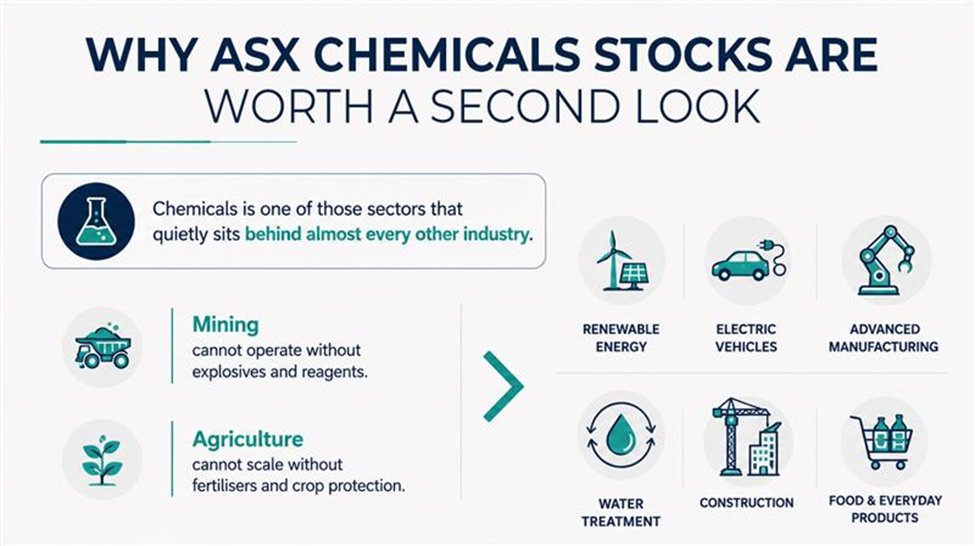
For Australian investors, ASX chemicals stocks bring a few specific attractions. First, they tend to be tied to Commodity cycles, agricultural cycles, and industrial activity — which means they often move on a different rhythm to the financials and tech names that dominate broader index returns. Second, several Australian chemicals companies are deeply integrated with the country's Mining and farming sectors, giving them structural advantages that overseas competitors find hard to replicate. Third, the global push toward decarbonisation, critical minerals, food security, and circular-economy thinking has placed chemicals firms — particularly those with cleaner technologies — squarely in the path of long-duration Capital flows.
That does not mean every chemicals stock is a winner. Many face heavy capital intensity, lumpy Earnings, regulatory scrutiny, and exposure to volatile input prices. But it does mean the sector is worth genuine attention, especially when multiple names are simultaneously carrying Buy consensus ratings from the analysts who cover them.
The four stocks below sit on very different ends of the size spectrum, from a roughly A$116 million market-cap challenger to a A$6 billion industrial heavyweight. That spread itself is a useful feature: it allows investors to think about the sector through both a growth lens and a more defensive, income-oriented lens.
Stock 1: Astron Ltd (ATR:ASX) — A Small-Cap With a Specialty Edge
Market cap: about A$238 million
5-year beta: 0.8008
Dividend yield: not listed
Consensus rating: Buy
Astron Ltd is the kind of small-cap chemicals name that tends to fly under the radar of most retail investors. With a Market Capitalisation of around A$238 million, it sits firmly in the “smaller end of town” bracket, but its consensus Buy rating suggests that the analysts who do cover it see something they like.
Astron is involved in the development of mineral sands and rare-earth-related projects, which puts it at the intersection of basic materials and the broader critical-minerals theme that has dominated investor conversations over recent years. Mineral sands feed into everything from titanium pigments to ceramics, while rare-earth elements are essential for permanent magnets used in electric vehicles, wind turbines, and a growing list of high-tech applications.
What makes Astron interesting from a portfolio perspective is the combination of its size and its 5-year beta of 0.8008. A beta below 1.0 implies that, historically, the stock has been less volatile than the broader market. For a small-cap exposed to commodity-style end markets, that is a slightly unusual profile. It does not mean Astron will not have wild trading days — small-caps almost always do — but it does suggest that, looked at over a longer arc, the share price has not been as jumpy as the typical micro-cap explorer.
There is, of course, no listed dividend yield. That is normal for a company at this stage of its life cycle, where capital is generally being reinvested into project development, exploration, or strategic partnerships rather than paid out to shareholders. Investors stepping into a stock like Astron are buying a story about future production and development, not a current income stream.
The Buy consensus is the kind of signal that warrants further homework rather than instant action. Investors who like the idea of small-cap exposure to mineral sands and rare-earth thematics — and who can stomach the natural volatility of names this size — may find Astron a worthwhile addition to a watch list.
Stock 2: Calix Ltd (CXL:ASX) — A High-Beta Bet on Cleaner Industrial Tech
Market cap: about A$109 million
5-year beta: 1.67
Dividend yield: not listed
Consensus rating: Buy
Calix Ltd is the smallest of the four stocks on this list, with a market cap of roughly A$109 million, and it is also by far the most volatile based on its 5-year beta of 1.67. A beta of 1.67 implies that, historically, Calix has tended to move about 67% more than the broader market on a given trading day. That is a meaningful number and one investors should not ignore.
But Calix is also a name with a genuinely differentiated story. The company has built a reputation around its proprietary kiln technology, with applications spanning carbon capture, lower-emissions cement and lime production, water treatment, and battery materials. In other words, Calix is one of those rare ASX-listed chemicals plays that ties directly into the global energy-transition narrative. Whether the market chooses to reward that story in any given quarter is another matter entirely, which is part of what drives the elevated beta.
Like Astron, Calix does not currently list a dividend yield. Again, that is consistent with its position as a growth-stage, technology-led company that needs to reinvest into commercialisation rather than distribute cash to shareholders. The Investment case is unapologetically built around upside potential rather than current income.
The consensus Buy rating reflects the optimism that some analysts have around Calix's technology pipeline and Partnership opportunities. But investors should be very clear-eyed about what they are buying. A 1.67 beta combined with a sub-A$120 million market cap is a profile that demands position-sizing discipline. Even if you love the long-term thesis, the day-to-day ride can be uncomfortable.
For investors specifically looking for a high-conviction, high-volatility exposure to clean-tech-adjacent chemicals on the ASX, Calix is one of the most-talked-about names in the small-cap segment. Just be sure that volatility tolerance and time horizon match the size of the position.
Stock 3: Dyno Nobel Ltd (DNL:ASX) — The Heavyweight With the Dividend
Market cap: about A$6.03 billion
5-year beta: 0.9291
Dividend yield: 3.58%
Consensus rating: Buy
If Astron and Calix sit at the speculative end of the chemicals spectrum, Dyno Nobel sits at the institutional, Blue-Chip-adjacent end. With a market cap of around A$6.03 billion, it is comfortably the largest of the four names and brings a profile that looks much more familiar to traditional dividend-focused investors.
Dyno Nobel is a major player in industrial explosives, particularly for the global mining and quarrying industries. The blasting and explosives market is one of those quietly essential niches: as long as the world is digging up metals, minerals, coal, aggregates, and stone, businesses like Dyno Nobel have a reason to exist. Long-term contracts, embedded customer relationships, and significant technical know-how create barriers to entry that few smaller competitors can challenge.
That structural durability is reflected in the company's financial profile. With a 5-year beta of 0.9291, Dyno Nobel has historically traded with slightly lower volatility than the broader market. That is broadly what you would expect from an industrial heavyweight tied to long-cycle infrastructure and resources Demand. It is not a “boring” stock — it can still be moved by commodity cycles, mining capex, and global growth fears — but it tends not to lurch around in the way a high-beta micro-cap does.
The headline number for many investors will be the 3.58% dividend yield. In an environment where income remains a key consideration for many portfolios — particularly for investors balancing growth allocations with cash-flow-generative holdings — a 3.58% yield from an ASX-listed industrial heavyweight is the kind of figure that earns a stock a permanent slot on most income screens. Combined with a Buy consensus rating, the proposition becomes more compelling.
Of course, dividends are never guaranteed. They depend on earnings, payout ratios, Capital Expenditure plans, and the broader economic environment. But for a Business of Dyno Nobel's scale and entrenched market position, the income story is at least credible. For investors who already own plenty of speculative growth and are looking for a chemicals stock with both yield and a defensive-leaning beta, Dyno Nobel arguably stands out as the most “core holding” candidate of the four.
Stock 4: Nufarm Ltd (NUF:ASX) — The Mid-Cap Crop Protection Specialist
Market cap: about A$933 million
5-year beta: 0.5225
Dividend yield: not listed
Consensus rating: Buy
Nufarm Ltd sits in the mid-cap zone of this list, with a market capitalisation of roughly A$933 million. It is best known as a specialist in crop protection and agricultural chemicals, with a global footprint spanning herbicides, fungicides, insecticides, and seed technologies. In an era where food security, climate resilience, and sustainable agriculture are reshaping how policymakers and corporates think, businesses with deep agricultural exposure tend to attract longer-term investor attention.
What stands out about Nufarm immediately is its 5-year beta of 0.5225 — by far the lowest of the four stocks on this list. A beta of 0.52 implies that, historically, Nufarm has tended to move only about half as much as the broader market on any given trading day. For investors who find Calix's 1.67 beta nerve-wracking, Nufarm sits at the opposite end of the volatility spectrum and may suit a more conservative tilt within a chemicals allocation.
That lower beta should not be confused with low risk in an absolute sense. Agricultural chemicals are deeply tied to weather patterns, crop cycles, commodity prices, regulatory frameworks, and currency moves. Drought conditions in key markets, sudden shifts in pesticide regulation, or pricing pressure from generic competitors can all weigh on earnings. But over a five-year horizon, the share price has tended to behave in a relatively measured way compared with the broader index.
Nufarm does not currently list a dividend yield, which means investors who are attracted to the stock are buying it primarily for its operational story and longer-term earnings trajectory rather than for current income. With a Buy consensus rating, analysts appear to see continued upside in the company's strategic positioning, particularly around higher-Margin specialty crop protection products and seed technologies.
For investors wanting an ASX chemicals stock with genuine global exposure, lower historical volatility, and a clear operational link to long-term agricultural themes, Nufarm offers a profile that is hard to find elsewhere on this list.
Comparing the Smaller Names With the Larger Dyno Nobel
When you put Astron, Calix, and Nufarm side by side with Dyno Nobel, the comparison is genuinely useful for portfolio construction.
Dyno Nobel is, by every meaningful measure, the heavyweight. Its A$6.03 billion market cap dwarfs the other three combined. Its business is built on long-term industrial contracts, scale, and technical depth. Its 0.9291 beta sits close to the broader market, and it pays a 3.58% dividend yield. For investors looking for a chemicals stock that can sit comfortably in a “core” or “income” sleeve, it ticks more conventional boxes than its smaller peers.
Astron, Calix, and Nufarm, by contrast, each offer something more specialist and, in different ways, more growth-oriented.
Astron, at around A$246 million, is small but historically less volatile than you might expect for a company of its size, with a beta of 0.8008. It is a more pure-play exposure to the mineral sands and rare-earth thematic.
Calix is the most speculative of the bunch — an A$116 million market cap with a 1.67 beta. The upside narrative around its proprietary clean-industrial technology is compelling, but the volatility profile is genuinely high. For investors comfortable with sharp swings in pursuit of asymmetric upside, this is the one that fits the description.
Nufarm is the in-between option: a roughly A$972 million mid-cap with a notably low beta of 0.5225, anchored by exposure to global agricultural markets. It is neither as speculative as Calix nor as institutionally sized as Dyno Nobel.
The key insight from this comparison is that ASX chemicals exposure does not have to be one-dimensional. A thoughtful investor could conceivably build a small basket using Dyno Nobel as the income-and-defensive anchor, Nufarm as the lower-volatility mid-cap operational story, Astron as a small-cap critical-materials story, and Calix as a high-beta clean-industrial bet. The relative position sizes would, of course, need to reflect the very different risk profiles of each name.
What Beta Says About Volatility — And What It Doesn’t
Because beta numbers are central to comparing these four stocks, it is worth pausing on what they actually mean — and where they have limits.
In simple terms, beta measures how much a stock has historically moved in relation to the broader market. A beta of 1.0 implies the stock has tended to move roughly in line with the market. A beta below 1.0 implies it has tended to move less than the market, while a beta above 1.0 implies it has tended to move more.
By that definition, Nufarm (0.5225) has historically been the calmest of the four, followed by Astron (0.8008), Dyno Nobel (0.9291), and finally Calix (1.67), which has been the most volatile.
But beta is a backward-looking statistical measure. It tells you what has happened, not what will happen. A company that has historically traded with a low beta can still produce a sudden, large drawdown if its fundamentals deteriorate or if a sector-specific shock arrives. Equally, a high-beta stock like Calix could deliver outsized returns if its underlying story unfolds favourably. Beta is a useful framing tool, especially when comparing peers within the same sector, but it should not be treated as a precise predictor of future risk.
Investors building chemicals exposure should also remember that small and mid-cap stocks — like Astron, Calix, and even Nufarm relative to Dyno Nobel — can be inherently more volatile than headline beta numbers might imply on a quiet day. Trading volumes are typically thinner, news flow can move share prices sharply, and broker upgrades or downgrades can have an outsized influence. The point is not to avoid these names but to size positions in a way that reflects this reality.
Risks to Keep on the Radar
No “Buy Alert” piece is complete without a sober look at what could go wrong. ASX chemicals stocks face several risk vectors that prospective investors should understand before committing capital.
Commodity and end-market exposure is the most obvious one. Dyno Nobel's fortunes are tied to global mining activity. A slowdown in commodity demand, a downturn in capex by major miners, or a slump in coal or iron ore volumes can all flow through to its earnings. Nufarm's earnings can be moved by weather conditions, agricultural commodity prices, and crop cycles — none of which are within the company's control.
Regulatory Risk is another important Factor. Chemicals companies operate in a heavily regulated environment, particularly when it comes to environmental impact, worker safety, and product approvals. Changes in regulation around explosives, agricultural chemicals, or industrial emissions can have significant cost implications.
Currency exposure matters for any ASX-listed business with offshore operations or revenues. Nufarm's global footprint, in particular, makes it sensitive to exchange-rate moves between the Australian dollar and currencies in its key markets. Even Dyno Nobel, with its global mining customer base, is not immune.
For the smaller names, financing risk and execution risk are particularly relevant. Companies like Astron and Calix tend to require capital for project development and commercialisation. Capital raisings, joint ventures, or strategic partnerships can dilute existing shareholders or change the investment thesis materially. Delays in project milestones — a common feature of resource and clean-tech development — can weigh heavily on share prices.
And then there is the broader macro overlay. Interest rates, Inflation, global growth, trade policy, and geopolitical events all influence sentiment toward cyclical, industrial-linked stocks. Chemicals firms are not immune to those forces.
None of this is unique to chemicals, but the combination of capital intensity, regulatory burden, and commodity sensitivity means investors should be especially deliberate about position sizing and time horizon when considering the names on this list.
The Investor Takeaway
Pulling all of this together, what does the picture look like for an investor weighing up ASX chemicals exposure right now?
First, the fact that all four names — Astron, Calix, Dyno Nobel, and Nufarm — currently carry Buy consensus ratings is, on its own, a notable signal. Consensus ratings are imperfect, but when multiple analysts independently land on the same view, it is at least worth understanding why.
Second, the four stocks together offer a genuinely diverse exposure to the chemicals industry. Investors are not being asked to bet on a single narrow story. Mineral sands and rare earths, clean-industrial process technology, global mining explosives, and crop protection are very different end markets with very different drivers. That breadth, in itself, can be valuable in a sector-aware portfolio.
Third, the spread of beta values across the four stocks — from Nufarm's 0.5225 to Calix's 1.67 — gives investors a real choice about volatility profile. A more conservative investor might lean toward Dyno Nobel and Nufarm, attracted to lower beta and, in Dyno Nobel's case, a 3.58% dividend yield. A more growth-oriented investor might tilt toward Astron and Calix for the upside potential, while accepting the more turbulent ride that comes with smaller, more thematic names.
Fourth, the income angle around Dyno Nobel deserves to be highlighted again. A 3.58% dividend yield from an ASX industrial heavyweight with a sub-1 beta is the kind of profile that fits comfortably into many income-focused strategies. For investors who already own plenty of speculative growth and want a chemicals name with a more defensive flavour, Dyno Nobel arguably stands out.
Finally, and most importantly, ratings and beta numbers are tools — not decisions. The best use of an article like this is as a starting point for a deeper look at each company's financial statements, strategic outlook, competitive position, and management track record.
Conclusion
ASX chemicals stocks are easy to overlook in a market dominated by miners, banks, and headline-grabbing tech names. But scratch beneath the surface and the sector reveals a set of businesses that are deeply embedded in some of the most important long-term themes shaping the global economy: critical materials, clean industrial technology, food production, and the infrastructure of mining itself.
Astron, Calix, Dyno Nobel, and Nufarm each represent a different angle on this story. Astron offers small-cap exposure to mineral sands and rare-earth thematics with a surprisingly moderate beta. Calix brings high-conviction, high-volatility exposure to clean-industrial technology. Dyno Nobel anchors the list as a large-cap industrial heavyweight with a 3.58% dividend yield and a beta close to that of the broader market. Nufarm rounds things out with a mid-cap, lower-beta exposure to global agricultural chemicals.
With Buy consensus ratings across all four names, this is a corner of the ASX that warrants more than a passing glance. Whether or not any of these stocks belong in your specific portfolio depends on your time horizon, Risk tolerance, income requirements, and broader asset allocation. But as a sector-level insight, the message is clear: chemicals deserves a seat at the table.


 Nov 12, 2026





 Please wait processing your request...