
 CA
 NZ
 UK
 US
 IND

 AU

 Share
 X (Formerly Twitter)
 Whatsapp
 Facebook
 LinkedIn
 Telegram
 Email This Article
 Copy Link
 Summarize with AI
 Chat GPT
 Perplexity

Highlights
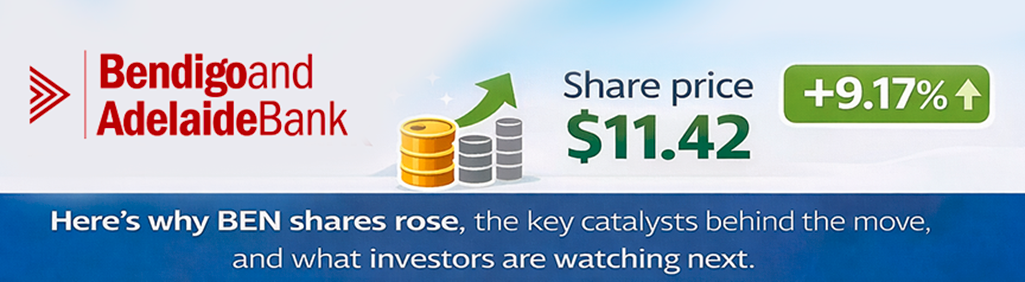
- The BEN share price trading at $11.42, up 9.17% on the day.
- The rally followed strength across the Big Four and regional banks, suggesting a sector-wide re-rating rather than a single company-specific catalyst.
- Improving net interest margin commentary and a steady dividend profile continue to support investor sentiment.
- Market speculation points to renewed interest in BEN’s strategic expansion plans, including its reported pursuit of RACQ Bank.
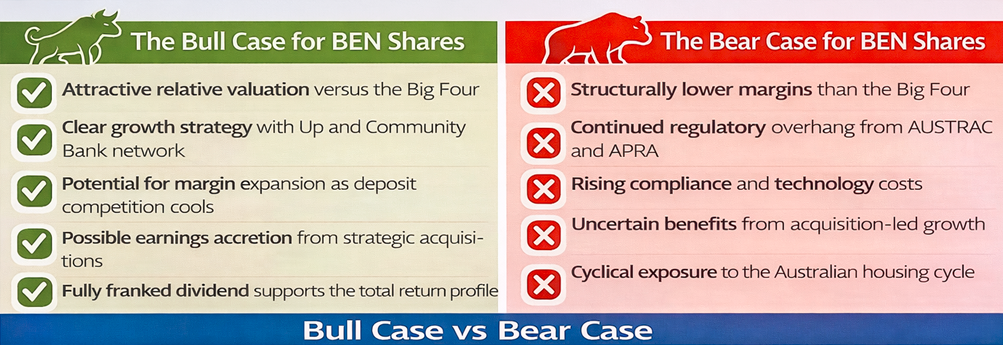
- Key risks include ongoing regulatory scrutiny from AUSTRAC and APRA, mortgage competition, and credit quality as rate cuts slow.
The Bendigo and Adelaide Bank share price (ASX:BEN) trading higher on Thursday, lifting $0.95 to $11.42, a daily gain of +9.17%. That move put BEN near the top of the S&P/ASX 200’s daily leaderboard and marked one of its strongest single-day rallies in months, catching the attention of retail investors and analysts covering Australia’s regional banking sector.
So, what actually drove the move? Below, we break down the likely catalysts, the company fundamentals behind the Bendigo and Adelaide Bank share price action, the broader banking sector context, and the risks and opportunities shareholders should keep in mind.
Company overview: Who is Bendigo and Adelaide Bank?

Bendigo and Adelaide Bank Limited is one of Australia’s largest regional banks, headquartered in Bendigo, Victoria. It was formed in 2007 through the merger of Bendigo Bank and Adelaide Bank and today operates one of the country’s most recognised community banking networks. The group serves more than 2.5 million customers through a combination of owned branches, community bank partnerships, digital banking platforms, and wholly owned consumer brands such as Up.
BEN’s business is spread across retail banking, business banking, agribusiness, and wealth management. Unlike the Big Four, Bendigo does not dominate by scale; instead, it competes through community focus, customer satisfaction, and a growing digital proposition through Up. The bank is consistently ranked among the highest in customer trust and Net Promoter Score surveys across the Australian banking sector.
Its earnings are driven by net interest margin (NIM), fee income, funding costs, and credit quality. Over the past several years BEN has been investing heavily in technology and simplifying its product suite in an effort to narrow the cost-to-income gap with the majors. Investors watch BEN closely because it offers exposure to the Australian housing market, small business lending, and agricultural finance, all without the complexity of a global trading book.
Why Bendigo and Adelaide Bank shares went up today
The BEN share price rally looks like a combination of company-specific sentiment and a broader sector rotation. Let’s break it down.
1. Renewed interest in Australian regional banks
Regional bank valuations have been compressed for much of the past year as investors worried about margin pressure and slowing credit growth. In today’s session, the S&P/ASX 200 Financials index rebounded strongly, with both the Big Four and regional lenders moving higher. That re-rating benefited BEN disproportionately because it carries a lower price-to-earnings multiple than its larger peers.
When global and local bond yields stabilise and the outlook for net interest margins improves even modestly, regional banks tend to outperform because their earnings are more geared to Australian domestic lending. BEN’s 9.17% gain is consistent with that pattern.
2. Improved sentiment around NIM and deposit competition
A recurring headwind for Australian banks over the past two years has been fierce competition for mortgage and deposit market share. Recent industry commentary has suggested that the most aggressive deposit pricing may have peaked and that mortgage discounting has started to ease. If that’s accurate, it would flow directly into improved NIM for lenders like Bendigo. Traders appeared to price in some of that optimism today.
3. Market speculation about the RACQ Bank pursuit
Bendigo has been publicly reported as a potential acquirer of RACQ Bank, the banking arm of the Royal Automobile Club of Queensland. The market sees a deal as a potentially strategic move that would expand BEN’s footprint in Queensland, add depositors, and strengthen its mortgage book. While no fresh announcement has been confirmed today, ongoing speculation about the deal’s progress is a likely driver of buying interest in the BEN share price.
4. Short covering and technical buying
BEN had spent much of the past few weeks trading near the lower end of its 12-month range, and short interest in the stock has been elevated. A rally of this magnitude on an otherwise quiet news day is often explained by short covering, as traders who had bet against the stock rush to close positions once the price breaks above key technical resistance levels.
5. A dividend-friendly narrative
BEN remains one of the more attractive dividend names among ASX-listed regional banks. With its fully franked yield continuing to appeal to retail and self-managed super fund investors, any perception that the payout is safe tends to attract yield-focused buying. There was no dividend announcement today, but the combination of steady earnings commentary and a stable payout profile supports the long-running income thesis.
News, announcements, and market catalysts to watch
No price-sensitive ASX announcement was released by BEN on the day of the rally. That makes the move a classic example of sector-driven buying supported by market speculation. Several ongoing narratives are worth highlighting for context.
Half-year results and dividend
BEN’s most recent half-year results delivered a higher cash profit, a steady interim dividend, and management commentary around margin stability. The market continues to trade on that data point, and any confirmation that second-half trading is tracking in line with or ahead of guidance would support further upside.
RACQ Bank strategic review
Industry media have reported that Bendigo is one of the parties in discussions over RACQ Bank. A successful transaction would add scale in Queensland and accelerate BEN’s push to grow deposit funding. Investors should watch for further disclosure on this front.
Regulatory oversight
BEN remains under scrutiny from both AUSTRAC and APRA in relation to historic anti-money laundering compliance. These matters predate the current management team’s remediation program and BEN has said it is cooperating. The market views the regulatory overhang as manageable but not fully resolved.
Community Bank network
BEN’s distinctive Community Bank model continues to expand, with new franchise openings supporting deposit growth. While the model is low-margin, it is a genuine point of differentiation and builds long-term loyalty.
Sector and macro factors affecting the move
The Bendigo and Adelaide Bank share price does not move in isolation. Today’s rally needs to be understood in the context of Australia’s broader financials sector and macro backdrop.
Australian banking sector rebound
Australian bank stocks had lagged the broader ASX 200 through much of early 2026 as investors worried about slower credit growth and sticky deposit costs. Any green shoots in those metrics tend to produce outsized rallies, particularly in the smaller lenders. With the Big Four also gaining today, BEN participated strongly.
Interest rate expectations
The Reserve Bank of Australia’s rate cutting cycle, combined with ongoing debate about the terminal cash rate, has created volatility in bank NIM forecasts. When markets believe the worst of the margin compression is priced in, bank shares typically rebound. Today’s session reflected some of that optimism.
Housing and credit growth
Australian housing values have been stabilising, and owner-occupier lending continues to grow at a modest but steady pace. For BEN, which carries a heavy residential mortgage book, any signal that credit growth is holding up supports the earnings outlook.
Yield rotation and dividend appeal
With term deposit rates declining as the RBA eases, dividend-paying bank stocks become more attractive on a relative yield basis. That rotation benefits BEN’s fully franked yield profile.
Global banking sentiment
International bank indices have been stable to positive in recent sessions, which tends to support ASX financials. Global credit spreads have not widened meaningfully, reducing fears of a broader funding stress event.
Sector positioning and fund flows
One under-appreciated driver of today’s move is institutional positioning. For much of the past twelve months, many Australian equity funds have been underweight regional banks in favour of the majors, global peers, or insurance names. When sentiment turns, unwinding those underweight positions creates outsized buying pressure on names like BEN, where free float is smaller and liquidity is thinner than the Big Four. This helps explain why a sector rally delivered a 9.17% move in BEN rather than the 2 to 3% seen in its larger peers. Anecdotally, ETF inflows into ASX 200 Financial index products can also lift BEN disproportionately because of the way passive flows distribute buying across index constituents.
What investors are watching next
Investors in the BEN share price should keep an eye on several upcoming catalysts.
Investors will be watching next for the formal full-year result and any update on net interest margin, the outcome of the RACQ Bank strategic review, progress on AUSTRAC and APRA remediation, signs that deposit competition is easing, and any change in RBA commentary around the pace of future rate cuts.
Beyond earnings, BEN’s digital transformation program and the scaling of Up will continue to shape the bank’s longer-term investment thesis. Any material update on cost-to-income ratio targets, or on the integration of the various legacy platforms, would likely move the BEN share price.
Brokers will also be reviewing their models to update valuations after today’s move. A broader re-rating of the ASX regional banks could see analysts lift price targets if the sector’s earnings outlook stabilises.
Key data points investors should track
Several quantitative signals could confirm or undermine today’s bullish move. The most important is the half-on-half change in net interest margin, which is the single biggest lever for bank earnings. Investors should also watch the cost-to-income ratio, which BEN has publicly committed to lowering as part of its transformation program. A third number to watch is the 90-day mortgage arrears rate, a leading indicator of credit quality. BEN’s loan loss provisions and its common equity tier 1 ratio round out the key metrics.
Ultimately, sustained share price gains will depend on whether management can deliver earnings growth that is visibly independent of the rate cycle. That is the promise of the Up platform and of the Community Bank model, but it remains a multi-year project rather than a quarterly one.
Broker views and analyst targets
Consensus broker price targets for BEN have drifted sideways over the past six months, reflecting a cautious but not bearish view. Most analysts remain neutral rather than outright bullish, citing the margin outlook and execution risks around technology spend. A surprise upgrade cycle would be a strong signal that the market is buying into the transformation story. Retail investors should check the most recent analyst notes before assuming today’s rally will be sustained.
Risks to the current momentum
While the Bendigo and Adelaide Bank share price move is encouraging for holders, there are several risks to the rally continuing.
First, net interest margin remains under pressure. Even with some stabilisation, BEN operates in a market where the Big Four can aggressively compete on mortgages. Second, regulatory scrutiny from AUSTRAC and APRA is unresolved and could lead to remediation costs or enforceable undertakings. Third, credit quality may deteriorate if unemployment rises; BEN is heavily exposed to Australian households and small business lending. Fourth, cost inflation in technology, compliance, and salaries continues to weigh on operating leverage.
Finally, the risk of a disappointing acquisition outcome is real. If a deal such as RACQ Bank is executed at too high a multiple, or if integration risks emerge, the market could punish the BEN share price.
Macro and policy risks
Beyond company-specific issues, BEN is exposed to macroeconomic risks that no amount of good execution can fully offset. A sharp rise in unemployment would feed directly into arrears on mortgage and small-business loans. A deeper-than-expected RBA rate cutting cycle could squeeze the deposit book’s earnings power. A slowdown in housing turnover would cap new loan origination volumes. Each of these factors has historically shown up quickly in bank share prices, and BEN would not be insulated from any of them.
Geopolitical and global credit market risks are also worth noting. While BEN is largely a domestic lender, Australian bank funding costs are partly set by offshore wholesale markets. Any widening of global credit spreads would lift BEN’s funding costs and put pressure on net interest margin.
Conclusion: What today’s BEN rally means
Today’s 9.17% gain in the Bendigo and Adelaide Bank share price reflects a combination of sector rotation, improving sentiment on net interest margin, and ongoing speculation around BEN’s strategic growth path. There was no single confirmed announcement to explain the move, which is why it’s best characterised as a market-driven rally rather than a fundamental re-rating.
For long-term investors, the story at BEN remains one of slow, steady transformation. The bank is investing in digital, defending its community franchise, and hunting for targeted acquisitions. Patience is still required, but days like today remind holders that regional banks can deliver meaningful returns when sentiment turns.
The Bendigo and Adelaide Bank share price at $11.42 still trades at a discount to many of its peers on a price-to-book basis, which leaves room for further upside if management continues to execute and regulatory matters are resolved cleanly.


 Nov 12, 2026





 Please wait processing your request...