
 CA
 NZ
 UK
 US
 IND

 AU

 Share
 X (Formerly Twitter)
 Whatsapp
 Facebook
 LinkedIn
 Telegram
 Email This Article
 Copy Link
 Summarize with AI
 Chat GPT
 Perplexity
We are officially standing at the epicenter of a historic macroeconomic storm, and Australian gold miners are catching the ultimate tailwind. If you thought the original gold rushes built fortunes, wait until you see what the modern Australian gold sector is quietly achieving right now.
Over the last few years, the global narrative around gold has shifted dramatically. No longer dismissed as a "barbarous relic" or a dusty boomer rock, gold has reclaimed its throne as the ultimate safe-haven asset. Driven by sticky global inflation, volatile interest rate cycles, unprecedented central bank accumulation (particularly from BRICS nations), and rising geopolitical fractures, the US-dollar gold price has shattered historical resistance ceilings.
But for Australian investors, this story is doubly potent. Because physical gold is priced globally in US Dollars (USD) but Australian miners pay their operational costs—labor, diesel, and steel—in Australian Dollars (AUD), a favorable exchange rate has supercharged the AUD gold price to uncharted, record-shattering highs.
Right now, ASX gold miners are printing free cash flow at rates we have rarely seen in modern market history. Balance sheets are flush. Dividends are climbing. Debt is being eradicated. And yet, the broader retail market is still catching up. Despite operating at record profit margins, many ASX gold stocks have traded at conservative multiples, sparking a massive, sector-wide wave of Mergers and Acquisitions (M&A) as companies scramble to buy cheap ounces.
In this exhaustive, deep-dive report, we are putting 12 of the most talked-about, aggressively accumulated ASX precious metals and gold stocks under the microscope. From the multi-billion-dollar blue-chip behemoths to the high-growth mid-tiers, explosive turnaround plays, and high-risk African developers, we are breaking down exactly what you need to know.
Grab a coffee. Let’s look under the hood and find out which miners are ready to shine brightest in Gold Rush 2.0.
Why ASX Gold Miners Are Attracting Serious Investor Attention
If you want to play the gold boom, why buy Australian miners instead of simply buying physical bullion or a US ETF? It all comes down to Leverage, Margin Expansion, and Jurisdiction.
Let's do the math. If the AUD gold price is sitting at A$3,500 per ounce, and an ASX miner has an AISC of A$1,800 per ounce, they are generating a colossal A$1,700 of pure profit margin on every single ounce pulled out of the dirt. A 10% increase in the gold price can result in a 40% to 50% increase in a miner's free cash flow. That is the magic of equity leverage.
Furthermore, Western Australia (WA) consistently ranks as the safest, most attractive Tier-1 mining jurisdiction on the planet. While North American developers struggle with endless environmental permitting delays, and South American miners navigate the constant threat of resource nationalization, Australia offers the strict rule of law, elite infrastructure, and a phenomenally rich geological endowment.
Because of this immense cash flow generation, the ASX gold sector is currently playing a giant game of Pac-Man. Big companies are eating small companies to replace their aging reserves. Mid-tiers are merging to gain the scale required to attract global index funds. If you pick the right stocks, you win on both the fundamental cash generation and the hidden M&A takeover premiums.
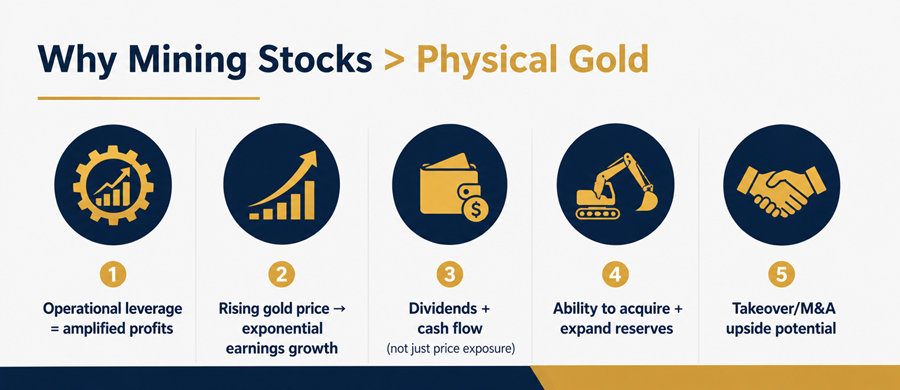
Image source: © 2026 Krish Capital Pty. Ltd.
Let’s dive into the masterclass analysis of the 12 companies leading the charge.
Company-by-Company Masterclass Analysis
1. Northern Star Resources Ltd (ASX:NST)
The Undisputed Heavyweight Champion
- The Hook: Northern Star is the undisputed alpha of the Australian gold sector. Boasting a massive double-digit-billion market capitalization, NST is a global top-10 gold producer and the default “must-own” blue-chip choice for institutional money seeking Australian gold exposure.
- Production Profile: A colossal ~1.6 to 1.8 million ounces of gold per annum, with a clear line of sight to 2 million ounces.
- Asset Quality & Jurisdiction Risk: Exceptional / Low Risk. NST owns 100% of the legendary Kalgoorlie Super Pit (KCGM), the high-grade Jundee operation, and the Pogo mine in Alaska. Jurisdiction risk is practically zero (WA and USA).
- Growth Pipeline & Balance Sheet: The centerpiece of NST's growth is the ongoing expansion of the KCGM mill. This multi-billion-dollar mega-project will vastly increase throughput, slash unit costs, and elevate the Super Pit into a multi-decade, bottom-quartile cost cash cow. Their balance sheet is a fortress, boasting massive liquidity to fund this organic expansion internally without diluting shareholders.
- Key Catalysts: Successful, on-budget milestones at the KCGM mill expansion; continued exploration success at depth in Pogo and Jundee.
- Major Risks: Execution risk on the KCGM expansion. Any massive capital expenditure (CapEx) blowouts, severe labor shortages, or construction delays could spook institutional investors. Furthermore, because of its massive scale, NST requires a structurally high gold price to move the needle on its valuation.
2. Greatland Resources Ltd (ASX:GGP)
The Transformational Giant-Killer
- The Hook: Originally making its name on the London AIM market as the plucky discoverer of the high-grade Havieron deposit in WA's Paterson Province, Greatland completely transformed its destiny. They engineered the deal of the decade by acquiring the legendary Telfer mine and the remainder of Havieron from US-giant Newmont.
- Production Profile: Rapidly transitioning from an explorer/developer into a major producer, targeting hundreds of thousands of ounces annually as the Havieron underground comes online.
- Asset Quality & Jurisdiction Risk: Tier-1 / Low Risk. Havieron is widely regarded as one of the highest-grade gold-copper discoveries of the 21st century. Telfer is an aging behemoth, but it gifts Greatland immediate, massive-scale milling infrastructure. Jurisdiction risk is zero (WA).
- Growth Pipeline & Balance Sheet: The growth story is the development of the Havieron underground decline. By owning the Telfer mill, Greatland effectively solved the biggest hurdle for any developer: how to process the rock. The balance sheet was overhauled via capital raises and debt facilities to fund the Newmont acquisition, making them highly leveraged to future operational success.
- Key Catalysts: Reaching commercial production at Havieron; extending the life of the Telfer open pit to bridge the cash flow gap; attracting domestic Australian superannuation funds to the register.
- Major Risks: Transitioning from an explorer to an operator is the hardest pivot in mining. Operational hiccups at the older Telfer mill or geotechnical delays reaching the high-grade ore at Havieron could strain their cash flows and newly acquired debt covenants.
3. Perseus Mining Ltd (ASX:PRU)
The African Cash-Printing Machine
- The Hook: Led by the highly pragmatic Jeff Quartermaine, Perseus is the poster child for exceptional management in emerging markets. While the broader market frequently penalizes African-focused miners due to perceived sovereign risk, Perseus has repeatedly beaten guidance, delivered projects ahead of schedule, and built a mountainous cash pile.
- Production Profile: A highly robust and predictable ~500,000+ ounces per annum.
- Asset Quality & Jurisdiction Risk: High Quality / High Risk. Operating in Africa carries inherent jurisdictional discounts. They operate Edikan (Ghana), and Sissingué and Yaouré (Côte d'Ivoire). They also acquired the Nyanzaga project in Tanzania and the Meyas Sand project in Sudan. Jurisdiction risk is inherently high.
- Growth Pipeline & Balance Sheet: Nyanzaga is the next major build, providing a vital geographical pivot toward East Africa to diversify their geopolitical risk. Their balance sheet is arguably the best in the mid-tier space—a colossal net cash position (nearing A$1 Billion) and zero debt.
- Key Catalysts: Final Investment Decision (FID) and construction progress at Nyanzaga. Potential massive M&A (PRU has a habit of buying cheap, high-quality assets when peers falter).
- Major Risks: Geopolitical instability. Their asset in Sudan is heavily discounted due to civil war, proving that African jurisdiction risk is a stark reality. Sudden changes in mining codes, excessive royalties, or military coups in West Africa can crater the stock overnight.
4. Genesis Minerals Ltd (ASX:GMD)
The Master Innovator’s Leonora Consolidation
- The Hook: Led by Raleigh Finlayson (the visionary architect who built Saracen Mineral Holdings before merging it with Northern Star), Genesis is an absolute darling of the ASX. Over the last few years, Genesis has aggressively executed a masterclass in M&A, consolidating the Leonora region of WA by acquiring St Barbara's Gwalia mine and Dacian Gold.
- Production Profile: Ramping up aggressively toward an aspirational "ASPIRE 400" target of roughly 300,000 to 400,000 ounces per annum.
- Asset Quality & Jurisdiction Risk: High Quality / Low Risk. The Gwalia underground mine is historically one of Australia’s greatest (and deepest) gold mines. Jurisdiction risk is zero (WA).
- Growth Pipeline & Balance Sheet: The "Leonora Strategy" involves filling the underutilized mills. Genesis is feeding high-grade underground ore from Gwalia and new regional satellite deposits (like Tower Hill) into their centralized processing hubs to crush fixed costs. The balance sheet is heavily capitalized with strong institutional backing.
- Key Catalysts: Proving that the operational turnaround of the complex Gwalia mine is working by drastically lowering AISC numbers; successfully ramping up open-pit production at Tower Hill.
- Major Risks: Valuation premium and operational depth. Because it is run by Finlayson, it trades at a premium. Gwalia is also incredibly deep, bringing massive seismic challenges, extreme ventilation costs, and long haulage times. Execution must be flawless.
5. Ramelius Resources Ltd (ASX:RMS)
The Ruthless Margin Predator
- The Hook: Under Mark Zeptner, Ramelius is the quiet achiever that bites. Known for buying undervalued assets, trucking the ore to centralized hubs, and turning a handsome profit, RMS has built a formidable, highly profitable production base.
- Production Profile: ~250,000 to 300,000 ounces per annum.
- Asset Quality & Jurisdiction Risk: Tier-1 / Low Risk. Their Mt Magnet hub is a reliable workhorse, but it has been supercharged by ultra-high-grade ore trucked in from the legendary Penny Gold Mine. Jurisdiction risk is zero (WA).
- Growth Pipeline & Balance Sheet: Ramelius generates massive free cash flow thanks to the high-grade "sweetener" from Penny, which drags their average AISC through the floor. Their balance sheet is pristine, holding zero debt and an enormous cash war chest for future M&A (including their strategic stake in Spartan Resources).
- Key Catalysts: What will they buy next? Deploying their massive cash pile for a strategic, accretive acquisition to replace the aging Edna May hub is the ultimate catalyst.
- Major Risks: "Life of Mine" visibility. The market loves Ramelius’ cash generation, but the Penny mine won't last forever. If they overpay for an acquisition or fail to find a high-grade replacement, their cost profile will spike as grades drop.
6. Capricorn Metals Ltd (ASX:CMM)
The Low-Grade Execution Masters
- The Hook: Led by Executive Chairman Mark Clark (one of the most respected mining executives in Australia), Capricorn is the definition of operational perfection. They don't boast the highest grades, but they boast flawless execution and relentless cost control.
- Production Profile: ~115,000+ ounces from Karlawinda, targeting 250,000+ ounces once their second mine comes online.
- Asset Quality & Jurisdiction Risk: Bulk Tonnage / Low Risk. Karlawinda is a low-grade open pit, but the profit margins are superb due to incredible simplicity and cost management. Jurisdiction risk is zero (WA).
- Growth Pipeline & Balance Sheet: The Mt Gibson gold project is the growth engine. CMM is permitting and building Mt Gibson to replicate their highly successful Karlawinda playbook. Their balance sheet is excellent, organically funding Mt Gibson largely from internal cash flows.
- Key Catalysts: Final environmental approvals, construction milestones, and the all-important first gold pour at Mt Gibson.
- Major Risks: The "Management Premium." Because Capricorn is run so well, the stock is priced for absolute perfection. Any operational hiccup at Karlawinda or unexpected environmental delays/cost blowouts at Mt Gibson could trigger a sharp valuation contraction.
7. Regis Resources Ltd (ASX:RRL)
The Contrarian Turnaround (or Value Trap?)
- The Hook: Regis has endured a brutal few years. Once a darling of the sector, they suffered a devastating blow when the federal government intervened to block their fully approved McPhillamys gold project in NSW over Indigenous heritage claims, destroying their medium-term growth narrative.
- Production Profile: ~400,000+ ounces per annum.
- Asset Quality & Jurisdiction Risk: Tier-1 / Moderate Sovereign Risk. Duketon is aging, but their 30% stake in the world-class Tropicana mine is a cash generator. Jurisdiction risk was thought to be zero, but domestic sovereign risk materialized harshly at McPhillamys.
- Growth Pipeline & Balance Sheet: Severely damaged pipeline. With McPhillamys blocked, Regis has a gaping hole for future growth and must pivot heavily to underground exploration at Duketon. However, strong gold prices are helping them rapidly pay down Tropicana acquisition debt.
- Key Catalysts: Discovery of new high-grade resources at Duketon; paying off the remainder of their corporate debt; potential for them to become a prime takeover target given their depressed valuation.
- Major Risks: Shrinking mine life. Without a new flagship project, Regis is racing against the clock as its existing open pits deplete. Margins could squeeze if AISC rises faster than they can find new ore.
8. Westgold Resources Ltd (ASX:WGX)
The Unhedged Murchison Juggernaut
- The Hook: Westgold completely transformed itself via a mega-merger with Karora Resources, consolidating operations in WA. Crucially, CEO Wayne Bramwell famously removed all their gold hedges, exposing the company 100% to the record spot gold prices.
- Production Profile: ~400,000+ ounces per annum post-merger.
- Asset Quality & Jurisdiction Risk: Tier-1 / Low Risk. They possess a massive footprint across the Murchison region and the Goldfields (including the phenomenal Beta Hunt asset, which produces both gold and nickel). Jurisdiction risk is zero (WA).
- Growth Pipeline & Balance Sheet: Expanding the Beta Hunt underground footprint and fully utilizing their multiple processing plants. Their balance sheet is robust, with cash flows supercharged by their unhedged status.
- Key Catalysts: Synergy realization from the Karora merger (slashing corporate overheads and sharing equipment); discovering new high-grade lenses at Beta Hunt; instituting strong dividend payouts.
- Major Risks: Integration risk. Mashing two large mid-tier companies together involves clashing corporate cultures and complex underground asset rationalization. Underground mining in WA is prone to seismic challenges and equipment constraints.
9. Vault Minerals Ltd (ASX:VAU)
The New Synergy Superpower (Red 5 + Silver Lake)
- The Hook: Vault Minerals was born out of the highly anticipated "merger of equals" between Red 5 and Silver Lake Resources. This created a highly liquid, multi-asset mid-tier designed to attract global institutional index money.
- Production Profile: ~350,000 to 400,000 ounces per annum.
- Asset Quality & Jurisdiction Risk: Tier-1 / Low Risk. The flagship is the massive King of the Hills (KOTH) operation, bolstered by the cash-generating Deflector mine and the Mount Monger hub. They also own the Sugar Zone mine in Canada. Jurisdiction risk is low.
- Growth Pipeline & Balance Sheet: Maximizing throughput at the massive KOTH mill and optimizing high-grade underground feed. Silver Lake brought a mountain of cash to the merger, effectively extinguishing Red 5’s historic debt and leaving Vault with a fortress balance sheet.
- Key Catalysts: Successful ramp-up of underground grades at KOTH; divesting or successfully turning around the troublesome Sugar Zone asset; declaring a maiden dividend.
- Major Risks: KOTH is a massive bulk-tonnage operation. Because it is lower grade, if the grade of the rock drops even slightly below models, or if open-pit stripping costs inflate, margins get squeezed very quickly.
10. Predictive Discovery Ltd (ASX:PDI)
The Tier-1 Speculative Lottery Ticket
- The Hook: Predictive Discovery doesn't mine gold (yet), but they have found one of the most exciting greenfield gold deposits of the decade: the Bankan project in Guinea. This is your classic massive-upside, massive-risk exploration play.
- Production Profile: Pre-production (Explorer/Developer).
- Asset Quality & Jurisdiction Risk: Tier-1 Asset / Extreme Risk. Bankan is a multi-million-ounce discovery, thick and high-grade. However, Guinea is a high-risk jurisdiction with a history of political instability. Part of the deposit sits near a protected national park buffer zone, creating immense permitting hurdles. Jurisdiction risk is Extreme.
- Growth Pipeline & Balance Sheet: Entirely focused on permitting and completing the Definitive Feasibility Study (DFS). As a pre-revenue developer, they rely on equity capital raises to keep the drills spinning, meaning dilution is a constant factor.
- Key Catalysts: Receiving the final environmental and mining decrees from the Guinean government. Once fully permitted, they are a prime takeover target for a major miner (like Barrick or AngloGold).
- Major Risks: Environmental and political limbo. If the Guinean junta demands an extortionate free-carried interest, or if NGOs successfully block the development, the stock could crash.
11. West African Resources Ltd (ASX:WAF)
The Unapologetic Growth Engine
- The Hook: Led by Richard Hyde, WAF is a fascinating, high-octane stock. They build massive mines on time and on budget. However, Burkina Faso has suffered coups and terrorism, causing the broader market to heavily discount WAF’s valuation despite its world-class cash generation.
- Production Profile: ~220,000 ounces, targeting an explosive +400,000 ounces per annum as their mega-project, Kiaka, ramps up.
- Asset Quality & Jurisdiction Risk: High Quality / Extreme Risk. The Sanbrado mine is an absolute cash cow. The Kiaka project is a massive, long-life bulk tonnage asset. Jurisdiction risk is Very High due to the Sahel security situation.
- Growth Pipeline & Balance Sheet: The construction of the Kiaka mine is fully funded and underway. They utilize debt, but it is comfortably backed by the massive unhedged cash flow of Sanbrado.
- Key Catalysts: First gold pour and seamless commercial ramp-up at the Kiaka mega-project, which will mathematically transform WAF into a West African titan.
- Major Risks: Pure sovereign and geopolitical risk. Changes to the mining code by the military junta, security threats to supply chains, or regional instability could heavily impact the stock regardless of flawless operational execution.
12. Ora Banda Mining Ltd (ASX:OBM)
The Spectacular Turnaround of the Decade
- The Hook: Once left for dead as a struggling operator dealing with the low-grade Davyhurst system, Ora Banda brought in Luke Creagh (a former Northern Star executive). He aggressively pivoted the company toward high-grade underground mining, and the stock went parabolic.
- Production Profile: Ramping up toward ~150,000 ounces per annum.
- Asset Quality & Jurisdiction Risk: Tier-1 / Low Risk. The Riverina and Sand King undergrounds represent the premium-dirt future of the company. Jurisdiction risk is zero (WA).
- Growth Pipeline & Balance Sheet: Stripping away the low-grade open pits and filling the Davyhurst mill entirely with high-grade dirt. The balance sheet was beautifully restructured via a lucrative lithium JV with Wesfarmers, injecting non-dilutive capital.
- Key Catalysts: Consistent quarters of beating AISC guidance; hitting commercial steady-state production rates at Sand King; further high-grade drill hits extending the mine life.
- Major Risks: Underground mining is inherently tricky. Poor ground conditions or delayed stope production can quickly cause missed quarters. Additionally, the Davyhurst mill is older and historically temperamental; mechanical breakdowns are a risk.
__________________________________________________
Conclusion: The Train is Leaving the Station
We are witnessing a structural paradigm shift in global finance. As fiat currencies continue to lose purchasing power and sovereign debt spirals out of control, gold has firmly re-established itself as the ultimate anchor of value.
But the real, generational wealth generation isn't in holding the physical metal in a safe—it is in owning the highly leveraged, cash-producing companies that dig it out of the ground. Due to the spectacular strength of the Australian Dollar gold price, the ASX gold sector offers a spectrum of opportunities unlike any other equity market on earth. Margins are exploding, debts are being wiped out, and a wave of M&A consolidation is sweeping through the sector to create globally relevant heavyweights.
The strategy is simple but requires discipline: Anchor your portfolio with low-risk, tier-one operators like Northern Star (NST) or Genesis (GMD). If you want yield, look to the cash-rich balance sheets of Ramelius (RMS) or Perseus (PRU). And if you have the stomach for volatility, sprinkle in the high-octane growth of a Greatland (GGP) or an Ora Banda (OBM).
Do not ignore this sector. The macro stars have aligned, the local currency is playing along, and the free cash flow is incredibly real.
Read the tape, do your own research, check the latest quarterly AISC numbers, and get ready. Australia's Gold Rush 2.0 is just getting started.


 Nov 12, 2026





 Please wait processing your request...