
 CA
 NZ
 UK
 US
 IND

 AU

 Share
 X (Formerly Twitter)
 Whatsapp
 Facebook
 LinkedIn
 Telegram
 Email This Article
 Copy Link
 Summarize with AI
 Chat GPT
 Perplexity

Key Highlights
- Utilities (XUJ) led the supplied sector indices, gaining 1.80% on 13 October 2026.
- Financials (XFJ) advanced 1.39%, supported by buying in major banks as the broader market held near flat.
- Consumer Staples (XSJ) rose 1.31%, while Energy (XEJ) gained 1.22%.
- Consumer Discretionary (XDJ) climbed 0.91%, and Industrials (XNJ) added 0.23%.
- Communication Services (XTJ) edged up 0.02%, while Healthcare (XHJ) slipped 0.10%.
- Real Estate (XPJ) declined 0.31%, and Resources (XJR) fell 1.60%.
- Materials (XMJ) dropped 2.03%, while Information Technology (XIJ) plunged 4.37%, the weakest supplied index.
- The 6.17-percentage-point gap between Utilities and Information Technology highlighted sharp sector rotation.
The Australian share market finished almost unchanged on 13 October 2026, with the S&P/ASX 200 closing around 8,783.9 points. Beneath the muted headline result, sector returns were sharply divided. Utilities, Financials and consumer-facing defensive shares advanced, while technology and materials stocks faced substantial selling pressure.
News coverage pointed to several forces behind the uneven session, including buying in major banks, concerns about Chinese competition in semiconductor technology, weakness in lithium and Mining shares, and a hawkish tone from the Reserve Bank of Australia. The performance pattern suggested investors were rotating toward selected large-cap and defensive stocks rather than taking broad market risk.
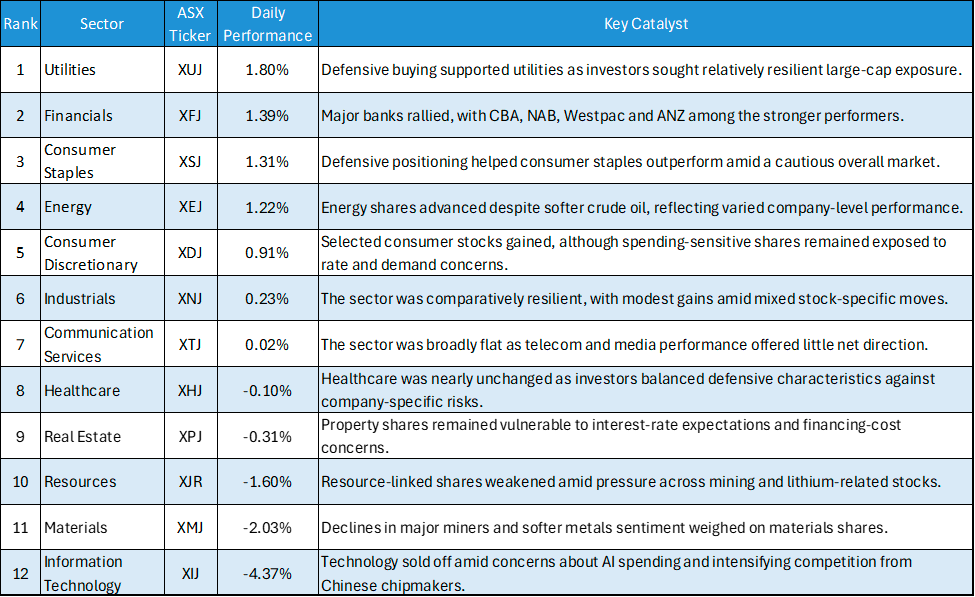
Daily ASX Sector Performance Summary
Utilities and Financials Lead the Advance
Utilities was the strongest-performing supplied index, gaining 1.80%. Its Leadership stood out in a session marked by caution, as investors favoured more defensive exposure while technology and mining shares weakened. The gain suggests that the market’s appetite was selective, with Capital moving toward sectors perceived as more resilient during periods of uncertainty.
Financials rose 1.39%, supported by strength among the major banks. Commonwealth Bank, NAB, Westpac and ANZ all advanced, helping offset losses elsewhere and keeping the benchmark index close to unchanged. Bank performance remains important to the Australian market because of the sector’s substantial index weighting. However, the RBA’s hawkish stance and concerns about persistent Inflation mean that investors will continue to assess Credit demand, margins and household resilience.
Consumer Sectors and Energy Show Relative Strength
Consumer Staples advanced 1.31%, while Consumer Discretionary gained 0.91%. The stronger performance in staples was consistent with a defensive tilt, while the discretionary sector’s gain showed that buying extended beyond traditionally defensive shares. Even so, consumer Demand remains sensitive to borrowing costs and household budgets, making the sustainability of these advances dependent on Earnings and spending trends.
Energy rose 1.22%, despite news coverage pointing to softer Crude Oil prices. The divergence indicates that sector returns can reflect company-specific factors and the composition of the index, rather than a direct relationship with a single Commodity price. Industrials added 0.23%, while Communication Services was virtually unchanged at 0.02%. Healthcare slipped just 0.10%, leaving these sectors close to flat compared with the much larger moves in technology and materials.
Technology and Materials Face Heavy Selling
Information Technology was the weakest supplied sector, falling 4.37%. News reports highlighted renewed selling in AI-linked shares and concern about competition from Chinese semiconductor producer CXMT. Codan and WiseTech were among the notable decliners, while reported delays to the AirTrunk listing and steep falls in selected technology-related names added to concerns about valuations and funding appetite for capital-intensive digital infrastructure.
Materials declined 2.03%, with weakness in major miners and lithium-related companies weighing on the sector. BHP and Rio Tinto fell, while lithium shares also faced pressure amid developments affecting Chinese hybrid imports and investor concerns about demand. Resources dropped 1.60%, reinforcing the broader weakness in commodity-linked equities. These declines showed that recent strength in selected commodities did not translate into uniform gains across mining and materials stocks.
Real Estate fell 0.31%, a relatively modest decline compared with technology and materials. Nonetheless, property securities remain sensitive to financing costs, bond yields and changes in interest-rate expectations. Investors will likely continue to monitor the RBA’s policy outlook and its implications for property valuations and funding conditions.
Bottom Line
The 13 October 2026 session was characterised by strong sector divergence beneath a nearly flat ASX 200 close. Utilities led with a 1.80% gain, followed by Financials at 1.39% and Consumer Staples at 1.31%. At the other end, Information Technology plunged 4.37%, Materials fell 2.03% and Resources declined 1.60%.
The 6.17-percentage-point spread between Utilities and Information Technology highlights a pronounced rotation in investor positioning. Going forward, market direction may depend on bank resilience, RBA policy signals, commodity prices and whether concerns about AI valuations and semiconductor competition continue to pressure technology stocks.


 Nov 12, 2026





 Please wait processing your request...