
 CA
 NZ
 UK
 US
 IND

 AU

 Share
 X (Formerly Twitter)
 Whatsapp
 Facebook
 LinkedIn
 Telegram
 Email This Article
 Copy Link
 Summarize with AI
 Chat GPT
 Perplexity

Key Highlights
- Utilities Leads: Utilities (ASX:XUJ) gained 1.17%, the strongest supplied sector, as investors favoured defensive, income-oriented shares amid political and market uncertainty.
- Energy Recovers: Energy (ASX:XEJ) rose 0.86%, supported by a stabilisation in crude prices and a rebound in fuel retailers, refiners and major oil and gas producers.
- Consumer Staples and Technology Edge Higher: Consumer Staples (ASX:XSJ) added 0.28%, while Information Technology (ASX:XIJ) advanced 0.17%, showing selective resilience.
- Communication Services and Financials Little Changed: Communication Services (ASX:XTJ) slipped 0.01%, while Financials (ASX:XFJ) fell 0.20%, broadly tracking the cautious market tone.
- Cyclical Sectors Weaken: Healthcare and Consumer Discretionary declined 0.66% and 0.68%, respectively, as investors reduced exposure to selected growth and consumer-facing shares.
- Materials Records the Largest Decline: Materials (ASX:XMJ) fell 1.46%, followed by Industrials (ASX:XNJ) at -1.25%, as resource-linked and cyclical stocks came under pressure.
Australian equities weakened on Wednesday, 4 November, as the S&P/ASX 200 fell 0.59% and Market Breadth remained negative. Utilities and Energy were the strongest sectors, reflecting Demand for defensive income exposure and a partial recovery in energy shares. By contrast, Materials and Industrials led the declines as investors assessed the implications of US midterm election developments, potential scrutiny of artificial-intelligence Investment and softer prices across several metals. The divergence between Utilities’ 1.17% gain and Materials’ 1.46% decline highlights a session characterised by defensive positioning rather than broad-based strength.
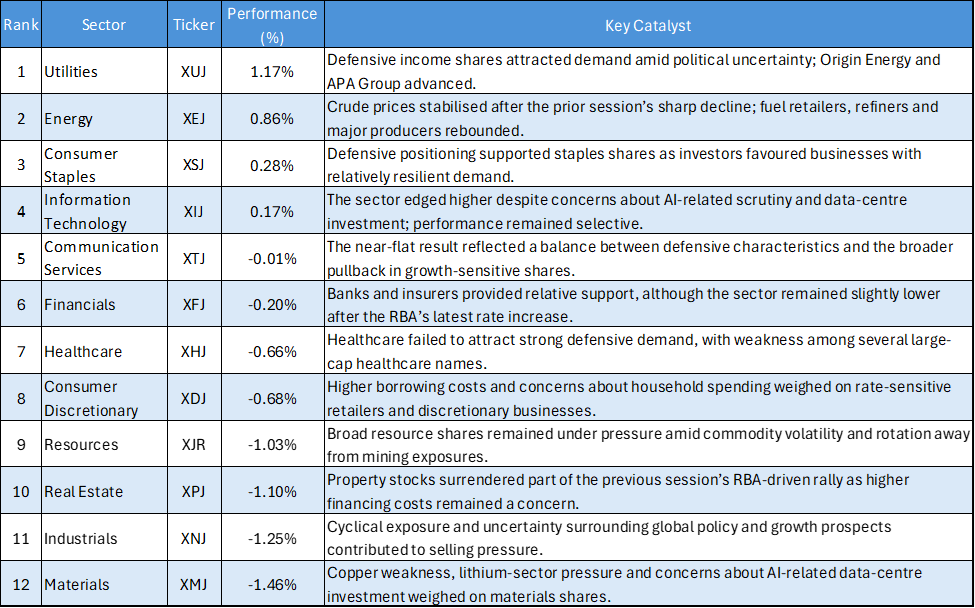
Daily ASX Sector Performance Summary
Utilities and Energy Lead as Defensive Demand Strengthens
Utilities (ASX:XUJ) rose 1.17%, making it the strongest sector in the supplied data. The advance was consistent with a shift towards defensive income-oriented businesses as uncertainty surrounding the US midterm results weighed on broader market sentiment. Origin Energy and APA Group both recorded gains, providing support to the sector. Utilities can attract investors seeking comparatively predictable cash flows when the outlook for cyclical Earnings becomes less certain. However, higher interest rates remain a consideration because regulated infrastructure and other yield-sensitive businesses can be affected by financing costs and bond-market movements.
Energy (ASX:XEJ) advanced 0.86%, recovering part of the previous session’s losses. Brent Crude stabilised in Asian trading after a sharp earlier decline linked to hopes for diplomatic progress in the Middle East. The improvement in oil-price sentiment supported a rebound across fuel retailers, refiners and oil and gas producers. Viva Energy and Ampol were among the stronger names, while Santos and Woodside also moved higher. The sector’s gain therefore reflected a partial recovery in energy pricing and related equities rather than a clear change in the longer-term Supply and demand outlook.
Defensive Shares Hold Up While Cyclicals Retreat
Consumer Staples (ASX:XSJ) added 0.28%, extending the relative resilience of defensive businesses. Demand for everyday goods can be less sensitive to changes in economic conditions than discretionary purchases, making the sector comparatively attractive during periods of uncertainty. Information Technology (ASX:XIJ) edged 0.17% higher, although the broader technology outlook remained mixed. Market commentary highlighted concerns that US political developments could lead to greater scrutiny of artificial-intelligence activity and data-centre expansion. The modest gain suggests that local technology shares did not move uniformly with global growth sentiment.
Communication Services (ASX:XTJ) was virtually unchanged, slipping 0.01%, while Financials (ASX:XFJ) declined 0.20%. Financial stocks showed relative resilience within the broader market, with selected insurers and major banks advancing. Nevertheless, the RBA’s recent 25-basis-point cash-rate increase to 4.85% remained relevant to the sector. Australian banks subsequently indicated that variable Mortgage rates would rise, reinforcing the potential pressure on borrowers even as higher lending rates may have mixed implications for bank margins. Healthcare (ASX:XHJ) fell 0.66%, with several large-cap names weakening and the sector failing to attract the defensive buying seen in Utilities.
Materials and Industrials Underperform
Materials (ASX:XMJ) recorded the largest decline, falling 1.46%. Copper weakness was a key pressure point, with market commentary linking the metal’s sensitivity to concerns about future AI-related data-centre investment and the potential for tighter scrutiny of technology infrastructure spending. Lithium shares also remained under pressure, while a firmer iron ore price offered limited support to the broader sector. Resources (ASX:XJR) declined 1.03%, reflecting the wider retreat in Mining exposures and uneven performance across commodities. The divergence between individual metals reinforces the importance of commodity-specific demand, supply conditions and company-level factors.
Industrials (ASX:XNJ) fell 1.25%, while Real Estate (ASX:XPJ) lost 1.10% and Consumer Discretionary (ASX:XDJ) declined 0.68%. These sectors were exposed to concerns about economic growth, borrowing costs and the durability of consumer demand. Property stocks also gave back part of their strong advance from the previous session, when investors had responded positively to the RBA announcement. The Reversal illustrates how quickly rate-sensitive sectors can move when investors reassess the outlook for financing costs and household spending.
Market Outlook and Risks
The near-term outlook will depend on the market’s interpretation of US political developments, the direction of Global Bond yields and commodity-price movements. Utilities and Energy may continue to benefit from defensive positioning if uncertainty persists, although their performance remains sensitive to interest rates and changes in oil and gas prices. Materials and Resources face risks from weaker metal prices, uncertain demand and continued Volatility in lithium. Real Estate and Consumer Discretionary will remain exposed to the effects of higher borrowing costs and household budget pressure. Investors should also monitor company earnings and guidance, as the performance gap between sectors and individual stocks suggests that broad sector labels may conceal significant differences in fundamentals.
Bottom Line
Utilities led ASX sector performance on 4 November 2026, gaining 1.17%, followed by Energy at 0.86% and Consumer Staples at 0.28%. Materials was the weakest sector, declining 1.46%, while Industrials and Real Estate also recorded notable losses. Defensive positioning provided support to Utilities and selected Energy shares, whereas mining and other cyclical sectors faced pressure from Commodity volatility and uncertainty surrounding global growth and technology investment. The session’s sector dispersion points to selective risk reduction rather than a uniform market retreat.


 Nov 12, 2026





 Please wait processing your request...